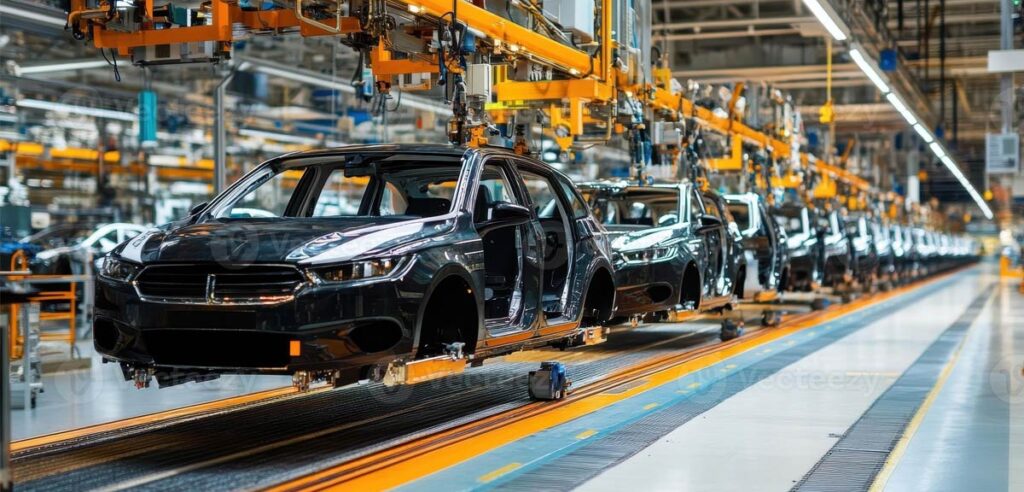
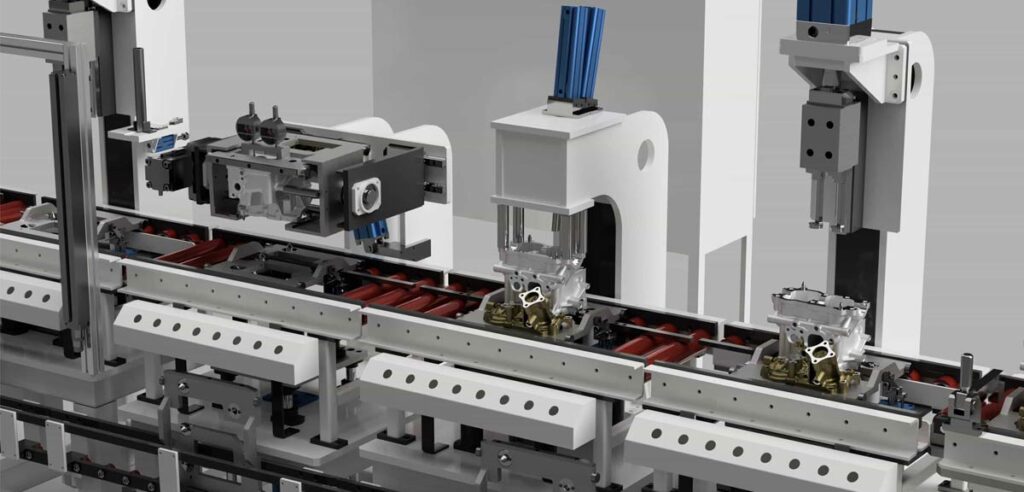
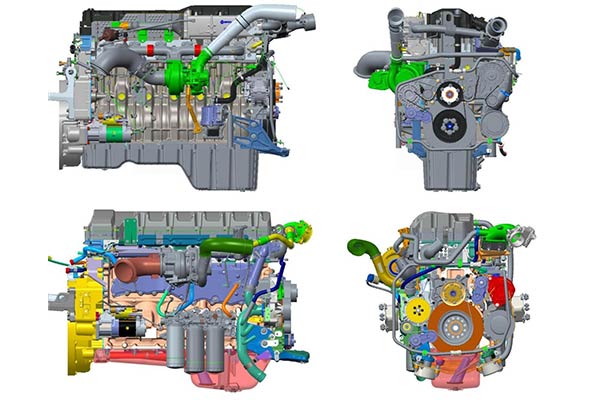
The powertrain is one of the most important systems in a vehicle. It generates and transfers power to the wheels and directly affects vehicle performance, efficiency, reliability, and driving characteristics.
Traditional vehicle powertrains typically include an internal combustion engine, transmission, driveshafts, differentials, and related components. Modern electrified vehicles use different architectures, including hybrid powertrains, electric motors, reduction gears, and battery systems.
As automotive technology continues to evolve, powertrain assembly has become increasingly complex. Manufacturers need production systems that can handle precision assembly, controlled fastening, automated inspection, functional testing, and complete production traceability.
A modern powertrain assembly system may integrate:
- Engine assembly
- Transmission assembly
- Electric motor assembly
- Reduction gear assembly
- Powertrain joining
- Torque tightening
- Leak testing
- Functional testing
- Conveyor systems
- Industrial robots
- Vision inspection
- PLC control
- MES integration
For automotive OEMs and powertrain component manufacturers, the objective is to develop an assembly system that provides stable production capacity, consistent quality, flexible manufacturing, and reliable process control.
What Is Powertrain Assembly?
Powertrain assembly is the process of assembling the major components that generate, convert, and transfer vehicle power into an integrated powertrain system.
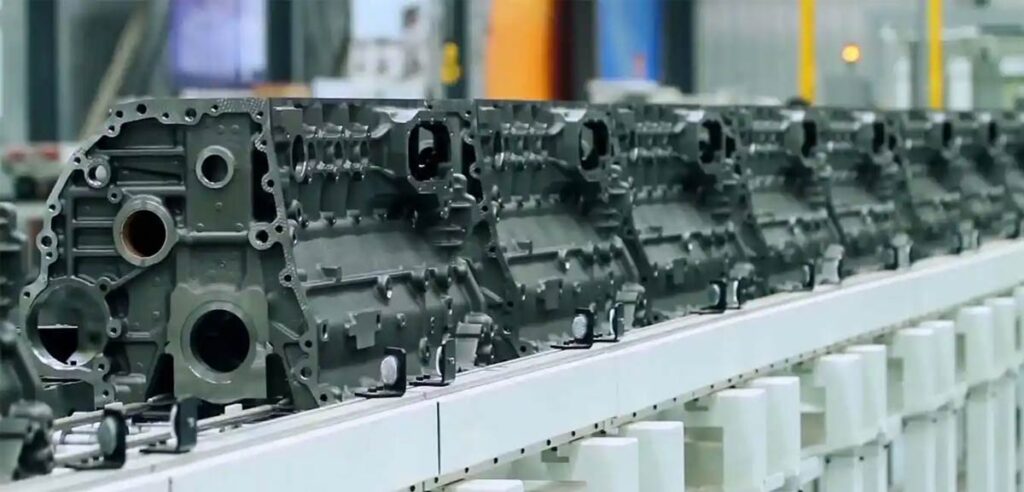
The exact configuration depends on the vehicle architecture.
A conventional internal combustion vehicle may include:
- Engine
- Transmission
- Clutch or torque converter
- Driveshaft
- Differential
A hybrid vehicle may combine:
- Internal combustion engine
- Electric motor
- Transmission or hybrid gearbox
- Power electronics
An electric vehicle may use:
- Electric motor
- Reduction gearbox
- Inverter
- Differential
- Battery system
Because powertrain architectures differ significantly, the assembly line must be designed around the specific vehicle platform and production requirements.
Types of Automotive Powertrain Assembly
Modern automotive manufacturing can be divided into several major powertrain categories.
Internal Combustion Powertrain Assembly
Traditional powertrain production focuses on integrating the engine and transmission with other mechanical components.
Typical processes include:
- Engine assembly
- Transmission assembly
- Engine-to-transmission joining
- Accessory installation
- Fluid filling
- Leak testing
- Functional testing
Internal combustion powertrain assembly requires strict control of mechanical tolerances and fastening parameters.
Internal Link:
Engine Assembly Line: Process, Equipment and Automation
Internal Link:
Transmission Assembly Line: Process, Equipment and Automation
Hybrid Powertrain Assembly
Hybrid powertrains combine an internal combustion engine with one or more electric drive components.
A hybrid powertrain assembly line may involve:
- Engine installation
- Electric motor installation
- Hybrid transmission assembly
- Power electronics installation
- High-voltage component integration
- Cooling system installation
- Electrical testing
Hybrid production requires both mechanical assembly and electrical process control.
Safety systems are also important when handling high-voltage components.
Electric Powertrain Assembly
Electric vehicles use a fundamentally different powertrain architecture.
A typical electric powertrain may include:
- Electric motor
- Reduction gearbox
- Inverter
- Differential
- Cooling system
Electric powertrain assembly focuses heavily on:
- Rotor and stator assembly
- Motor housing assembly
- Gear and bearing installation
- Precision fastening
- Electrical connections
- Insulation testing
- Functional testing
Internal Link:
Battery Pack Assembly Line for Electric Vehicles
Powertrain Assembly Process
The exact process varies depending on the powertrain architecture, but a typical production system includes several common stages.
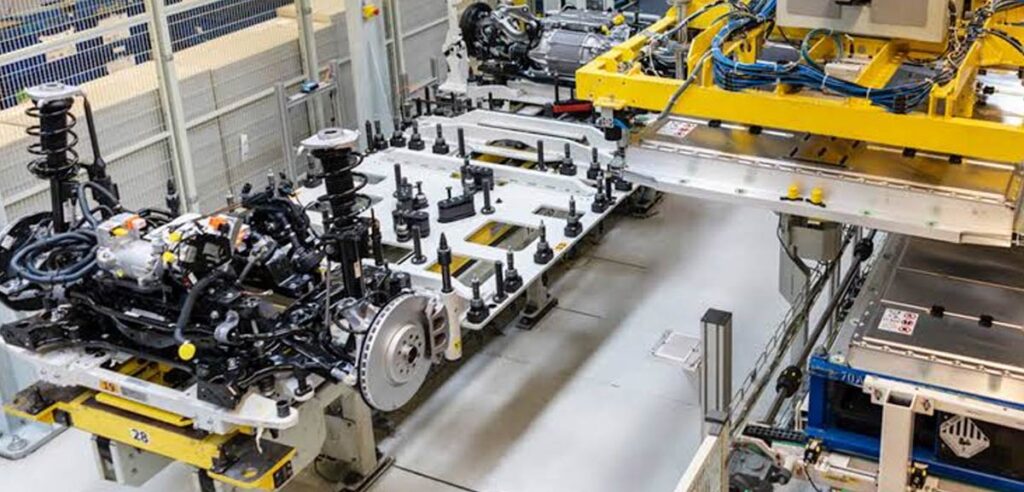
Component Preparation
Before assembly begins, major powertrain components must be prepared and verified.
Typical components include:
- Engine
- Transmission
- Electric motor
- Gearbox
- Differential
- Mounting brackets
- Electrical connectors
Component identification systems can verify that the correct parts are being used for a specific vehicle or powertrain model.
Barcode and RFID systems are commonly used to support production traceability.
Component Loading and Positioning
Components are loaded onto production pallets or assembly fixtures.
Accurate positioning is essential because powertrain components are often heavy and require precise alignment.
Material handling systems may include:
- Pallet conveyors
- Lift tables
- Transfer systems
- Industrial robots
- AGVs
Fixtures hold the components securely during assembly and provide repeatable positioning.
Engine and Transmission Joining
For conventional powertrains, engine-to-transmission joining is a critical assembly operation.
The process may require:
- Alignment
- Position verification
- Bolt installation
- Torque tightening
- Gap inspection
The joining system must maintain accurate alignment between the mating components.
Automated lifting and positioning equipment can improve both assembly accuracy and operator safety.
Electric Motor and Reduction Gear Assembly
For electric powertrains, the electric motor and reduction gearbox require highly precise assembly.
Typical processes include:
- Rotor installation
- Stator installation
- Bearing installation
- Gear assembly
- Housing assembly
- Seal installation
- Fastening
High rotational speeds make dimensional accuracy particularly important.
Incorrect alignment can result in:
- Increased vibration
- Excessive noise
- Reduced efficiency
- Premature component wear
Torque Tightening
Torque tightening is one of the most important processes in powertrain assembly.
Critical fasteners may be found in:
- Engine assemblies
- Transmission housings
- Motor housings
- Gearboxes
- Differential systems
- Powertrain mounting structures
Modern electric tightening systems can control:
- Torque
- Angle
- Tightening sequence
- Tightening speed
The tightening result can be automatically evaluated against predefined limits.
For critical applications, the tightening data is stored together with the product serial number.
This provides complete process traceability.
Internal Link:
Torque Tightening Systems in Automotive Assembly Lines
Leak Testing
Powertrain components often contain oil, coolant, refrigerant, or other fluids.
Leak testing is therefore an important quality control process.
Typical applications include:
- Engine cooling passages
- Transmission housings
- Oil circuits
- Motor cooling systems
- Reduction gear housings
- Battery cooling systems
Common leak testing methods include:
- Pressure decay
- Vacuum testing
- Differential pressure testing
- Flow testing
- Helium leak testing
The appropriate method depends on the component design and required leakage specification.
Internal Link:
Leak Testing Equipment in Automotive Manufacturing
Fluid Filling
Depending on the powertrain architecture, automated fluid filling may be required.
Examples include:
- Engine oil
- Transmission fluid
- Coolant
- Gear oil
Automated filling equipment can control:
- Filling volume
- Filling pressure
- Filling speed
- Fluid type
The system can record the filling parameters and associate them with the product serial number.
Powertrain Assembly Equipment
A modern powertrain assembly line combines multiple specialized equipment systems.
Powertrain Conveyor Systems
Conveyors provide the primary material flow between production stations.
Common systems include:
- Pallet conveyors
- Chain conveyors
- Roller conveyors
- Slat conveyors
- Lift tables
- Transfer machines
- Cross-transfer systems
Because powertrain assemblies can be heavy, conveyor systems must be designed according to:
- Product weight
- Pallet dimensions
- Required positioning accuracy
- Production cycle time
- Factory layout
Internal Link:
Automotive Conveyor Systems: Types, Design & Applications
Lifting and Positioning Equipment
Powertrain components often require controlled vertical or horizontal movement during assembly.
Lifting equipment may be used for:
- Engine positioning
- Transmission installation
- Powertrain joining
- Component transfer
Servo-controlled lifting systems can provide accurate positioning and repeatable movement.
Industrial Robots
Robots are increasingly used in powertrain production.
Applications include:
- Component handling
- Loading and unloading
- Assembly assistance
- Sealant dispensing
- Material transfer
- Inspection
Robots are particularly useful for heavy or repetitive operations.
Internal Link:
Industrial Robots in Automotive Manufacturing
Servo Press Systems
Servo presses provide controlled force and displacement during assembly.
Typical applications include:
- Bearing installation
- Gear installation
- Bush installation
- Shaft assembly
- Rotor assembly
Force-displacement monitoring allows the production system to determine whether the assembly process meets the specified requirements.
Vision Inspection Systems
Machine vision can verify:
- Component presence
- Component orientation
- Assembly position
- Fastener status
- Labels and barcodes
- Sealant application
Vision inspection can be integrated directly into automated assembly stations.
Internal Link:
Vision Inspection Systems in Automotive Manufacturing
Powertrain End-of-Line Testing
End-of-line testing is the final major quality control stage.
The exact testing requirements depend on the powertrain type.
Mechanical Testing
Mechanical testing may include:
- Rotation testing
- Torque measurement
- Speed measurement
- Gear shifting verification
Electrical Testing
Electric powertrain production may require:
- Insulation testing
- Electrical continuity testing
- Motor performance testing
- Communication testing
Noise and Vibration Testing
Noise and vibration testing is particularly important for modern electric powertrains.
Because electric motors are relatively quiet, mechanical noise from gears, bearings, and other components can become more noticeable.
Testing systems can evaluate:
- Vibration
- Rotational noise
- Gear noise
- Mechanical abnormalities
Leak Testing
Final leak testing verifies that the assembled powertrain meets the required sealing performance before leaving production.
PLC and MES Integration
A modern powertrain assembly line requires an integrated control and data architecture.
PLC systems coordinate:
- Conveyors
- Robots
- Fixtures
- Tightening systems
- Testing equipment
- Sensors
- Safety systems
MES systems manage production data and traceability.
Important data may include:
- Product serial number
- Component identification
- Torque values
- Press-fitting data
- Leak test results
- Functional test results
- Production time
- Equipment status
This information creates a digital manufacturing record for every powertrain.
Internal Link:
PLC & MES Integration in Automotive Manufacturing
Powertrain Assembly Line Design Considerations
Designing a powertrain assembly line requires a combination of process engineering, automation engineering, and production planning.
Production Capacity
The line should be designed according to:
- Annual production volume
- Daily production target
- Number of shifts
- Takt time
- Product variants
- Future capacity requirements
Production capacity should be determined before equipment selection.
Line Balancing
A powertrain assembly line may contain many different operations.
If one workstation requires significantly more time than the others, it can become a bottleneck.
Engineers therefore analyze:
- Station cycle time
- Equipment utilization
- Operator activity
- Material transfer time
- Buffer capacity
Proper line balancing helps maintain stable production flow.
Product Flexibility
Modern automotive manufacturers may produce multiple powertrain variants.
Flexible production systems can use:
- Modular fixtures
- Programmable robots
- Automatic tool selection
- Barcode identification
- Automatic parameter switching
This allows the production system to adapt to different products without major manual intervention.
Safety Requirements
Powertrain assembly involves heavy mechanical components and, in the case of electric vehicles, high-voltage systems.
Production lines should therefore include appropriate:
- Safety guarding
- Emergency stops
- Interlocks
- Light curtains
- Safety PLCs
- High-voltage safety measures where applicable
Safety should be considered during the initial line design rather than added after equipment installation.
Powertrain Assembly for Electric Vehicles
The transition toward electrification is changing powertrain manufacturing.
Electric powertrain production requires different assembly and testing technologies compared with traditional engine and transmission production.
Key areas include:
- Electric motor assembly
- Reduction gear assembly
- Inverter integration
- High-voltage electrical testing
- Cooling system assembly
- End-of-line performance testing
Manufacturers therefore need production lines capable of supporting new powertrain architectures while maintaining high automation and traceability.
Smart Manufacturing in Powertrain Production
Industry 4.0 technologies are increasingly integrated into powertrain assembly.
Connected production equipment allows manufacturers to monitor:
- Production output
- Equipment status
- Cycle time
- Quality data
- Energy consumption
Data analytics can then be used to identify:
- Production bottlenecks
- Equipment abnormalities
- Quality trends
- Maintenance requirements
This creates opportunities for predictive maintenance and continuous process improvement.
How to Select a Powertrain Assembly Line Manufacturer
Selecting a qualified powertrain assembly supplier is critical for the success of a large-scale manufacturing project.
Important evaluation criteria include:
Automotive Engineering Experience
The supplier should understand automotive manufacturing processes and quality requirements.
Experience in:
- Engine assembly
- Transmission assembly
- Powertrain assembly
- Automotive component manufacturing
- EV powertrain production
is particularly valuable.
Complete Automation Capability
A powertrain assembly line requires multiple engineering disciplines.
A capable supplier should provide:
- Mechanical design
- Electrical engineering
- PLC programming
- Robot integration
- Fixture development
- Testing system integration
Turnkey Project Management
For overseas automotive manufacturers, turnkey project capability can significantly simplify project execution.
A complete project may include:
- Process planning
- Line layout design
- Equipment manufacturing
- Factory acceptance testing
- Shipping
- Installation
- Commissioning
- Operator training
International Technical Support
International customers should also evaluate the supplier’s ability to support overseas projects.
Important capabilities include:
- English technical documentation
- Remote troubleshooting
- Overseas installation
- Commissioning support
- Spare parts support
- Operator training
Hongbo Automation Powertrain Assembly Solutions
Hongbo Automation focuses on automotive production line and automation solutions for automotive manufacturers and component suppliers.
Our capabilities include:
- Powertrain assembly lines
- Engine assembly lines
- Transmission assembly lines
- Automotive component assembly lines
- EV battery pack assembly lines
- Conveyor systems
- Automated assembly equipment
- Testing and inspection systems
Hongbo’s approach is based on integrating production processes, mechanical equipment, automation controls, material handling, and quality systems into a complete manufacturing solution.
For international automotive manufacturers, this integrated approach can simplify project management and provide a single engineering partner for the complete production line.
Conclusion
Powertrain assembly is a critical part of automotive manufacturing and requires precise engineering, controlled assembly processes, advanced automation, and comprehensive testing.
Traditional powertrain production focuses on engine and transmission integration, while hybrid and electric vehicles introduce additional requirements for electric motors, reduction gears, power electronics, and high-voltage systems.
A modern powertrain assembly line may integrate:
- Automated conveyors
- Lifting and positioning equipment
- Industrial robots
- Servo presses
- Torque tightening systems
- Vision inspection
- Leak testing
- Functional testing
- PLC control
- MES traceability
As automotive manufacturers transition toward electrification and intelligent manufacturing, powertrain production lines must become more flexible, connected, and data-driven.
For automotive OEMs and component manufacturers planning a new powertrain production project, an experienced automotive assembly line manufacturer can provide the engineering expertise and automation capabilities required to develop a reliable and scalable manufacturing system.
Frequently Asked Questions
What is powertrain assembly?
Powertrain assembly is the process of assembling the components responsible for generating and transmitting vehicle power, such as engines, transmissions, electric motors, reduction gears, and related systems.
What equipment is used in a powertrain assembly line?
Common equipment includes conveyors, lifting systems, assembly fixtures, servo presses, industrial robots, torque tightening systems, leak testers, vision inspection systems, and end-of-line test equipment.
What is the difference between engine assembly and powertrain assembly?
Engine assembly focuses specifically on building the engine, while powertrain assembly covers a broader system that can include the engine, transmission, electric motor, reduction gear, and other power transmission components.
Does EV manufacturing require powertrain assembly?
Yes. EVs still require powertrain assembly, although the architecture is different from conventional vehicles. Electric powertrains commonly include an electric motor, reduction gear, differential, inverter, and associated cooling and electrical systems.
Why is torque control important in powertrain assembly?
Controlled torque ensures that critical fasteners achieve the required clamping force. Recording torque and angle data also provides production traceability.
What is end-of-line testing?
End-of-line testing verifies the performance and quality of a completed powertrain before it leaves the production line.
Can a powertrain assembly line support multiple models?
Yes. With flexible fixtures, programmable automation, product identification, and automatic parameter selection, a production line can be designed to support multiple powertrain variants.
What should automotive manufacturers consider when selecting a powertrain assembly line supplier?
Key factors include automotive engineering experience, automation capability, production line design expertise, testing integration, MES capability, commissioning support, and international project experience.