Introduction
Industrial robots have become one of the most important technologies in modern automotive manufacturing. From vehicle body welding and powertrain assembly to battery production and final quality inspection, robotic automation enables manufacturers to achieve higher productivity, greater precision, and consistent product quality while reducing manual labor and operational costs.
The automotive industry has long been a pioneer in industrial robotics. Today, automotive manufacturers integrate robots into almost every stage of production, including material handling, component assembly, precision fastening, machine tending, inspection, packaging, and palletizing. As electric vehicles (EVs), intelligent manufacturing, and digital factories continue to evolve, the role of industrial robots is expanding beyond repetitive motion toward intelligent, data-driven production systems.
This guide explains how industrial robots are used throughout automotive manufacturing, explores the most common robot types and applications, and discusses key considerations when selecting robotic automation solutions.
Quick Summary
| Item | Details |
| Industry | Automotive Manufacturing |
| Equipment | Industrial Robots |
| Primary Function | Automated Assembly & Material Handling |
| Applications | Vehicle Assembly, Engine, Transmission, Battery Pack, E-Axle |
| Automation Level | Semi-Automatic & Fully Automatic |
| Typical Users | Automotive OEMs, Tier 1 & Tier 2 Suppliers |
What Are Industrial Robots?
Industrial robots are programmable, automatically controlled mechanical systems designed to perform manufacturing operations with high speed, precision, and repeatability.
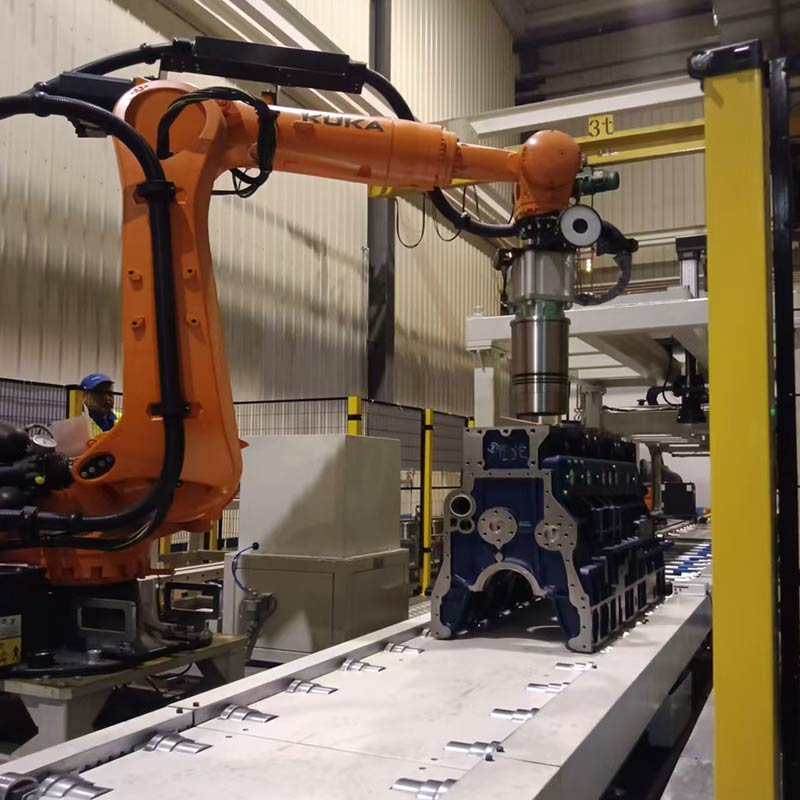
Unlike manual labor, robots can execute repetitive tasks continuously while maintaining consistent process quality and minimizing human error.
Modern industrial robots are typically integrated with:
- PLC control systems
- Servo positioning systems
- Machine vision systems
- Intelligent torque tools
- Leak testing equipment
- Manufacturing Execution Systems (MES)
This integration enables fully automated production lines capable of real-time monitoring and complete production traceability.
Why Industrial Robots Are Essential in Automotive Manufacturing
The automotive industry demands exceptional manufacturing precision, short production cycles, and consistent quality across millions of components.
Industrial robots address these challenges by delivering reliable and repeatable performance in high-volume production environments.
Increased Productivity
Robots operate continuously with minimal interruptions, allowing manufacturers to increase production output while maintaining stable cycle times.
Unlike manual operations, robotic systems perform repetitive tasks with consistent speed throughout multiple production shifts.
Improved Product Quality
Every robotic movement follows precisely programmed paths and process parameters.
This consistency reduces assembly variation and improves product quality, particularly in applications such as precision fastening, adhesive dispensing, welding, and press fitting.
Enhanced Workplace Safety
Many automotive manufacturing processes involve heavy lifting, repetitive motion, high temperatures, or hazardous environments.
Industrial robots can safely perform these tasks while reducing ergonomic risks and improving workplace safety.
Greater Manufacturing Flexibility
Modern robotic systems support rapid product changeovers through programmable motion paths and automatic tooling changes.
This flexibility allows manufacturers to produce multiple vehicle models or component variants on the same production line.
Better Production Traceability
Robotic workstations can automatically record process data such as:
- Cycle time
- Robot status
- Torque values
- Vision inspection results
- Product serial numbers
When integrated with MES platforms, this information provides complete manufacturing traceability and supports quality management throughout the production lifecycle.
Common Applications of Industrial Robots
Industrial robots are used throughout automotive production.
Their applications continue to expand as manufacturers pursue higher levels of automation and digital manufacturing.
Material Handling
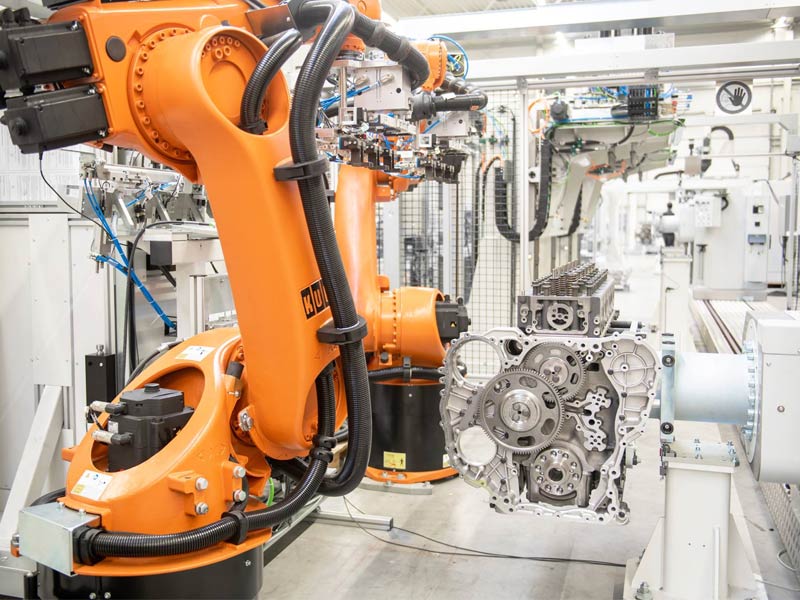
Material handling is one of the most common robotic applications.
Robots automatically transfer components between conveyors, assembly stations, testing equipment, and packaging areas.
Typical products include:
- Engine blocks
- Transmission housings
- Battery modules
- Electric motors
- Automotive electronic components
Robotic handling improves efficiency while minimizing product damage during transportation.
Types of Industrial Robots Used in Automotive Manufacturing
Selecting the appropriate robot depends on the application, payload, reach, cycle time, positioning accuracy, and production requirements. Each robot type is designed to perform specific manufacturing tasks efficiently.
Six-Axis Articulated Robots
Six-axis articulated robots are the most widely used robots in automotive manufacturing due to their exceptional flexibility and wide working range.
With six independently controlled joints, these robots can move freely in almost any direction, making them suitable for complex assembly operations and multi-angle positioning.
Typical applications include:
- Component assembly
- Machine tending
- Adhesive dispensing
- Arc welding
- Spot welding
- Material handling
- Palletizing
Advantages
- High flexibility
- Large working envelope
- Excellent positioning accuracy
- Suitable for complex assembly tasks
- Easy integration with vision systems
Because of their versatility, six-axis robots are often the preferred choice for both automotive OEMs and Tier 1 suppliers.
SCARA Robots
SCARA (Selective Compliance Assembly Robot Arm) robots are designed for high-speed horizontal assembly operations.
Compared with six-axis robots, SCARA robots offer faster cycle times for lightweight components requiring precise insertion or assembly.
Typical applications include:
- Bearing installation
- Electronic module assembly
- Connector insertion
- Precision screw fastening
- Sensor assembly
Advantages
- Extremely fast operation
- High repeatability
- Compact footprint
- Lower investment cost
- Ideal for small automotive components
SCARA robots are widely used in electric motor, electronic control unit (ECU), and sensor manufacturing.
Delta Robots
Delta robots use a parallel-arm mechanism that enables extremely high-speed pick-and-place operations.
Although less common in vehicle assembly, they are frequently applied in automotive electronics production.
Typical applications include:
- Picking small components
- Sorting
- Packaging
- Feeding assembly machines
Delta robots are particularly suitable for lightweight products requiring very short cycle times.
Collaborative Robots (Cobots)
Collaborative robots, commonly known as cobots, are designed to work safely alongside human operators.
Unlike traditional industrial robots that require protective fencing, cobots incorporate force-limiting technology and advanced safety functions that allow direct human interaction under appropriate risk assessments.
Typical applications include:
- Assisted assembly
- Screw tightening
- Inspection
- Small-part handling
- Quality verification
Although cobots generally have lower payload capacities and operating speeds than conventional industrial robots, they provide excellent flexibility for low-volume or mixed-model production.
Typical Robotic Applications in Automotive Manufacturing
Industrial robots perform far more than simple material handling. Today’s production lines rely on robotic automation for numerous precision manufacturing processes.
Robotic Assembly
Robotic assembly systems precisely position and install automotive components while maintaining consistent process quality.
Typical assembly operations include:
- Gear installation
- Bearing assembly
- Motor assembly
- Transmission assembly
- Battery module assembly
- E-axle assembly
Robotic assembly significantly improves repeatability while reducing operator fatigue.
Robotic Screw Tightening
Precision fastening is one of the most critical operations in automotive manufacturing.
Robots equipped with intelligent electric nutrunners automatically tighten fasteners according to predefined torque and angle specifications.
Benefits include:
- Consistent tightening quality
- Automatic torque recording
- Error prevention
- Complete production traceability
Robotic Welding
Welding remains one of the largest robotic applications in the automotive industry.
Industrial robots perform:
- Spot welding
- Arc welding
- Laser welding
- MIG welding
- MAG welding
Robotic welding delivers:
- High consistency
- Increased productivity
- Reduced heat distortion
- Improved operator safety
Body-in-White (BIW) production lines may include hundreds of welding robots operating simultaneously.
Adhesive Dispensing and Sealing
Modern vehicles increasingly rely on structural adhesives and sealants.
Robots accurately control dispensing paths, bead width, flow rate, and application speed.
Typical applications include:
- Windshield bonding
- Battery pack sealing
- Door sealing
- Structural adhesive application
Automated dispensing minimizes material waste while improving sealing quality.
Machine Vision Guided Robotics
Vision-guided robots combine industrial cameras with robotic motion control.
The vision system identifies product position, orientation, and quality before automatically adjusting robot movements.
Typical applications include:
- Component positioning
- Barcode reading
- OCR verification
- Defect detection
- Pick-and-place operations
Vision-guided robotics significantly increases manufacturing flexibility, especially when handling randomly positioned components.
Robotic Palletizing
At the end of production, robots automatically stack finished products onto pallets for packaging and shipment.
Robotic palletizing offers:
- Higher throughput
- Reduced manual labor
- Improved workplace safety
- Consistent stacking quality
This technology is widely used for automotive parts logistics and warehouse automation.
Key Considerations When Selecting an Industrial Robot
Selecting an industrial robot involves much more than comparing robot brands or purchase prices.
Engineers should evaluate the complete production process and application requirements before making a decision.
Payload Capacity
Payload refers to the maximum weight that a robot can safely handle, including tooling and workpieces.
Selecting a robot with insufficient payload may reduce reliability, while excessive payload capacity can unnecessarily increase project costs.
Working Reach
Robot reach determines the maximum operating area.
The selected robot should comfortably access every required workstation without operating continuously near its mechanical limits.
Positioning Accuracy and Repeatability
High-precision assembly operations require excellent repeatability.
Applications such as precision fastening, bearing installation, and electronic assembly often demand repeatability within fractions of a millimeter.
Cycle Time
Robot speed should match the takt time of the production line.
Excessively fast robots provide little benefit if downstream equipment limits overall production capacity.
A balanced production line delivers higher Overall Equipment Effectiveness (OEE) than isolated high-speed workstations.
H3 System Integration
Modern robots should integrate seamlessly with:
- PLC control systems
- Conveyor systems
- Machine vision
- Leak testing equipment
- MES software
- Production traceability systems
Integrated automation improves communication between equipment and simplifies production management.
Leading Industrial Robot Brands in Automotive Manufacturing
The automotive industry relies on industrial robots from a number of globally recognized manufacturers. While each brand offers unique technologies and product portfolios, the final selection should always be based on application requirements, system compatibility, after-sales support, and long-term operational goals.
Some of the most widely used industrial robot manufacturers include:
| Manufacturer | Typical Applications |
| ABB | Assembly, material handling, welding, machine tending |
| FANUC | High-speed production, welding, palletizing |
| KUKA | Automotive body assembly, heavy payload handling |
| Yaskawa Motoman | Arc welding, assembly, handling |
| Kawasaki Robotics | General automotive automation |
| Epson | Small component assembly |
| DENSO Robotics | Precision assembly and electronics manufacturing |
Rather than focusing solely on robot brands, manufacturers should evaluate the overall automation solution, including conveyor systems, tooling, machine vision, intelligent fastening, PLC programming, MES integration, safety systems, and lifecycle support.
A well-integrated production system typically delivers greater long-term value than selecting individual pieces of equipment independently.
Future Trends in Automotive Robotics
Industrial robotics continues to evolve rapidly as automotive manufacturers pursue higher levels of automation, flexibility, and digitalization.
Several technologies are shaping the future of robotic manufacturing.
Artificial Intelligence
Artificial Intelligence (AI) enables robots to make more intelligent production decisions based on real-time data.
Typical AI applications include:
- Adaptive assembly
- Defect recognition
- Predictive maintenance
- Intelligent process optimization
- Production scheduling
AI helps manufacturers improve quality while reducing downtime and operational costs.
Digital Twin Technology
Digital Twin technology creates a virtual representation of an entire robotic production line.
Engineers can simulate:
- Robot motion
- Production flow
- Cycle time
- Collision detection
- Equipment utilization
Simulation before installation significantly reduces commissioning time and project risk.
Human-Robot Collaboration
Collaborative manufacturing is becoming increasingly common, particularly for flexible production environments.
Instead of replacing operators, robots assist workers by performing repetitive, heavy, or ergonomically challenging tasks while operators focus on skilled assembly and quality verification.
This approach combines human flexibility with robotic precision.
Smart Factory Integration
Modern robotic workstations are increasingly connected to factory-wide digital platforms.
Industrial robots exchange data with:
- PLC systems
- Manufacturing Execution Systems (MES)
- SCADA platforms
- Warehouse Management Systems (WMS)
- ERP software
- Cloud-based analytics
This connectivity enables real-time production monitoring, complete traceability, and data-driven continuous improvement.
Choosing the Right Robotic Automation Partner
Selecting the right automation partner is just as important as selecting the robot itself.
A successful automotive automation project requires expertise in mechanical engineering, electrical control, robotics, manufacturing processes, quality systems, and project management.
When evaluating an automation supplier, manufacturers should consider:
- Experience in automotive manufacturing projects
- Turnkey system integration capability
- Mechanical and electrical engineering expertise
- Robot programming experience
- Production process optimization
- Functional testing and validation
- Global installation and commissioning support
- Training and after-sales service
- Long-term technical partnership
An experienced automation integrator can help manufacturers optimize the entire production process rather than simply supplying robotic equipment.
Conclusion
Industrial robots have transformed automotive manufacturing by enabling faster production, higher precision, improved product quality, and greater manufacturing flexibility.
From material handling and robotic assembly to welding, precision fastening, machine vision, and intelligent inspection, robotic automation plays a vital role throughout modern automotive production.
As the industry continues to embrace electric vehicles, smart factories, and Industry 4.0 technologies, robots will become even more intelligent, connected, and adaptable. Manufacturers who invest in scalable robotic automation solutions will be better positioned to improve operational efficiency, respond to changing market demands, and maintain a competitive advantage.
Whether designing a new production line or upgrading an existing facility, selecting the right robotic automation strategy is essential for achieving sustainable manufacturing success.
Frequently Asked Questions
What are industrial robots used for in automotive manufacturing?
Industrial robots perform material handling, assembly, welding, screw tightening, adhesive dispensing, inspection, machine tending, palletizing, and many other automated production tasks.
Which type of robot is most commonly used in automotive factories?
Six-axis articulated robots are the most widely used because they offer excellent flexibility, large working ranges, and high positioning accuracy.
Are collaborative robots suitable for automotive production?
Yes. Collaborative robots are suitable for light assembly, inspection, screw tightening, and low-volume production where human operators and robots work together safely.
How do robots improve manufacturing quality?
Robots execute programmed movements with exceptional repeatability, reducing assembly variation and improving process consistency.
Can industrial robots work with machine vision systems?
Yes. Vision-guided robots can identify component position, orientation, and quality before automatically adjusting robot movements.
Do industrial robots integrate with MES systems?
Yes. Modern robotic workstations can exchange production data with MES platforms, enabling real-time monitoring, production traceability, and quality management.
How long does it take to implement a robotic production line?
Project timelines vary depending on system complexity, but complete automotive automation projects generally include engineering design, manufacturing, assembly, commissioning, and production validation before mass production.
How should manufacturers select a robotic automation supplier?
Manufacturers should evaluate industry experience, engineering capability, system integration expertise, project management, technical support, and long-term service rather than comparing robot brands alone.
Related Technical Guides
To learn more about automotive automation technologies, explore these related articles in the Hongbo Knowledge Center:
- Automotive Assembly Line: Complete Guide for Manufacturers
- Automotive Conveyor Systems: Types, Design & Applications
- Torque Tightening Systems in Automotive Assembly Lines
- Vision Inspection Systems Guide
- Leak Testing Equipment Explained
- PLC & MES Integration in Automotive Manufacturing
- End-of-Line Testing for Automotive Components
- Production Traceability Systems