The rapid growth of electric vehicles (EVs) is transforming the automotive manufacturing industry. Unlike traditional vehicles powered by internal combustion engines, electric vehicles rely on high-performance battery systems that require advanced manufacturing processes, precise assembly technologies, and strict quality control.
A battery pack assembly line is the core production system used to transform individual battery cells into complete battery modules and final battery packs that can be installed in electric vehicles.
Modern EV battery production requires a combination of:
- Automated material handling systems
- Robotic assembly equipment
- Precision fastening systems
- Battery testing equipment
- Vision inspection systems
- Industrial control systems
- Manufacturing Execution Systems (MES)
For automotive manufacturers and battery suppliers, designing an efficient and reliable battery pack assembly line is essential to achieving high production capacity, consistent quality, and long-term manufacturing competitiveness.
This article explains the main processes, equipment, automation technologies, and key considerations involved in modern EV battery pack manufacturing.
Overview of EV Battery Pack Manufacturing Process
An electric vehicle battery pack consists of multiple components, including:
- Battery cells
- Battery modules
- Busbars
- Battery Management System (BMS)
- Cooling systems
- Structural enclosure
- High-voltage connectors
- Thermal management components
The battery manufacturing process is usually divided into several stages:
- Battery cell preparation
- Cell inspection and sorting
- Module assembly
- Battery pack assembly
- Electrical connection
- Thermal system installation
- Battery Management System integration
- End-of-line testing
Each stage requires precise control to ensure battery safety, reliability, and performance.
What Is a Battery Pack Assembly Line?
A battery pack assembly line is an automated production system designed to assemble battery cells, modules, and related components into complete EV battery packs.
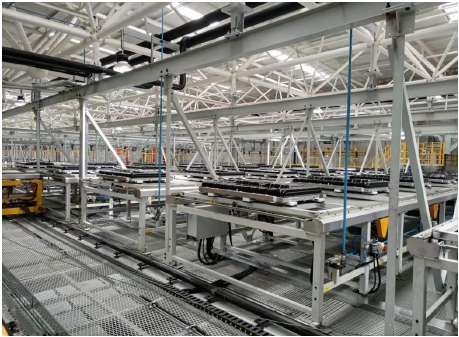
Unlike traditional automotive assembly lines, battery production requires extremely high precision because small assembly errors can affect battery performance and safety.
A modern battery pack assembly line typically includes:
- Cell handling systems
- Module assembly stations
- Robotic dispensing equipment
- Automatic screw tightening systems
- Laser welding equipment
- Vision inspection systems
- Electrical testing stations
- Leak testing systems
- Conveyor and pallet transfer systems
- MES traceability systems
The entire production process is controlled through PLC automation and connected with factory-level manufacturing systems.
Main Processes of an EV Battery Pack Assembly Line
Battery Cell Inspection and Sorting
Battery cells are the fundamental building blocks of an EV battery system.
Before assembly, each cell must be inspected to ensure it meets manufacturing requirements.
Typical inspection parameters include:
- Voltage
- Internal resistance
- Capacity
- Appearance defects
- Dimensional accuracy
Automated testing equipment helps manufacturers identify abnormal cells before they enter the assembly process.
Cell sorting is critical because battery packs require cells with consistent performance characteristics.
Battery Module Assembly
A battery module consists of multiple battery cells connected together through mechanical and electrical structures.
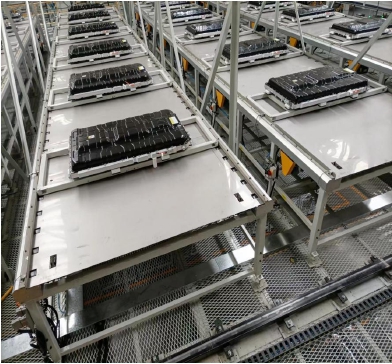
The module assembly process usually includes:
- Cell positioning
- Cell stacking
- Module frame installation
- Busbar connection
- Insulation component installation
- Electrical testing
High-precision positioning equipment is required because battery cells must be assembled with accurate spacing and alignment.
Typical equipment includes:
- Robotic handling systems
- Precision fixtures
- Vision guidance systems
- Automatic fastening tools
Battery Pack Housing Assembly
The battery enclosure provides mechanical protection and environmental sealing for the battery system.
During this stage, the production line performs:
- Housing positioning
- Sealing application
- Cooling plate installation
- Module loading
- Cover installation
The battery housing must provide:
- Structural strength
- Water resistance
- Thermal management capability
- Long-term durability
Automated assembly improves consistency and reduces manual errors.
Thermal Management System Installation
Battery temperature management is essential for EV performance and safety.
Battery packs commonly use liquid cooling systems to maintain optimal operating temperatures.
The assembly process includes:
- Cooling plate installation
- Cooling pipe connection
- Seal inspection
- Leakage testing
Leak testing equipment is commonly integrated into battery production lines to verify cooling system integrity.
Leak Testing Equipment in Automotive Manufacturing
Electrical Connection and Busbar Assembly
Electrical connections are critical components of battery pack manufacturing.
The assembly process includes:
- Busbar installation
- High-voltage connector assembly
- Cable routing
- Insulation inspection
Depending on the battery design, manufacturers may use:
- Laser welding
- Ultrasonic welding
- Bolted connections
Each connection requires strict quality control because electrical failures can affect battery safety.
Battery Pack Testing Process
Battery testing is one of the most important stages in EV battery manufacturing. Since battery packs directly affect vehicle safety, performance, and reliability, manufacturers must perform comprehensive testing before the battery system is installed into the vehicle.
A modern battery pack assembly line usually integrates multiple inspection and testing processes to verify mechanical, electrical, and safety performance.
Electrical Performance Testing
Electrical testing verifies whether the battery pack meets design specifications.
Typical inspection items include:
- Voltage measurement
- Current testing
- Insulation resistance testing
- Cell balancing verification
- Charging and discharging performance
These tests ensure that battery modules and packs operate within the required electrical parameters.
Battery Management System (BMS) Testing
The Battery Management System is the control center of an EV battery pack.
The BMS monitors:
- Cell voltage
- Battery temperature
- Charging status
- Discharging status
- Safety conditions
During production, manufacturers verify communication between the battery pack and the BMS.
Typical tests include:
- Communication verification
- Sensor signal checking
- Fault detection testing
- Software configuration verification
A properly functioning BMS is essential for battery safety and energy management.
Insulation and High Voltage Testing
Since EV battery packs operate at high voltage, electrical safety testing is mandatory.
Common tests include:
- Insulation resistance testing
- High voltage withstand testing
- Ground fault detection
These tests help prevent:
- Electrical leakage
- Short circuits
- Safety hazards
High-voltage testing equipment is normally integrated into automated end-of-line testing stations.
Battery Pack Leak Testing
Battery packs require excellent sealing performance to prevent water and moisture intrusion.
Leak testing is typically performed on:
- Battery housing
- Cooling channels
- Sealing interfaces
Common testing methods include:
- Pressure decay testing
- Vacuum testing
- Helium leak testing
Reliable sealing is essential because moisture contamination can damage electrical components and reduce battery life.
Leak Testing Equipment in Automotive Manufacturing
End-of-Line Testing
Before leaving the production line, every battery pack undergoes final inspection.
The end-of-line testing process may include:
- Electrical verification
- Communication testing
- Charging simulation
- Insulation testing
- Functional testing
- Data recording
Only battery packs that pass all inspection criteria are released for vehicle assembly.
Main Equipment Used in EV Battery Assembly Lines
A complete battery pack assembly line consists of multiple automated systems working together.
The main equipment includes:
Cell Handling Systems
Battery cells require careful handling because they are sensitive components.
Automated cell handling equipment provides:
- Accurate positioning
- Damage prevention
- High production efficiency
- Consistent assembly quality
Common equipment includes:
- Industrial robots
- Vacuum handling systems
- Automatic feeding systems
- Precision positioning fixtures
Battery Module Assembly Equipment
Module assembly equipment performs the transformation from individual cells into battery modules.
Typical operations include:
- Cell stacking
- Compression
- Frame assembly
- Electrical connection
- Inspection
High precision is required because small positioning errors may affect module performance.
Robotic Assembly Systems
Industrial robots are widely used in EV battery manufacturing because they provide:
- High repeatability
- Flexible production capability
- Reduced manual operation
- Improved safety
Typical robotic applications include:
- Cell loading
- Module handling
- Adhesive dispensing
- Cover installation
- Battery pack transfer
Industrial Robots in Automotive Manufacturing
Automatic Dispensing Systems
Adhesive and thermal materials play important roles in battery pack manufacturing.
Dispensing systems apply materials such as:
- Structural adhesive
- Thermal paste
- Sealant
Accurate dispensing is essential because incorrect application may affect:
- Heat dissipation
- Structural strength
- Sealing performance
Modern dispensing systems use vision inspection and automatic control to maintain consistent quality.
Torque Tightening Systems
Battery packs contain many critical fastening points.
Examples include:
- Module fixing bolts
- Battery enclosure bolts
- Electrical connection fasteners
- Cooling system components
Intelligent torque tightening systems ensure:
- Accurate torque values
- Process traceability
- Error prevention
- Quality consistency
Each tightening result can be automatically stored in the MES system.
Torque Tightening Systems in Automotive Assembly Lines
Conveyor and Material Handling Systems
Efficient material flow is essential for battery production.
Battery pack assembly lines commonly use:
- Pallet conveyors
- Roller conveyors
- Chain conveyors
- Lift transfer systems
- Automatic storage systems
The conveyor system must support:
- Heavy loads
- Precise positioning
- Flexible production layouts
- Automated transfer between stations
Automotive Conveyor Systems: Types, Design & Applications
Automation Technologies in EV Battery Manufacturing
The complexity of battery production requires advanced automation technologies to achieve high efficiency and consistent quality.
PLC Control Systems
PLC systems are responsible for controlling individual production stations and coordinating equipment operation.
PLC applications include:
- Conveyor control
- Robot communication
- Safety monitoring
- Sensor management
- Process sequencing
A reliable PLC architecture ensures stable production operation.
PLC & MES Integration in Automotive Manufacturing
Vision Inspection Systems
Machine vision technology is widely used in battery assembly lines.
Typical inspection tasks include:
- Cell positioning verification
- Barcode recognition
- Connector inspection
- Adhesive inspection
- Assembly defect detection
Vision systems improve accuracy while reducing dependence on manual inspection.
Vision Inspection Systems in Automotive Manufacturing
MES Integration and Production Traceability
Due to strict battery safety requirements, complete traceability is essential.
MES systems collect and manage production information including:
- Cell serial numbers
- Module information
- Assembly parameters
- Test results
- Operator records
- Equipment data
This creates a complete digital history for every battery pack.
For automotive manufacturers, MES integration helps achieve:
- Faster quality analysis
- Improved production management
- Reduced recall risks
- Better process optimization