Engine Assembly Line Design: Process, Equipment, and Automation Considerations
Introduction to Engine Assembly Lines in Automotive Manufacturing
Modern engine manufacturing requires precision, repeatability, and comprehensive quality control across every production stage. An engine assembly line integrates mechanical equipment, automated assembly stations, Conveyor Systems, torque tightening tools, leak testing machines, and PLC-based control systems into a coordinated production system. For automotive OEMs and component manufacturers, the design of an engine assembly line directly influences production efficiency, product quality, and long-term manufacturing flexibility.
This article provides a technical overview of engine assembly line engineering, covering production planning, equipment integration, quality assurance, and the key considerations manufacturers should evaluate when developing or upgrading Powertrain Assembly capacity.
What Is an Engine Assembly Line?
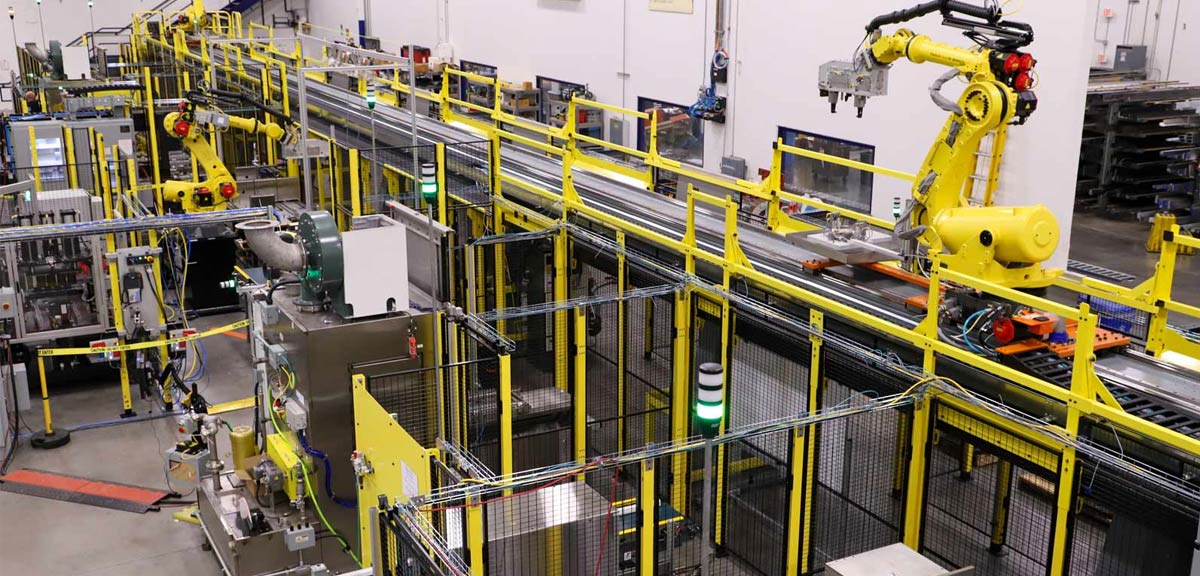
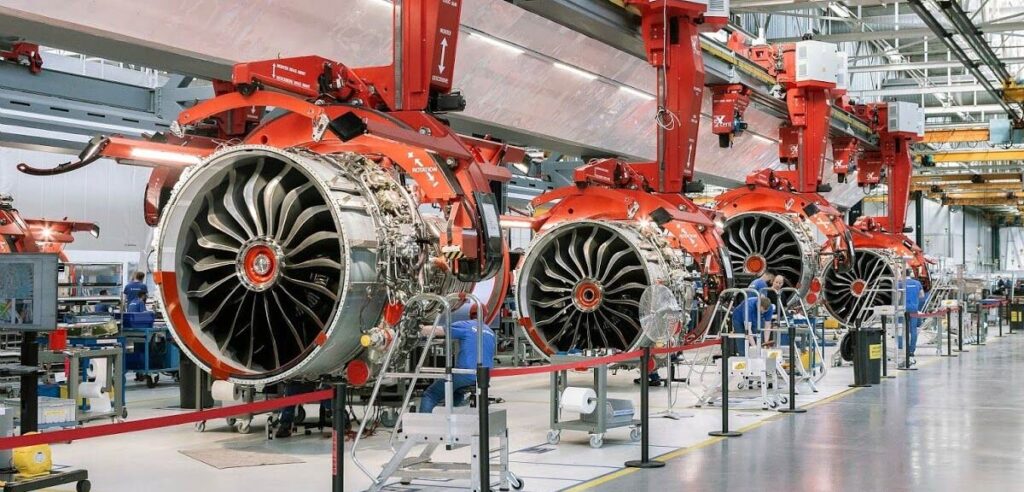
An engine assembly line is a manufacturing system designed to assemble engine components into a complete engine through a defined sequence of production operations. The line typically combines manual, semi-automated, and fully automated stations depending on the production volume, product complexity, and quality requirements.
Typical operations performed on an engine assembly line include:
- Component preparation and identification
- Cylinder block loading and positioning
- Piston and connecting rod subassembly
- Crankshaft and bearing installation
- Cylinder head assembly and fastening
- Timing component installation
- Torque-controlled tightening operations
- Leak testing of fluid passages
- Vision inspection of assembly conditions
- End-of-line functional testing
The exact process sequence depends on the engine architecture, product design, and the manufacturer’s specific production requirements.
Engine Assembly Manufacturing Process
Engine assembly is typically organized around a main assembly line with supporting subassembly areas. The production flow must be carefully planned to ensure that components arrive at the correct station at the right time and that each assembly operation is completed within the required takt time.
Core Assembly Stages
The main engine assembly process generally begins with the cylinder block, which serves as the structural foundation for the engine. From there, the assembly sequence proceeds through the installation of internal moving components, cylinder head installation, and finally the addition of auxiliary systems and sensors.
Key stages in the engine assembly process include:
- Short block assembly: Installation of the crankshaft, bearings, pistons, and connecting rods into the cylinder block
- Cylinder head assembly: Installation of the cylinder head, valves, and related components before final head fastening
- Final assembly: Installation of timing components, oil system parts, intake and exhaust components, and electrical sensors
- Testing and verification: Leak testing, functional checks, and end-of-line inspection
Each stage requires appropriate fixtures, tooling, and quality verification methods to ensure that components are positioned correctly and fastened to the required specifications.
Subassembly Operations
Many engine components are prepared in subassembly areas before being delivered to the main line. Typical subassembly operations include piston and connecting rod assembly, cylinder head subassembly, and preparation of auxiliary components. Subassembly areas help balance the main line by reducing the number of operations performed at each main assembly station.
Main Equipment and Automation Systems
An engine assembly line relies on several categories of equipment working together as an integrated production system. The selection and configuration of this equipment must be based on the production requirements, product design, and quality standards.
Assembly Stations and Fixtures
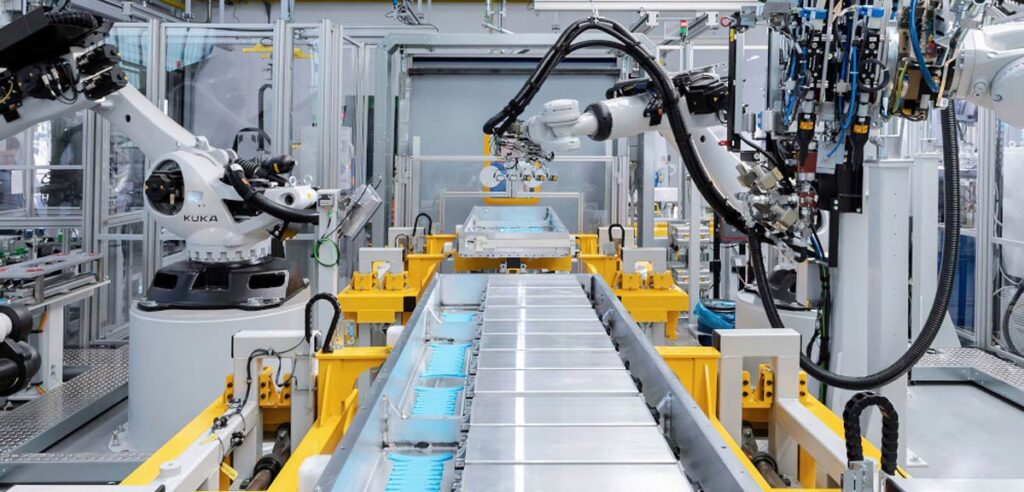
Assembly stations are dedicated workstations where specific manufacturing operations are performed. Stations may be manual, semi-automatic, or fully automatic depending on the operation type and production volume. Automated assembly stations typically integrate fixtures, pneumatic or servo actuators, sensors, and PLC control to perform operations with consistent positioning and repeatability.
Fixtures and tooling are essential for positioning and securing engine components during assembly. A properly designed fixture provides stable positioning, repeatable locating, and sufficient rigidity for the assembly operation. Fixture design must consider the product geometry, assembly sequence, datum requirements, and accessibility for both operators and automated equipment.
Conveyor and Material Handling Systems
Conveyor systems transport engines and engine components between assembly stations. Common conveyor technologies used in engine assembly include pallet conveyor systems, chain conveyors, roller conveyors, and transfer systems. Pallet systems are particularly common because they maintain product positioning as the engine moves between stations and can support product identification and production traceability.
Material handling also includes the supply of components to line-side positions. Depending on the plant layout and production strategy, this may involve manual material delivery, automated guided vehicles, or a combination of both.
Torque Tightening Systems
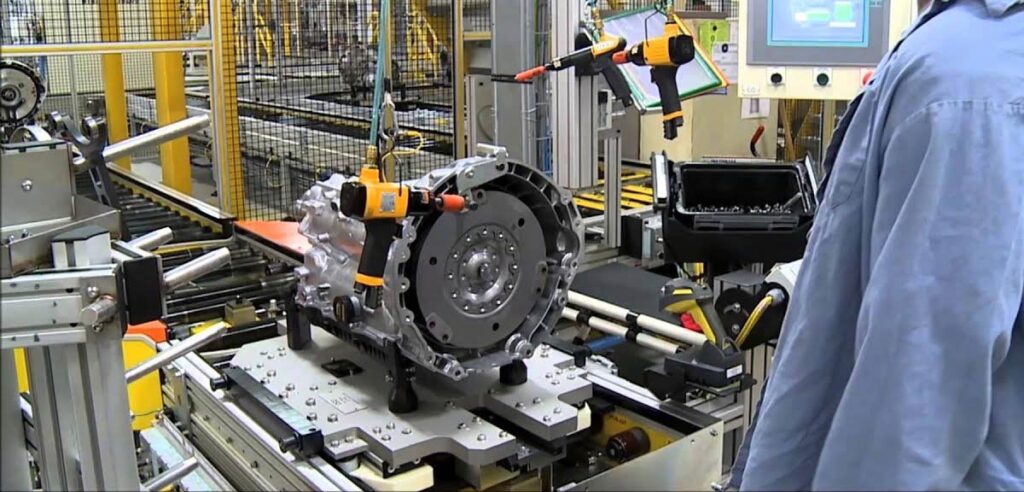
Torque-controlled tightening is one of the most critical processes in engine assembly. Critical fastening operations, such as cylinder head bolts, main bearing caps, and connecting rod bolts, require precise torque and angle control to ensure proper clamping force and joint integrity.
Automated torque tightening systems provide:
- Torque and angle monitoring
- Fastening sequence control
- Tool communication with the PLC system
- Result recording for production traceability
- OK/NOK judgment for each fastening operation
Torque data can be integrated with the production control system or MES to support quality monitoring and traceability requirements.
Leak Testing Equipment
Leak testing is used to verify the sealing performance of engine oil passages, cooling circuits, and other fluid-containing areas. The specific test method depends on the component structure, sealing requirements, and required sensitivity. Common applications include testing the cylinder block oil passages, cylinder head cooling circuits, and the assembled engine’s fluid systems.
Vision Inspection Systems
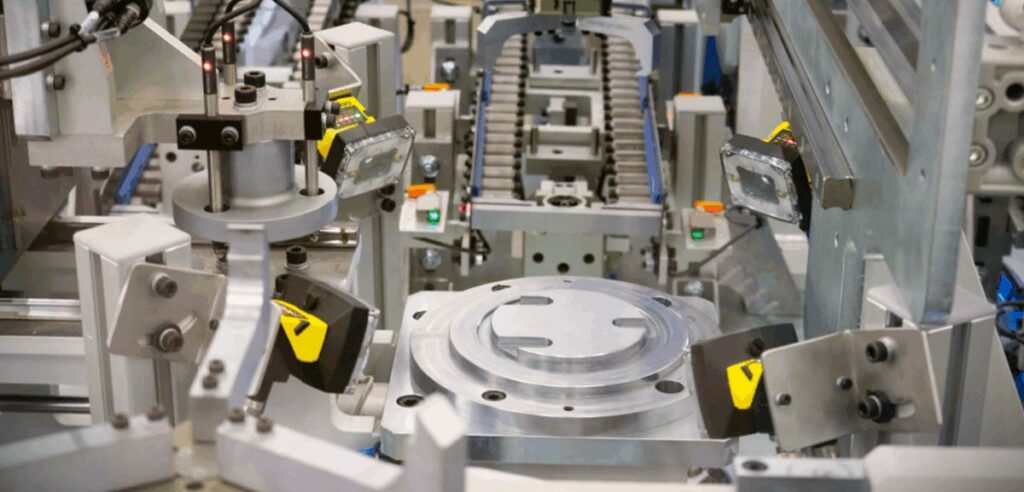
Vision Inspection Systems use cameras and image processing technology to verify assembly conditions. Typical applications in engine assembly include component presence detection, orientation verification, fastener presence inspection, and assembly position checking. Machine vision provides consistent inspection results and reduces dependence on manual visual inspection.
Production Planning and Line Design Considerations
Engine assembly line design must begin with a clear understanding of the production requirements and manufacturing objectives. Several engineering factors influence the line configuration, equipment selection, and overall system architecture.
Takt Time and Line Balancing
Production takt time represents the required production rate needed to meet customer demand. Takt time is used to determine the number of assembly stations, workstation workload, and production capacity. Cycle time, by contrast, represents the actual time required to complete a manufacturing operation at a specific station.
Line balancing distributes manufacturing operations across different stations to achieve stable production flow. A well-balanced line minimizes idle time and prevents workstation overload. For engine assembly, line balancing must account for variations in operation time, fastening requirements, inspection procedures, and testing duration.
Automation Level
The appropriate level of automation depends on production volume, product complexity, quality requirements, and investment considerations. Manual stations may be appropriate for complex operations that require operator judgment, while automated stations are preferred for repetitive operations that require consistent process control and traceability.
Many engine assembly lines use a combination of manual, semi-automated, and fully automated stations. The automation strategy should be developed during the initial line design phase rather than added as an afterthought.
Product Variants and Flexibility
Engine manufacturers often produce multiple engine variants on the same assembly line. A flexible production system can accommodate different engine configurations through programmable controls, adjustable fixtures, and modular equipment design. Flexibility requirements should be defined early in the planning process because they affect fixture design, conveyor configuration, and control system architecture.
Quality Control and Production Traceability
Quality control must be integrated throughout the engine assembly process rather than relying only on end-of-line inspection. Automated quality control methods provide consistent process monitoring and produce valuable production data for continuous improvement.
In-Process Quality Verification
Engine assembly lines typically incorporate multiple quality verification points throughout the production process. These may include torque monitoring at critical fastening operations, vision inspection after component installation, and leak testing after fluid circuits are completed. Error-proofing methods, such as part presence detection, orientation checks, and sequence control, help prevent common assembly errors.
Traceability and Data Collection
Production traceability is essential for engine manufacturing because critical assembly operations must be linked to individual engine units. Traceability data may include product serial number, assembly station identification, torque results, inspection results, leak test data, and production timestamps.
MES integration connects the assembly line equipment with production management systems, enabling real-time production tracking, quality data recording, and comprehensive traceability. Traceability architecture should be defined during the initial system design to ensure that the necessary data interfaces and identification methods are implemented correctly.
Applications of Engine Assembly Lines
Engine assembly lines are used by automotive OEMs and engine manufacturers for a range of applications, including passenger car engines, commercial vehicle engines, and industrial engines. The production requirements differ significantly between these applications in terms of volume, product complexity, and quality standards.
Beyond traditional internal combustion engines, the same assembly line engineering principles apply to electric drive systems and related powertrain components. Engine manufacturers expanding into hybrid or electric powertrain production can leverage existing assembly line expertise for electric motor assembly, Battery Pack Assembly Line, and electric drive unit production.
Hongbo Automation provides engine assembly line solutions covering automated assembly stations, torque tightening systems, leak testing equipment, conveyor integration, and PLC control systems. The company also supplies Transmission Assembly Line, battery pack assembly lines, and related automotive manufacturing automation equipment.
Selecting an Engine Assembly Line Supplier
When evaluating an engine assembly line supplier, procurement and engineering teams should assess the supplier’s capability as a system integrator rather than only as an equipment manufacturer. The supplier must understand the complete manufacturing process and be able to coordinate mechanical engineering, electrical control, automation, testing, and production management requirements.
Key evaluation criteria include:
- Engineering capability and process understanding
- Mechanical design and equipment manufacturing capability
- Automation and control system integration experience
- Testing system integration, including torque control and leak testing
- MES integration and production traceability capability
- Installation, commissioning, and training support
- Documentation quality and maintainability considerations
- Ability to support future product changes and expansion
The lowest equipment purchase price should not be the only evaluation criterion. Total project scope, integration capability, maintainability, and long-term production requirements should all be considered when selecting a supplier.
Hongbo Automation Engine Assembly Line Capabilities
Hongbo Automation specializes in automotive intelligent manufacturing equipment and turnkey production line solutions. The company provides design, manufacturing, installation, commissioning, and integration services for automotive manufacturers and component suppliers.
For engine assembly applications, Hongbo Automation offers:
- Engine assembly line design and production line layout planning
- Automated assembly stations and precision fixtures
- Torque tightening systems with data collection and traceability
- Leak Testing Equipment for engine components and assemblies
- Vision inspection systems for assembly verification
- Conveyor systems and pallet-based material handling
- AGV logistics systems for automated material supply
- PLC control systems and MES integration for production data management
Hongbo Automation has completed an automotive powertrain assembly project covering engine and transmission assembly automation. The project scope included automated assembly stations, torque tightening systems, leak testing equipment, conveyor integration, and PLC control systems, with engineering responsibilities spanning production line design, mechanical equipment manufacturing, electrical control development, and installation and commissioning.
Conclusion
An engine assembly line is a complex manufacturing system that requires careful planning, integrated equipment design, and comprehensive quality control. Production takt time, line balancing, automation strategy, fixture design, torque control, leak testing, and traceability must all be considered as part of a complete production system rather than as individual components.
For automotive manufacturers planning a new engine assembly line or upgrading existing powertrain assembly capacity, working with an experienced system integrator is essential. The right supplier should provide engineering expertise, manufacturing capability, and long-term technical support to ensure the production system meets current requirements and can adapt to future product changes.
Contact Hongbo Automation to discuss your engine assembly line requirements and learn how the company’s engineering team can support your automotive manufacturing automation project.
Frequently Asked Questions
What is an engine assembly line and how does it work?
An engine assembly line is a sequential manufacturing system where engine components are progressively assembled into a complete unit. It uses automated stations, conveyors, and robotic systems to perform tasks such as block loading, piston insertion, and torqueing. Each station is synchronized to maintain cycle time and ensure quality control, improving efficiency and consistency compared to manual assembly.
What are the key components of a modern engine assembly line?
Key components include automated guided vehicles or pallet conveyors, robotic arms for precision tasks, torque tools with data tracking, leak testers, vision inspection systems, and centralized control software. These integrate to handle parts feeding, assembly operations, and real-time quality monitoring. Modular designs allow reconfiguration for different engine models, reducing changeover time and increasing production flexibility.
How do you optimize cycle time in an engine assembly line?
Optimizing cycle time involves balancing workstation tasks to minimize idle time, using simulation software to model line flow, and implementing parallel stations for bottleneck operations. Automation of repetitive tasks like bolt tightening and part placement increases speed. Regular maintenance and predictive analytics reduce downtime, while lean manufacturing principles help eliminate non-value-added steps, improving overall throughput.
What are common quality control methods in engine assembly?
Common methods include in-process inspection using vision systems and sensors, torque monitoring with data traceability, and leak testing for fluid passages. Statistical process control tracks variability, while automated error-proofing prevents incorrect part installation. Final test stands verify engine performance. These methods ensure compliance with tolerances and reduce defect rates, supporting warranty cost reduction.
How much does it cost to set up an engine assembly line?
Costs vary widely based on capacity, automation level, and facility size. A small semi-automated line may start around $5 million, while a fully automated high-volume line can exceed $50 million. Expenses include equipment, robotics, tooling, software integration, and installation. Operational costs such as energy, maintenance, and labor also factor in. Detailed ROI analysis is essential before investment.