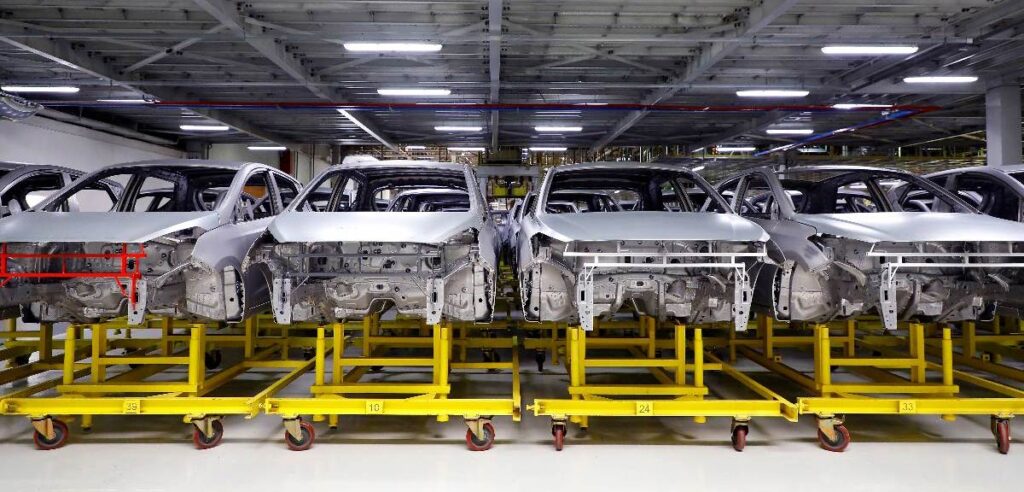
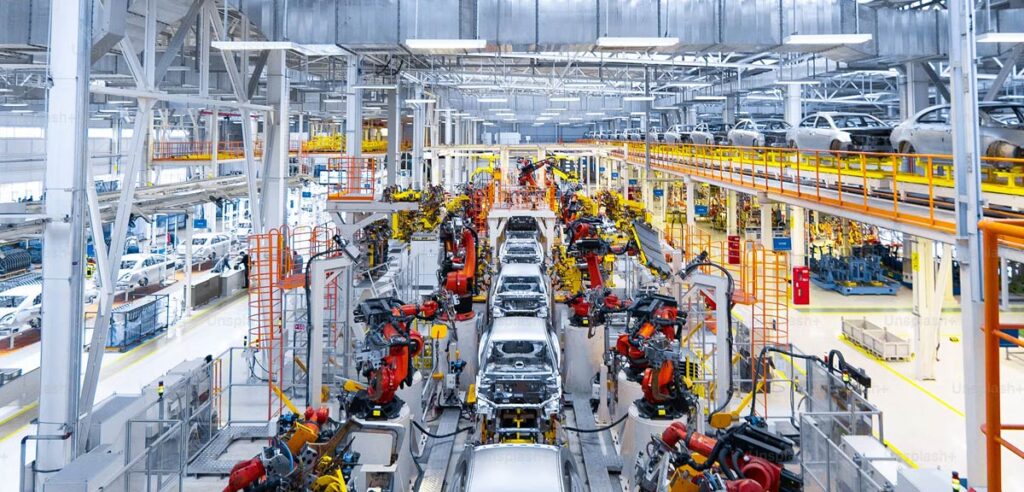
The global automotive industry depends on a highly developed network of component manufacturers supplying engines, transmissions, chassis systems, steering systems, braking systems, electrical components, battery systems, and other critical vehicle parts.
As automotive manufacturers increase production efficiency and introduce new vehicle technologies, automotive component suppliers are under growing pressure to improve productivity, quality, traceability, and manufacturing flexibility.
An automotive parts production line provides the manufacturing infrastructure required to produce and assemble automotive components efficiently and consistently.
Modern production lines combine mechanical equipment, industrial automation, robotics, inspection systems, material handling solutions, and digital manufacturing technologies.
For automotive OEMs and Tier 1 and Tier 2 suppliers, a properly designed production line can provide significant advantages in:
- Production efficiency
- Assembly accuracy
- Quality consistency
- Manufacturing traceability
- Labor efficiency
- Production flexibility
- Long-term scalability
This article explains the main processes, equipment, automation technologies, and design considerations involved in modern automotive parts production lines.
What Is an Automotive Parts Production Line?
An automotive parts production line is a structured manufacturing system designed to produce, assemble, inspect, and test automotive components through a series of connected production processes.
Depending on the product, a production line may include machining, cleaning, assembly, fastening, testing, inspection, and packaging processes.
Different automotive components require different production technologies.
For example, an engine component production line may require precision assembly and leak testing, while a suspension component production line may require pressing, fastening, and dimensional inspection.
A typical automotive parts production line may include:
- Automatic feeding systems
- Assembly workstations
- Industrial robots
- Servo presses
- Torque tightening systems
- Welding equipment
- Dispensing systems
- Vision inspection systems
- Leak testing equipment
- Functional testing equipment
- Conveyor systems
- PLC control systems
- MES integration
The production line is normally designed around the customer’s product, production capacity, quality requirements, and factory layout.
Types of Automotive Parts Production Lines
Automotive components cover a very broad range of products. As a result, production line configurations can vary significantly.
Some common applications include:
- Engine component production lines
- Transmission component production lines
- Chassis component assembly lines
- Steering system assembly lines
- Brake component production lines
- Automotive electrical component lines
- Battery module assembly lines
- Battery pack production lines
- Thermal management component lines
- Interior and exterior component assembly lines
Each production line should be engineered according to the specific characteristics of the product.
Main Processes in Automotive Parts Manufacturing
A modern automotive parts production line may contain several manufacturing stages.
The exact process depends on whether the project involves component machining, subassembly, final assembly, or complete component production.
Material Loading and Preparation
Production begins with the preparation of raw materials, semi-finished components, or purchased parts.
Automatic material handling systems can transfer components from storage areas to production stations.
Common solutions include:
- Conveyor systems
- Automatic feeding equipment
- Pallet systems
- Industrial robots
- AGVs
- Automated storage systems
Efficient material supply is important because interruptions in component availability can reduce overall line efficiency.
For high-volume manufacturing, automated logistics can provide stable material flow between production and assembly stations.
Component Assembly
Assembly is one of the most common processes in automotive parts production.
Depending on the product, assembly may involve:
- Component insertion
- Press fitting
- Fastening
- Welding
- Riveting
- Adhesive dispensing
- Connector installation
- Lubrication
Assembly operations should be designed around the product’s technical requirements and target cycle time.
Automated assembly equipment can improve repeatability and reduce variation between individual products.
Press-Fitting and Force-Controlled Assembly
Many automotive components require press-fitting operations.
Typical applications include:
- Bearing installation
- Bush installation
- Shaft assembly
- Gear installation
- Bushing insertion
- Pin assembly
Servo press systems allow manufacturers to control and monitor:
- Pressing force
- Position
- Speed
- Displacement
- Force-displacement curves
This data can be used to verify whether each assembly operation has been completed correctly.
Force-displacement monitoring is particularly valuable for safety-critical or precision automotive components.
Torque Tightening
Fastening is another critical process in automotive component manufacturing.
Many components require specific torque values to ensure proper clamping force.
Typical applications include:
- Engine components
- Transmission assemblies
- Brake systems
- Suspension components
- Battery packs
- Electric motor assemblies
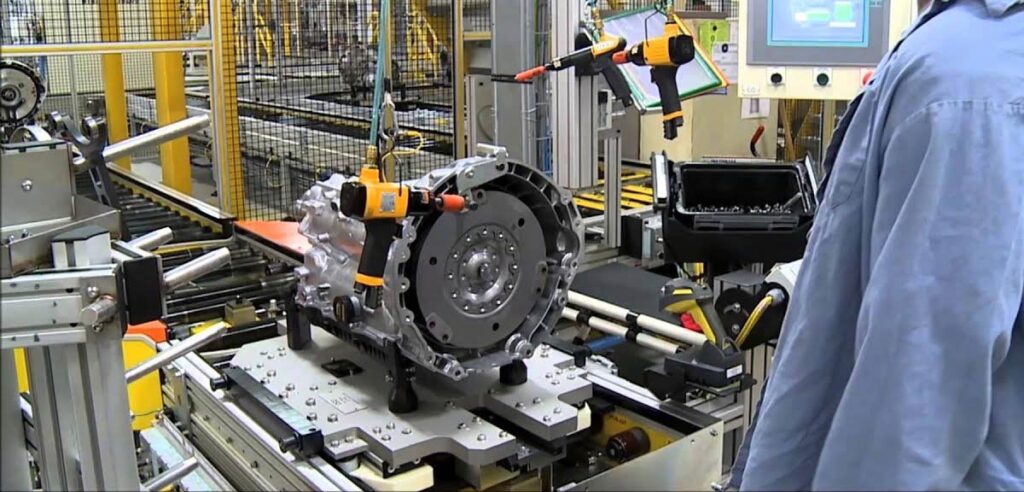
Modern electric tightening systems can control torque and angle while recording the results of every fastening operation.
This enables manufacturers to identify assembly deviations immediately.
The tightening data can also be connected to the product serial number and stored in an MES system.
Related article: Torque Tightening Systems in Automotive Assembly Lines
Robotic Assembly
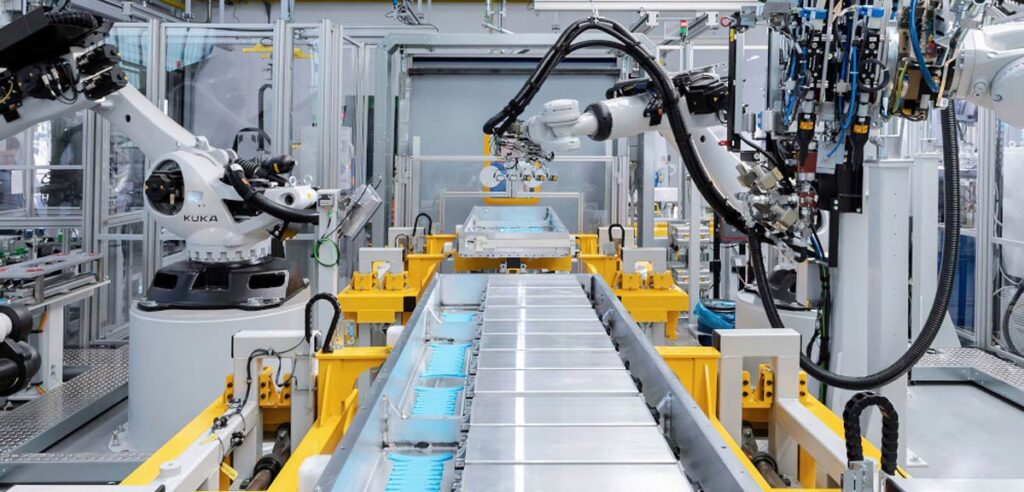
Industrial robots are widely used in modern automotive parts production.
Robots can perform repetitive or physically demanding operations with high repeatability.
Typical applications include:
- Component handling
- Part loading and unloading
- Assembly
- Dispensing
- Machine tending
- Pallet transfer
- Inspection assistance
Robot automation can improve production efficiency while reducing manual handling and improving workplace ergonomics.
For large automotive component factories, robots can also be integrated with conveyors, vision systems, PLCs, and other automated equipment.
Related article: Industrial Robots in Automotive Manufacturing
Automated Dispensing Systems
Adhesives, sealants, lubricants, and thermal materials are widely used in automotive component manufacturing.
Automated dispensing equipment controls the application of these materials with high precision.
Typical applications include:
- Sealant application
- Structural adhesive dispensing
- Thermal paste application
- Lubrication
- Gasket sealing
Important dispensing parameters include:
- Material quantity
- Application speed
- Dispensing path
- Bead width
- Application position
Consistent dispensing is important because excessive or insufficient material can affect product performance.
Vision Inspection Systems
Automated inspection is essential for maintaining quality in high-volume automotive production.
Machine vision systems can inspect components for:
- Correct part presence
- Component orientation
- Assembly position
- Surface defects
- Barcode information
- Fastener presence
- Adhesive application
Vision inspection can be performed automatically during production without requiring operators to inspect every component manually.
The inspection results can also be connected to the production control system for complete quality traceability.
Related article: Vision Inspection Systems in Automotive Manufacturing
Leak Testing
Many automotive components must maintain strict sealing performance.
Leak testing is commonly used for:
- Engine components
- Transmission housings
- Cooling systems
- Fuel system components
- Brake components
- Battery cooling systems
- EV battery enclosures
Common technologies include:
- Pressure decay testing
- Pressure differential testing
- Flow testing
- Vacuum testing
- Helium leak testing
The appropriate testing method depends on the required leakage limit, product structure, production volume, and quality requirements.
Related article: Leak Testing Equipment in Automotive Manufacturing
Functional Testing
After assembly, automotive components may require functional testing before being released.
Testing requirements depend on the product.
Examples include:
- Electrical testing
- Pressure testing
- Rotation testing
- Performance testing
- Noise and vibration testing
- Communication testing
End-of-line testing helps ensure that the finished component meets its technical specifications.
Main Equipment Used in Automotive Parts Production Lines
A complete automotive parts production line normally integrates multiple types of equipment.
Conveyor Systems
Conveyor systems provide the foundation for automated material movement.
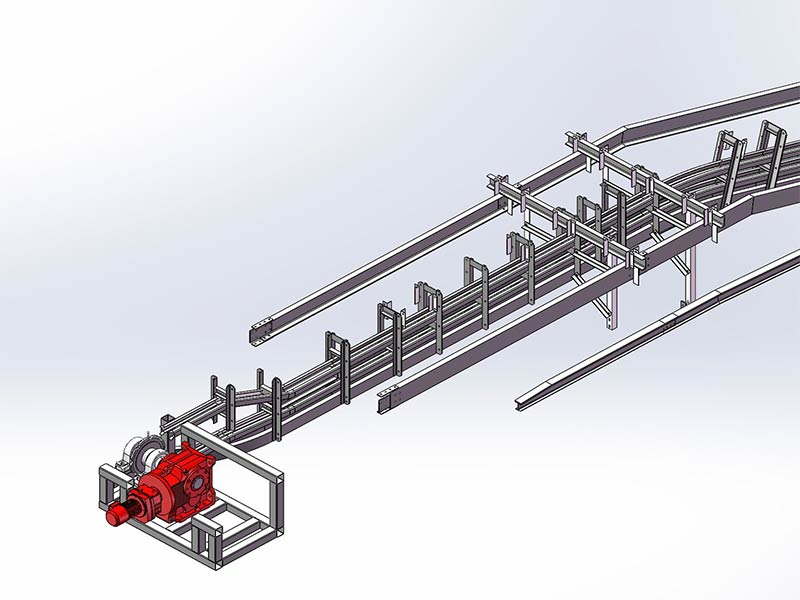
Common solutions include:
- Pallet conveyors
- Roller conveyors
- Chain conveyors
- Belt conveyors
- Lift transfer systems
- Cross-transfer systems
- Vertical conveyors
The conveyor system should be designed according to:
- Product weight
- Product dimensions
- Required positioning accuracy
- Production takt time
- Factory layout
Related article: Automotive Conveyor Systems: Types, Design & Applications
Industrial Robots
Robots provide flexible automation for material handling and assembly.
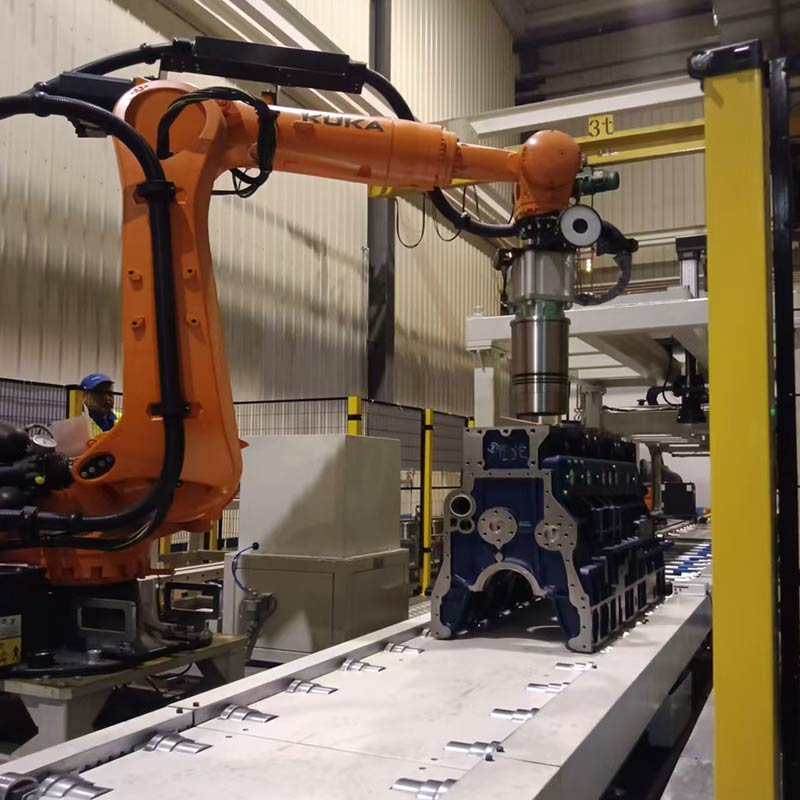
Depending on the application, manufacturers may use:
- Six-axis robots
- SCARA robots
- Cartesian robots
- Collaborative robots
Robot selection depends on payload, working range, cycle time, accuracy, and production environment.
Servo Press Systems
Servo presses provide precise control of assembly force and position.
They are commonly used for:
- Bearing installation
- Shaft assembly
- Bush insertion
- Gear assembly
- Component pressing
Compared with conventional mechanical presses, servo systems provide more detailed process monitoring and programmable motion control.
Automatic Fastening Equipment
Automatic fastening equipment is used where consistent torque and process traceability are required.
Modern systems can automatically:
- Position the tool
- Tighten fasteners
- Monitor torque
- Monitor angle
- Detect abnormal results
- Store process data
This makes intelligent fastening particularly suitable for automotive component production.
Testing Equipment
Testing equipment verifies product quality before components leave the production line.
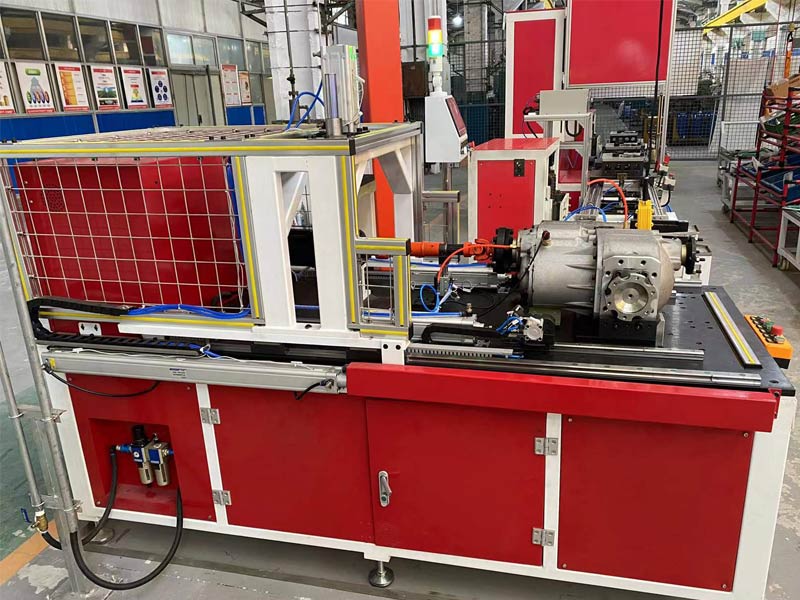
Depending on the application, the production system may include:
- Leak testers
- Electrical testers
- Pressure testers
- Functional test benches
- Noise and vibration testing systems
Testing equipment should be integrated into the production process rather than treated as a completely separate operation.
Automation and Control Systems
Modern automotive parts production lines require integrated control architectures.
PLC Control
PLC systems coordinate production equipment and manage the manufacturing sequence.
Typical PLC functions include:
- Conveyor control
- Robot communication
- Sensor monitoring
- Fixture control
- Safety management
- Process sequencing
- Equipment communication
A well-designed PLC architecture provides reliable production control and makes troubleshooting easier.
MES Integration and Traceability
Production traceability is increasingly important for automotive component manufacturers.
MES integration allows manufacturers to connect individual products with their complete manufacturing history.
Typical production data includes:
- Product serial number
- Component identification
- Torque results
- Press-fitting data
- Inspection results
- Leak test results
- Functional test results
- Production time
- Equipment information
Complete traceability allows manufacturers to quickly identify the production history of a defective component.
It also supports quality analysis, process optimization, and warranty management.
Related article: PLC & MES Integration in Automotive Manufacturing
Design Considerations for an Automotive Parts Production Line
Designing an automotive parts production line requires more than selecting individual machines.
The complete production system must be optimized as one integrated process.
Production Capacity
The first step is to determine the required production capacity.
Important parameters include:
- Annual production volume
- Daily production requirements
- Number of working shifts
- Takt time
- Product variants
- Expected future growth
The production line should have sufficient capacity while avoiding unnecessary equipment investment.
Production Takt Time
Takt time determines how quickly products need to move through the production system.
If one workstation takes significantly longer than the others, it can become a bottleneck.
Line balancing is therefore an important part of production engineering.
Engineers evaluate:
- Workstation cycle time
- Equipment utilization
- Operator activities
- Material transfer time
The objective is to create a balanced production flow.
Product Flexibility
Automotive suppliers frequently produce several component variants.
A flexible production line can support multiple models through:
- Programmable equipment
- Flexible fixtures
- Automatic parameter switching
- Modular workstations
- Robot programming
This reduces changeover time and improves production flexibility.
Quality Requirements
Quality control should be integrated directly into the manufacturing process.
Instead of waiting until the final inspection stage, modern production lines verify critical processes during assembly.
Examples include:
- Vision inspection
- Torque monitoring
- Force monitoring
- Leak testing
- Functional testing
This approach helps prevent defective products from moving to subsequent processes.
Smart Manufacturing for Automotive Parts Production
Industry 4.0 technologies are changing the way automotive components are manufactured.
Connected production systems allow manufacturers to collect and analyze production data in real time.
Production Data Collection
Production equipment can collect data from:
- Sensors
- Robots
- Tightening systems
- Presses
- Inspection equipment
- Testing systems
The data can then be transferred to MES or other manufacturing software.
Predictive Maintenance
Production equipment generates large amounts of operating data.
Manufacturers can use this information to identify potential equipment problems before unexpected failures occur.
Predictive maintenance can help reduce:
- Unplanned downtime
- Maintenance costs
- Production interruptions
Digital Twin Technology
Digital twins allow manufacturers to create virtual representations of production lines.
Engineers can simulate:
- Production flow
- Equipment operation
- Robot movement
- Cycle time
- Material flow
This can help identify potential bottlenecks before the physical production line is completed.
How to Build an Automotive Parts Production Line
A successful production line project normally follows several stages.
Process Analysis
The first stage is understanding the customer’s product and manufacturing requirements.
Engineers analyze:
- Product structure
- Assembly sequence
- Production volume
- Quality requirements
- Cycle time
- Automation requirements
Production Line Design
The next step is developing the production concept.
This may include:
- Process flow
- Equipment selection
- Factory layout
- Conveyor design
- Robot applications
- Inspection stations
Equipment Manufacturing
After the design is approved, the production equipment is manufactured and assembled.
Mechanical, electrical, and control systems are integrated during this stage.
Testing and Commissioning
Before shipment, the complete system should undergo testing to verify:
- Equipment operation
- Production sequence
- Safety functions
- Cycle time
- Inspection performance
After installation at the customer’s facility, engineers complete final commissioning and process optimization.
Operator Training
Training is important for maintaining stable production.
Training may cover:
- Equipment operation
- Safety procedures
- Maintenance
- Troubleshooting
- Production changeover
Why Automotive Component Manufacturers Need Integrated Automation Solutions
Automotive component manufacturing involves multiple processes that must work together.
Purchasing individual machines from different suppliers can create challenges related to:
- Communication between systems
- Production synchronization
- Quality data management
- Installation
- Commissioning
- Technical support
An integrated automation supplier can provide a complete solution covering:
- Process engineering
- Production line design
- Equipment manufacturing
- Automation control
- System integration
- Installation
- Commissioning
This approach can simplify project management and improve overall production line performance.
Choosing an Automotive Parts Production Line Manufacturer
When selecting an automation partner, automotive component manufacturers should evaluate several factors.
Automotive Industry Experience
The supplier should understand automotive manufacturing processes and quality requirements.
Relevant experience may include:
- Engine assembly
- Transmission assembly
- Powertrain production
- Automotive component assembly
- EV battery production
Engineering Capability
A capable supplier should have expertise in:
- Mechanical design
- Electrical engineering
- PLC programming
- Robotics
- Fixture design
- Production process engineering
Turnkey Project Capability
For large production projects, turnkey capability can simplify project execution.
The supplier should be able to manage:
- Process design
- Equipment development
- Manufacturing
- Installation
- Commissioning
International Support
For overseas automotive manufacturers, international project experience is especially important.
The supplier should be able to provide:
- English technical documentation
- Remote technical support
- Overseas installation assistance
- Operator training
- After-sales service
Hongbo Automation: Automotive Production Line and Equipment Solutions
Hongbo Automation focuses on automotive manufacturing automation and production line solutions.
Our capabilities cover automotive assembly lines and component production systems, including:
- Engine assembly lines
- Transmission assembly lines
- Powertrain assembly systems
- EV battery pack assembly lines
- Automotive component production lines
- Conveyor systems
- Automated assembly equipment
Hongbo can support customers through different stages of an automation project, from process analysis and production line design to equipment manufacturing, installation, commissioning, and technical support.
For automotive OEMs and component manufacturers, the objective is not simply to supply individual machines but to develop production systems that achieve reliable quality, stable output, and long-term manufacturing efficiency.
Conclusion
An automotive parts production line is a complex manufacturing system that combines production equipment, automation technology, quality inspection, material handling, and digital manufacturing systems.
A well-designed production line can help automotive component manufacturers achieve:
- Higher production efficiency
- Better assembly consistency
- Improved product quality
- Complete production traceability
- Reduced manual operations
- Greater manufacturing flexibility
From conveyor systems and industrial robots to torque tightening, vision inspection, leak testing, PLC control, and MES integration, every part of the production system must work together effectively.
As automotive manufacturing continues to evolve toward electrification, intelligent manufacturing, and flexible production, automotive component suppliers will increasingly require advanced and adaptable production solutions.
For OEMs, Tier 1 suppliers, and Tier 2 manufacturers planning a new production project, selecting an experienced automotive automation partner is an important step toward building a reliable and future-ready manufacturing operation.
Frequently Asked Questions
What is an automotive parts production line?
An automotive parts production line is an integrated manufacturing system used to produce, assemble, inspect, and test automotive components through a series of controlled production processes.
What equipment is used in automotive parts production?
Common equipment includes conveyors, industrial robots, servo presses, fastening systems, dispensing equipment, vision inspection systems, leak testers, and functional testing equipment.
Can automotive parts production lines be fully automated?
Yes. Depending on production volume, product complexity, and investment requirements, automotive parts production lines can range from semi-automated systems to highly automated production lines.
How does MES improve automotive parts manufacturing?
MES systems collect production data, provide product traceability, monitor manufacturing processes, and help manufacturers analyze quality and production performance.
Can one production line manufacture multiple automotive parts?
A flexible production line can be designed to support multiple product variants. However, the level of flexibility depends on product design, fixtures, equipment, automation architecture, and production requirements.
What industries use automotive parts production lines?
Automotive parts production lines are used by vehicle manufacturers, Tier 1 suppliers, Tier 2 suppliers, engine manufacturers, transmission manufacturers, battery manufacturers, and other automotive component producers.
How long does it take to build an automotive production line?
Project duration depends on product complexity, automation level, production capacity, equipment scope, and customer requirements. A complete project normally includes process design, engineering, manufacturing, testing, installation, and commissioning.
What should I consider when selecting an automotive production line supplier?
Important factors include automotive industry experience, engineering capabilities, automation expertise, turnkey project capability, quality management, commissioning support, and international service capability.