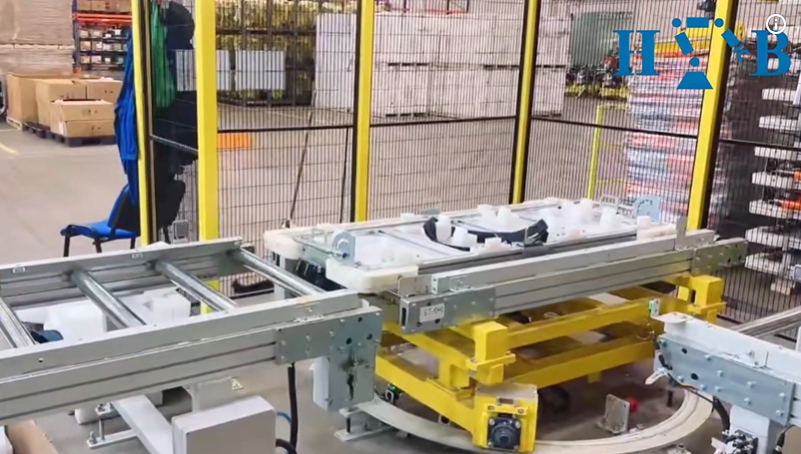
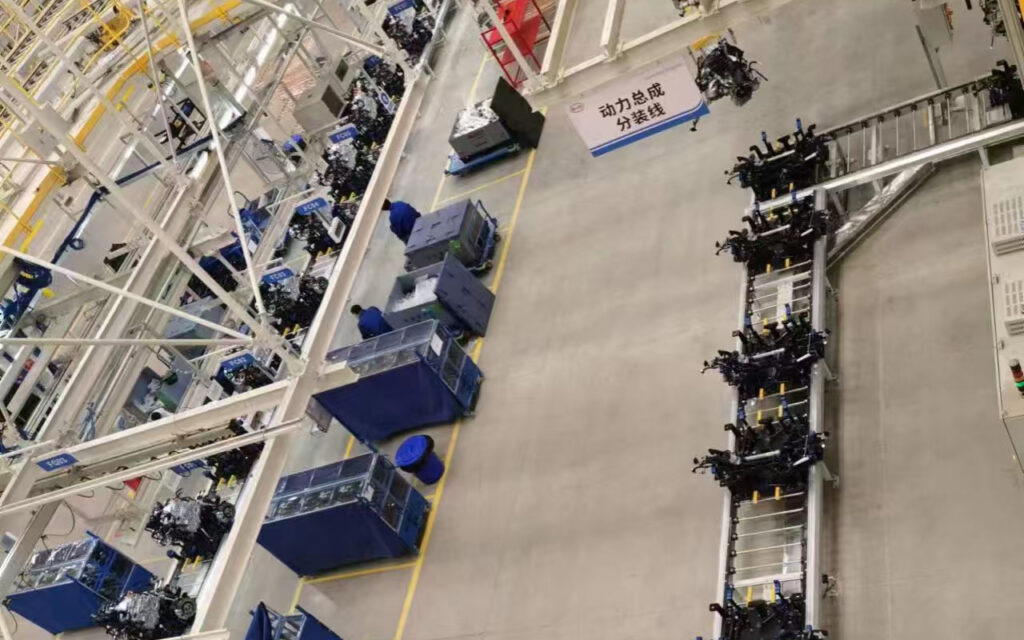
Slat conveyor systems are widely used in industrial manufacturing to transport products, components, pallets, and workpieces through defined production routes. In automotive manufacturing, they can provide a durable and flexible conveying solution for applications that require continuous movement, stable product support, and integration with automated workstations.
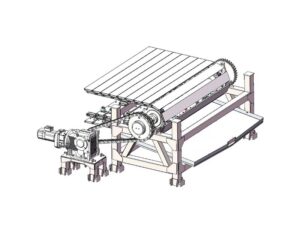
A slat conveyor typically consists of a series of connected plates or slats driven by a chain mechanism. The conveying surface can be configured according to the product dimensions, load requirements, operating environment, and production process.
Compared with some roller or belt conveyor configurations, slat conveyors can provide a continuous conveying surface and support products with different shapes or bottom structures. Depending on the design, they can also accommodate straight conveying, curved layouts, accumulation, and integration with assembly equipment.
For automotive manufacturers, the appropriate slat conveyor system should be designed around the product, required throughput, workstation arrangement, and overall factory material flow.
What Is a Slat Conveyor System?
A slat conveyor system is a mechanical conveyor that uses connected slats or plates mounted on one or more chains to transport products.
The chain drive moves the slats along a defined conveying path. The product rests on the conveying surface and moves with the slats.
Slats may be manufactured from materials such as:
- Carbon steel
- Stainless steel
- Engineering plastics
- Special wear-resistant materials
- Application-specific composite materials
The selection depends on payload, friction, temperature, corrosion exposure, product contact requirements, and operating conditions.
A typical slat conveyor system includes:
- Slats or conveying plates
- Drive chain
- Sprockets
- Drive motor
- Gearbox
- Conveyor frame
- Support rails
- Product guides
- Sensors
- Tensioning mechanism
- Control system
- Safety devices
The design can be adapted for different product sizes, conveying directions, line speeds, and workstation layouts.
Why Slat Conveyors Are Used in Automotive Manufacturing
Automotive production environments require material handling equipment that can operate reliably over long production cycles.
Products may vary in weight, size, shape, and surface characteristics. The conveyor must transport these products while maintaining stable movement and compatibility with the surrounding manufacturing equipment.
Slat conveyors can be useful for applications where a continuous and durable conveying surface is required.
Durable Mechanical Construction
A properly designed slat conveyor can support demanding industrial operating conditions.
The frame, chain, slats, and drive system can be selected according to the product weight and required operating frequency.
Flexible Product Handling
Slat conveyors can be configured for different product sizes and conveying arrangements.
The conveying surface may be adapted to support automotive components, containers, fixtures, or other production materials.
Integration with Production Stations
The conveyor can be connected to manual workstations, robots, inspection equipment, loading machines, and other production systems.
Suitable for Customized Layouts
Depending on the slat design and conveyor structure, the system can be configured for straight conveying, curved routes, and other layout requirements.
Main Components of a Slat Conveyor
The mechanical design of a slat conveyor directly affects its load capacity, reliability, service life, and conveying performance.
Conveyor Slats
The slats form the product support surface.
Their width, thickness, material, connection method, and surface design depend on the application.
For automotive production, the slat surface should provide sufficient support without damaging the product or interfering with the required process.
The slat design should also account for wear, cleaning requirements, temperature, and the possibility of product accumulation.
Drive Chain
The chain transfers power from the drive system to the conveying slats.
The chain specification should be selected according to the total load, conveyor length, speed, operating environment, and starting conditions.
For heavy-duty applications, the chain and supporting structure must be capable of handling both steady-state and dynamic loads.
Sprockets
Sprockets engage with the conveyor chain and transmit movement from the drive mechanism.
The sprocket design must be compatible with the chain specification and conveyor configuration.
Proper alignment is important because misalignment can increase wear and generate abnormal noise or vibration.
Drive Motor and Gearbox
The motor and gearbox provide the torque required to move the conveyor.
Selection should consider:
- Total conveyed load
- Conveyor length
- Inclination
- Required speed
- Starting torque
- Operating cycle
- Acceleration and deceleration
- Environmental conditions
The drive system should have sufficient capacity for normal operation and expected starting conditions.
Conveyor Frame
The frame supports the chain, slats, guide rails, drive components, and product load.
For automotive applications, the frame should maintain adequate rigidity and alignment throughout the conveyor’s operating life.
The structure may be manufactured from welded steel, formed sections, modular profiles, or another suitable construction.
Support Rails and Wear Strips
Support rails and wear strips guide and support the moving chain and slats.
The material should be selected according to friction, load, speed, operating temperature, and maintenance requirements.
Wear components should be accessible for inspection and replacement.
Types of Slat Conveyor Systems
Slat conveyors can be classified according to their slat material, mechanical configuration, conveying route, and application.
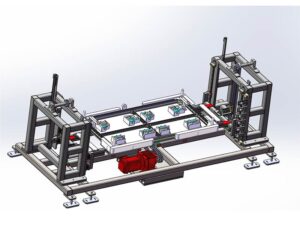
Steel Slat Conveyor
Steel slat conveyors are suitable for applications requiring a durable conveying surface and relatively high load capacity.
They may be used for industrial components, fixtures, containers, and other products that require strong mechanical support.
The steel material and surface treatment should be selected according to corrosion exposure, product contact, and operating conditions.
Plastic Slat Conveyor
Plastic slat conveyors use engineered plastic plates or modular slats.
They may be suitable for lighter products, applications requiring lower friction, or environments where product contact and cleaning are important.
The material must be selected according to the product weight, temperature, chemical exposure, and expected wear.
Heavy-Duty Slat Conveyor
Heavy-duty slat conveyors are designed for products with higher weight or more demanding operating conditions.
The design may require reinforced frames, stronger chains, larger drive components, and additional support structures.
The complete system should be evaluated based on the combined product load, fixture weight, conveyor length, and operating cycle.
Curved Slat Conveyor
A curved slat conveyor changes the conveying direction along a designed radius.
The feasibility of a curved configuration depends on the slat type, chain arrangement, product dimensions, and required turning radius.
Curved conveyors can help connect workstations when the factory layout does not allow a straight conveying route.
Slat Conveyor Applications in Automotive Manufacturing
Slat conveyors can be used in different areas of automotive production, depending on the product and process requirements.
Automotive Component Conveying
Slat conveyors can transport components, containers, and workpiece carriers between production areas.
The conveying surface can be designed according to the product’s dimensions and support requirements.
Assembly Line Material Handling
A slat conveyor may connect manual assembly workstations or automated processing equipment.
The conveyor can be designed with suitable access space for operators and compatible interfaces for automated machines.
Automotive Parts Production
In component production, slat conveyors may be used to transport parts between preparation, assembly, inspection, and packaging processes.
The actual application depends on the part weight, surface characteristics, production environment, and required conveying speed.
Engine and Transmission Component Handling
Selected engine and transmission components can be transported using slat conveyors when the product and fixture are compatible with the conveying surface.
For heavier or precision-positioned assemblies, the slat conveyor may be combined with dedicated pallets, fixtures, stoppers, and lift-and-locate units.
EV Component Production
Electric vehicle manufacturing may require material handling for motors, reducers, drive units, and other components.
The conveyor design should consider the product’s weight, geometry, surface protection requirements, and any special handling restrictions.
For battery-related applications, additional requirements may apply depending on the battery type, electrical condition, thermal risks, and factory safety procedures.
Slat Conveyor for Workpiece Handling
A slat conveyor is not automatically suitable for every product.
The product must remain stable on the conveying surface during acceleration, deceleration, and changes in direction.
Engineers should consider:
- Product bottom geometry
- Center of gravity
- Product dimensions
- Surface friction
- Product weight
- Required support area
- Product orientation
- Contact surface protection
If the product requires highly repeatable positioning, a dedicated pallet or fixture may be more appropriate than placing the product directly on the slats.
In this configuration, the slat conveyor transports the pallet, while the fixture provides the required product support and positioning.
Slat Conveyor and Pallet Integration
Slat conveyors can be designed to transport pallets or carrier fixtures.
This arrangement can provide a standardized interface between the conveyor and the product.
A pallet-based slat conveyor system may include:
- Dedicated carrier pallet
- Product fixture
- Stopper
- Pallet detection
- Positioning mechanism
- RFID or barcode identification
- Workstation interface
For precision assembly operations, the pallet may be transferred from the slat conveyor to a lift-and-locate station.
This allows the slat conveyor to perform transportation while a separate positioning system provides the reference required for assembly or inspection.
Slat Conveyor and Workstation Integration
A slat conveyor can be integrated with production stations along the conveying route.
Depending on the application, the workstation may include:
- Manual assembly tools
- Robotic equipment
- Vision inspection
- Press-fitting systems
- Tightening tools
- Testing equipment
- Labeling equipment
- Loading and unloading mechanisms
The conveyor layout should provide sufficient space for the equipment, product access, maintenance, and safety protection.
Workstation design should also consider whether the conveyor runs continuously or operates in an indexed mode.
Continuous Conveying vs. Indexed Conveying
Slat conveyors can operate in different conveying modes.
Continuous Conveying
The conveyor runs continuously at a defined speed.
This mode may be suitable for applications where products do not need to stop for individual processing operations.
It can also be used for simple material transportation or controlled movement through a defined area.
Indexed Conveying
The conveyor moves products in controlled steps.
The conveyor stops at specific positions so that assembly, inspection, or other operations can be performed.
Indexed conveying may require sensors, stoppers, positioning mechanisms, and PLC control.
The appropriate operating mode depends on the process cycle, workstation requirements, and product handling characteristics.
Slat Conveyor Speed and Cycle Time
Conveyor speed should be selected according to the production process and product characteristics.
Higher speed does not necessarily result in higher production efficiency if the downstream workstation cannot process products at the same rate.
Important factors include:
- Product spacing
- Workstation cycle time
- Required throughput
- Product stability
- Conveyor length
- Acceleration and deceleration
- Operator access
- Inspection requirements
For indexed systems, the complete cycle includes movement time, stopping time, positioning time, processing time, and release time.
The conveyor should be designed according to the required production takt time rather than using conveying speed as the only performance indicator.
Slat Conveyor Layout and Configuration
The layout depends on the factory space and production process.
Common configuration considerations include:
- Straight sections
- Curved sections
- Loading areas
- Unloading areas
- Buffer zones
- Transfer points
- Operator workstations
- Inspection stations
- Maintenance access
A slat conveyor may be connected to other conveyor types through transfer mechanisms or dedicated interfaces.
For example, a slat conveyor can feed a pallet conveyor or transfer machine when the product needs to enter a more precise assembly process.
Slat Conveyor and Transfer Equipment
In a complex automotive production line, slat conveyors may work together with transfer equipment.
A typical arrangement could be:
Slat Conveyor → Stopper → Transfer Machine → Pallet Conveyor
The slat conveyor transports the product or carrier.
The transfer machine moves it to another conveying system.
The pallet conveyor then delivers it to a workstation where more precise positioning may be required.
The interface between these machines should be designed around the product dimensions, conveyor height, transfer direction, and cycle time.
Slat Conveyor and Lift-and-Locate Systems
A slat conveyor can transport products toward a workstation where precision positioning is required.
At the workstation, a lift-and-locate mechanism may lift a pallet or fixture from the conveyor and establish the final processing position.
This arrangement separates transportation from precision positioning.
For example:
Slat Conveyor → Pallet Stop → Lift-and-Locate → Assembly Operation
The lift-and-locate system should be compatible with the pallet and conveyor structure.
If the product is placed directly on the slats, an additional fixture or positioning arrangement may be necessary.
Slat Conveyor Control System
A PLC-based control system can manage the operation of the slat conveyor and coordinate it with other production equipment.
The control system may monitor:
- Conveyor motor status
- Product presence
- Pallet presence
- Conveyor speed
- Stopper position
- Transfer equipment status
- Safety conditions
- Workstation readiness
The PLC can control conveyor start, stop, indexing, and communication with upstream and downstream equipment.
For a more advanced system, the conveyor can exchange information with robots, inspection equipment, and MES platforms.
Sensors and Product Detection
Sensors are used to monitor product movement and conveyor status.
Depending on the application, the system may use:
- Photoelectric sensors
- Proximity sensors
- Position sensors
- Encoder feedback
- Pallet identification readers
- Mechanical limit switches
Sensor placement should account for product size, conveying speed, detection reliability, and environmental conditions.
The control logic should also consider what happens when a product is missing, incorrectly positioned, or detected at an unexpected location.
Slat Conveyor and Production Traceability
A slat conveyor can be integrated with product tracking when products or pallets need to be identified during production.
RFID tags or barcodes can associate a product with its production information.
The control system may record the product’s movement through different process areas.
Potential information includes:
- Product identification
- Production order
- Current station
- Transfer time
- Process status
- Inspection status
- Error information
If the conveyor transports standardized pallets, pallet identification may provide a practical method for linking the physical carrier to the product record.
The actual traceability architecture depends on the factory’s PLC, MES, database, and communication requirements.
Slat Conveyor Design for Heavy Loads
Heavy-duty slat conveyors require careful mechanical design.
The engineering team should consider the total load, including the product, pallet, fixture, and any additional material placed on the conveyor.
The following parameters are important:
- Maximum payload
- Load distribution
- Conveyor length
- Chain capacity
- Slat strength
- Frame rigidity
- Drive torque
- Support rail design
- Starting and stopping loads
- Operating frequency
A conveyor designed only for static load may not perform reliably when subjected to repeated acceleration, deceleration, or uneven loading.
Dynamic operating conditions should therefore be included in the design evaluation.
Product Protection and Surface Requirements
The slat material and surface design should be selected according to the product being transported.
Some automotive components may have painted, machined, coated, or otherwise sensitive surfaces.
Direct contact with unsuitable slats can cause scratching, marking, or contamination.
Depending on the application, the system may require:
- Protective contact surfaces
- Polymer wear strips
- Dedicated pallets
- Rubber or engineered support elements
- Controlled product orientation
- Reduced contact pressure
The product protection strategy should be established during the initial equipment design.
Safety Considerations
Slat conveyors contain moving chains, slats, sprockets, and drive components.
Potential hazards include:
- Pinch points
- Chain engagement areas
- Shearing points
- Unexpected product movement
- Product falling from the conveyor
- Access to moving components
- Uncontrolled restart
Safety measures may include:
- Mechanical guarding
- Emergency stop devices
- Safety light curtains
- Safety scanners
- Safety interlocks
- Protective covers
- Warning signs
- Controlled restart procedures
The actual safety design should be based on the conveyor configuration, operating environment, access requirements, and applicable customer standards.
Maintenance of Slat Conveyor Systems
Regular maintenance helps maintain conveying performance and extend equipment service life.
Important maintenance items include:
- Conveyor chains
- Sprockets
- Slats
- Wear strips
- Guide rails
- Bearings
- Motors
- Gearboxes
- Chain tension
- Sensors
- Fasteners
- Safety devices
Chain tension and alignment should be checked according to the equipment design.
Excessive chain slack, abnormal noise, uneven movement, and increased vibration may indicate wear or alignment problems.
The maintenance plan should also define lubrication requirements, inspection intervals, and replacement criteria for wear components.
How to Select a Slat Conveyor System
The selection process should be based on the product and production requirements.
Important questions include:
- What product or pallet will the conveyor transport?
- What is the maximum payload?
- What are the product dimensions?
- What is the required conveyor length?
- Is the conveying route straight or curved?
- What conveying speed is required?
- Will the conveyor operate continuously or in indexed mode?
- Does the product require a dedicated fixture?
- Is product surface protection necessary?
- Will the conveyor connect to transfer equipment?
- What workstation interfaces are required?
- Is RFID or barcode tracking needed?
- What PLC and MES interfaces are required?
- What safety functions are necessary?
- What maintenance access is available?
These parameters help determine the slat material, chain type, drive system, conveyor frame, support structure, and control architecture.
Custom Slat Conveyor Solutions
A standard slat conveyor may be suitable for straightforward material handling. However, automotive production lines often require customized designs.
The conveyor may need to accommodate specific product dimensions, heavy loads, unusual layouts, automated workstations, or existing equipment interfaces.
A custom slat conveyor system can include:
- Product-specific slats
- Dedicated pallets
- Adjustable guides
- Heavy-duty chain drives
- Curved conveyor sections
- Buffer zones
- Transfer interfaces
- Stoppers
- Product detection
- PLC control
- Safety systems
- RFID tracking
The design should be developed around the actual product and manufacturing process.
Hongbo Slat Conveyor Solutions
Hongbo Automation designs and integrates conveyor equipment for automotive assembly and automotive component production.
Slat conveyor systems can be configured according to product dimensions, payload, conveying route, operating speed, workstation requirements, and factory layout.
Hongbo’s conveyor solutions can be integrated with transfer machines, pallet conveyors, lift-and-locate systems, robots, inspection equipment, assembly tools, PLC controls, and production tracking systems.
The conveyor can be engineered as part of a complete automated production line, helping ensure that material handling, workstation operation, and process control are coordinated.
For customers requiring customized automotive conveyor equipment, the design process can consider mechanical structure, product support, drive capacity, control architecture, safety, and maintenance requirements.
Conclusion
Slat conveyor systems provide a durable and flexible option for transporting automotive components, pallets, fixtures, and production materials.
Their performance depends on the correct combination of slat design, chain drive, frame structure, support system, motor capacity, product handling method, and control architecture.
For automotive manufacturing applications, slat conveyors can be integrated with assembly workstations, transfer machines, pallet conveyors, robots, inspection systems, and production tracking platforms.
The most suitable design should be selected according to the product’s weight, dimensions, surface requirements, conveying route, cycle time, and workstation configuration.
A well-engineered slat conveyor is not simply a transport device. It is part of the overall material handling and production architecture of the automotive manufacturing line.
Frequently Asked Questions
What is a slat conveyor system?
A slat conveyor system uses connected plates or slats mounted on chains to transport products, components, pallets, or workpieces along a defined conveying route.
What are slat conveyors used for in automotive manufacturing?
They can be used to transport automotive components, fixtures, containers, pallets, and other production materials between assembly, inspection, preparation, and handling stations.
Can slat conveyors handle heavy automotive products?
Yes. Heavy-duty slat conveyors can be engineered according to the combined product, pallet, and fixture weight, along with the required operating cycle and conveying distance.
What is the difference between a slat conveyor and a pallet conveyor?
A slat conveyor uses connected slats as its conveying surface, while a pallet conveyor is designed to transport standardized pallets or carriers. A slat conveyor can also be configured to transport pallets when the mechanical interface is suitable.
Can slat conveyors be used with robots?
Yes. Slat conveyors can deliver products or carriers to robotic workstations. A separate stopper, fixture, or lift-and-locate system may be required when the robot needs precise product positioning.
Can slat conveyors include curved sections?
Depending on the slat and chain configuration, curved sections may be possible. The design must consider the turning radius, product dimensions, slat movement, and mechanical constraints.
Can Hongbo customize slat conveyor systems?
Yes. Hongbo can develop slat conveyor systems according to product dimensions, payload, conveying route, speed, workstation interfaces, control requirements, safety conditions, and factory layout.