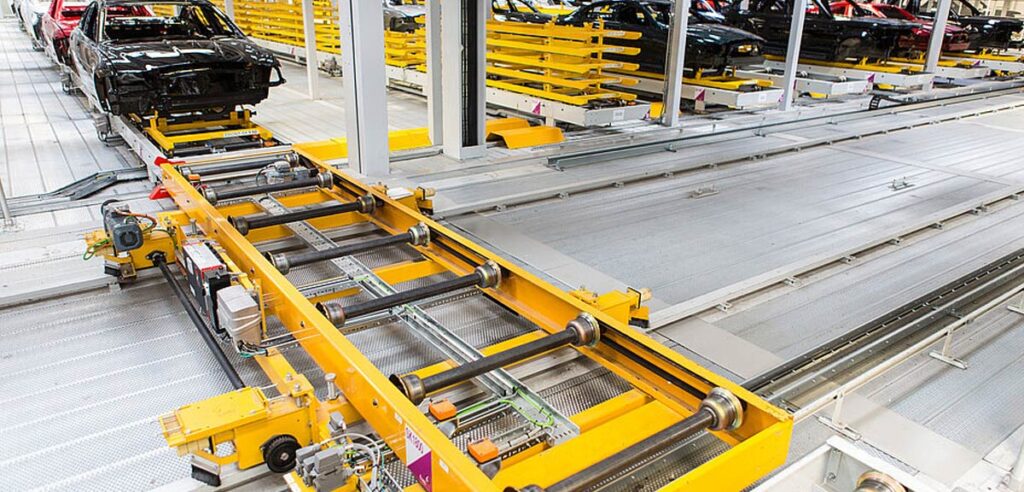
Vertical conveyor systems are used in automotive manufacturing facilities to move pallets, components, containers, and other production materials between different elevations.
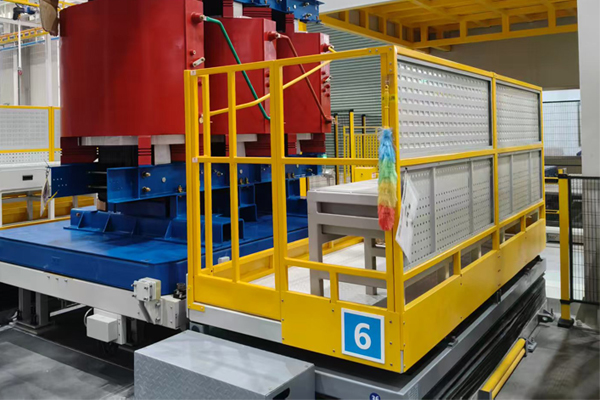
Unlike conventional horizontal conveyors, vertical conveyors provide controlled material movement in the vertical direction. They are particularly useful when production lines occupy multiple levels, when floor space is limited, or when materials need to be transferred between conveyors at different heights.
In automotive assembly plants, vertical conveyor systems can be integrated with pallet conveyors, lift-and-locate units, transfer machines, automated storage systems, robots, and production tracking systems.
The right vertical conveyor design can help manufacturers make better use of factory space while maintaining continuous and controlled material flow.
see how our engine vertical lift works in the warehouse:
What Is a Vertical Conveyor System?
A vertical conveyor system is an automated material handling machine designed to move products vertically between different elevations.
Depending on the application, the equipment may transport:
- Automotive pallets
- Engine assemblies
- Transmission assemblies
- Axle assemblies
- EV components
- Automotive parts
- Production containers
- Fixtures
- Workpiece carriers
A vertical conveyor can be configured as a standalone machine or integrated directly into an automated production line.
For palletized automotive production, the vertical conveyor normally receives a pallet from one horizontal conveyor, raises or lowers it to another level, and then transfers it to the destination conveyor.
A typical material flow can be:
Horizontal Conveyor → Vertical Conveyor → Horizontal Conveyor
This allows production areas at different elevations to operate as part of the same material handling system.
Why Automotive Plants Use Vertical Conveyors
Automotive factories often contain large production areas with complex equipment layouts.
As production requirements increase, manufacturers may need to connect different production levels without expanding the factory footprint.
A vertical conveyor provides a controlled way to overcome this height difference.
Better Use of Factory Space
Floor space is one of the most valuable resources in a manufacturing plant.
A vertical conveyor allows material to move upward or downward instead of requiring a long horizontal route.
This can reduce the footprint required for material transportation.
Connection Between Different Production Levels
Some factories use mezzanines, elevated platforms, multi-level assembly areas, or different floor elevations.
A vertical conveyor can connect these areas with automated material handling.
Flexible Production Line Layout
Vertical transportation can make it possible to separate production processes vertically.
For example, one level may be used for component preparation while another level contains final assembly or testing.
The vertical conveyor provides the connection between the two areas.
Reduced Manual Material Handling
Without an automated vertical transfer system, operators or forklifts may be required to move products between levels.
Automating this process can reduce manual handling and create a more consistent material flow.
Types of Vertical Conveyor Systems
There is no single vertical conveyor configuration suitable for every automotive application.
The appropriate type depends on payload, product dimensions, required stroke, cycle time, conveyor interface, and factory layout.
Vertical Lift Conveyor
A vertical lift conveyor raises and lowers a carrier or pallet between predefined levels.
The lifting platform can incorporate rollers, chains, or another conveyor mechanism.
When the platform reaches the destination height, the product can be transferred onto the horizontal conveyor.
Continuous Vertical Conveyor
A continuous vertical conveyor uses continuously circulating carriers or platforms to transport products between levels.
This configuration can be useful for applications involving a relatively continuous material flow.
Reciprocating Vertical Conveyor
A reciprocating vertical conveyor moves between different levels as required.
It can receive one or more pallets, move them to another elevation, and return for the next transfer cycle.
This configuration is often suitable for palletized production systems where controlled point-to-point movement is required.
Vertical Pallet Conveyor
A vertical pallet conveyor is designed specifically to transfer pallets between different elevations.
The pallet can remain on its existing fixture or carrier while being transported vertically.
This makes the system suitable for automotive assembly applications where product positioning and traceability must be maintained.
Main Components of a Vertical Conveyor
A typical automotive vertical conveyor includes several mechanical and control components.
Structural Frame
The frame supports the lifting mechanism, conveyor section, guide system, sensors, and payload.
The structure must be designed according to the maximum static and dynamic load.
Lifting Mechanism
The lifting mechanism moves the conveyor platform between different elevations.
Depending on the application, it may use:
- Electric motor and gearbox
- Chain drive
- Belt drive
- Screw mechanism
- Hydraulic cylinder
- Pneumatic cylinder
- Servo-driven actuator
The appropriate technology depends on payload, stroke, speed, positioning accuracy, and operating frequency.
Conveyor Platform
The platform carries the pallet or product during vertical movement.
It may include roller conveyor sections, chain conveyors, belt conveyors, or other material handling mechanisms.
The platform must maintain sufficient rigidity during acceleration, deceleration, and stopping.
Guide System
Guides maintain the platform’s movement along a controlled vertical path.
The guide structure should minimize unwanted lateral movement and maintain stable alignment with the upper and lower conveyors.
Sensors
Sensors provide position and status feedback to the PLC.
Typical sensors include:
- Pallet presence sensors
- Upper position sensors
- Lower position sensors
- Platform position sensors
- Door status sensors
- Conveyor status sensors
- Product detection sensors
How a Vertical Conveyor Works
The operating sequence depends on the specific design, but a typical pallet transfer process follows several steps.
Step 1: Pallet Arrival
A pallet travels along the incoming conveyor toward the vertical conveyor.
A sensor detects the pallet and communicates with the PLC.
Step 2: Pallet Position Confirmation
The system confirms that the pallet has reached the correct loading position.
The conveyor then stops the pallet.
Step 3: Vertical Transfer
The lifting mechanism raises or lowers the platform to the required level.
The PLC continuously monitors the movement.
Step 4: Destination Alignment
When the platform reaches the target elevation, the system verifies its position.
The vertical conveyor must align correctly with the destination conveyor before transfer begins.
Step 5: Pallet Transfer
The conveyor on the platform starts operating and transfers the pallet onto the destination conveyor.
Step 6: Platform Return
If the system is a reciprocating design, the platform returns to its initial level or moves to the next required position.
This sequence can then be repeated automatically.
Vertical Conveyor vs. Lift Table
Vertical conveyors and lift tables can appear similar because both involve vertical movement.
However, their functions are different.
A lift table is primarily designed to raise or lower a product or pallet to a different working height.
A vertical conveyor is generally designed to transport products between different conveyor levels.
For example:
Lift Table:
Raise a pallet → Perform assembly operation → Lower pallet
Vertical Conveyor:
Receive pallet → Move vertically → Transfer pallet to another conveyor
A lift table may therefore be part of an assembly workstation, while a vertical conveyor is more commonly part of the overall material flow system.
In some applications, the two technologies can be combined.
Vertical Conveyor Applications in Automotive Manufacturing
Vertical conveyors can be used in many automotive production environments.
Engine Assembly
Engine assemblies can be transported vertically between production levels when the factory layout requires multi-level material flow.
The pallet can remain on a dedicated fixture throughout the transfer.
Transmission Assembly
Transmission pallets can be moved between different assembly or inspection levels using a vertical pallet conveyor.
The system can be integrated with upstream and downstream pallet conveyors.
Powertrain Production
Powertrain manufacturing often involves heavy components and multiple process stations.
A vertical conveyor can provide a controlled connection between different areas while reducing manual transportation.
EV Component Manufacturing
EV production introduces additional automated material handling requirements for motors, reducers, drive units, and battery-related components.
Depending on the product and factory architecture, vertical conveyors can connect different process levels while maintaining automated pallet flow.
Automotive Parts Production
Vertical conveyors can also transport smaller automotive components and production containers.
The system can be designed for different carrier sizes and payload requirements.
Vertical Pallet Conveyor Design
For automotive applications, the pallet and conveyor interface are particularly important.
The vertical conveyor should be compatible with the pallet dimensions, conveyor height, guide system, and transfer mechanism used throughout the production line.
Important design parameters include:
- Pallet dimensions
- Product dimensions
- Pallet weight
- Product weight
- Maximum payload
- Center of gravity
- Lifting stroke
- Transfer height
- Cycle time
- Conveyor speed
- Positioning accuracy
The combined weight of the product, fixture, and pallet should be used when calculating the lifting capacity.
Payload and Center of Gravity
Payload is one of the most important parameters in vertical conveyor design.
A system carrying an engine assembly requires a significantly different mechanical design from one carrying a lightweight component container.
The center of gravity should also be considered.
An asymmetric or tall load may generate additional forces during acceleration and deceleration.
The lifting mechanism, guide system, and platform should therefore be designed as a complete mechanical system.
Conveyor Interface and Transfer Height
The upper and lower conveyor heights must be accurately defined.
When the vertical conveyor reaches the destination level, its conveyor surface needs to align with the adjacent conveyor.
If the height relationship is incorrect, pallet transfer may become unreliable.
The design should therefore account for:
- Conveyor frame height
- Pallet bottom height
- Roller or chain height
- Lift platform deflection
- Mechanical tolerances
- Positioning repeatability
Proper interface design is particularly important when the same pallet needs to move automatically between multiple conveyor types.
Positioning Accuracy
The vertical conveyor does not always require extremely high positioning accuracy.
However, its platform must reliably stop at the correct elevation for pallet transfer.
If the vertical conveyor feeds an automated assembly workstation, additional positioning equipment may be required downstream.
For example:
Vertical Conveyor → Pallet Conveyor → Stopper → Lift-and-Locate → Robot
The vertical conveyor provides elevation change.
The pallet conveyor provides horizontal transportation.
The lift-and-locate system provides the final precision positioning.
Separating these functions can make the complete system easier to engineer and maintain.
Vertical Conveyor and Cross Transfer Integration
Complex automotive factories may require both vertical and horizontal transfer.
A typical material flow may look like:
Pallet Conveyor → Cross Transfer → Vertical Conveyor → Pallet Conveyor
The cross transfer changes the horizontal production route.
The vertical conveyor changes the elevation.
The pallet conveyor then delivers the product to the next workstation.
Combining these technologies allows engineers to create three-dimensional material handling layouts.
This can be particularly useful when factory space is limited or multiple production levels need to be connected.
Vertical Conveyor and Pallet Tracking
Pallet tracking can continue through a vertical conveyor system.
An RFID tag or barcode can identify the pallet before it enters the vertical transfer.
The PLC or MES can associate the pallet with its production information.
The system can then record the transfer event and update the pallet’s production status.
This can provide traceability such as:
- Pallet ID
- Product model
- Product serial number
- Current production station
- Previous process
- Next process
- Transfer status
Maintaining this information across vertical transfers helps preserve production visibility throughout the manufacturing process.
PLC Control and Interlocking
A vertical conveyor requires coordinated control between the lifting mechanism and the connected conveyors.
The PLC should verify that the transfer conditions are correct before starting the vertical movement.
Typical interlocking conditions include:
- Pallet correctly positioned
- Incoming conveyor stopped
- Destination conveyor available
- Platform in the correct initial position
- Safety system ready
- Access doors closed
- No obstruction detected
After reaching the destination level, the system confirms platform position before activating the transfer conveyor.
This prevents the pallet from being transferred before the platform has reached the correct height.
Safety Considerations
Vertical conveyor systems can involve significant mechanical energy and heavy loads.
Safety must therefore be considered as part of the machine design.
Potential hazards include:
- Falling loads
- Crushing points
- Shearing points
- Unexpected platform movement
- Access to moving components
- Mechanical failure
- Uncontrolled descent
Depending on the system configuration, safety measures may include:
- Guarding
- Safety doors
- Safety interlocks
- Emergency stop devices
- Light curtains
- Safety scanners
- Mechanical anti-drop mechanisms
- Position monitoring
- Controlled restart procedures
The exact safety architecture should be determined according to the equipment configuration, operating environment, and applicable customer requirements.
Maintenance of Vertical Conveyor Systems
Preventive maintenance is important because vertical conveyors combine lifting and conveying functions.
Typical inspection items include:
- Motors
- Gearboxes
- Chains
- Belts
- Bearings
- Guide rails
- Lifting mechanisms
- Rollers
- Sensors
- Limit switches
- Mechanical fasteners
- Electrical connections
The lifting mechanism should be inspected regularly for abnormal noise, vibration, uneven movement, or excessive mechanical clearance.
Guide components should also be checked because wear can affect platform alignment.
How to Select a Vertical Conveyor System
Before selecting a vertical conveyor, engineers should define the complete application requirements.
Important parameters include:
- What is the maximum payload?
- What are the pallet dimensions?
- What are the product dimensions?
- What is the center of gravity?
- What is the required lifting stroke?
- How many levels need to be connected?
- What are the upper and lower conveyor heights?
- What is the required cycle time?
- What positioning accuracy is required?
- What conveyor type is used before and after the vertical transfer?
- Is RFID or barcode tracking required?
- Will the system connect to robots or automated assembly equipment?
- What safety functions are required?
These requirements determine the lifting technology, conveyor configuration, guide system, drive capacity, control architecture, and safety design.
Custom Vertical Conveyor Solutions
Automotive production environments often require customized vertical conveyor designs.
The system may need to fit a specific building structure, conveyor height, pallet size, or production layout.
A customized vertical conveyor can integrate:
- Vertical lifting mechanism
- Pallet conveyor
- Roller conveyor
- Chain conveyor
- Transfer mechanism
- Position sensors
- Pallet identification
- PLC control
- Safety system
- MES communication
The equipment can also be designed to connect directly with existing production lines.
This is particularly important for factory expansion projects where new production equipment needs to be connected to an existing material handling system.
Hongbo Vertical Conveyor Solutions
Hongbo Automation designs and integrates conveyor and material handling equipment for automotive manufacturing applications.
Vertical conveyor systems can be customized according to product dimensions, pallet configuration, payload, lifting height, cycle time, conveyor interface, and factory layout.
The system can be integrated with pallet conveyors, cross transfer systems, lift-and-locate units, automated assembly equipment, testing systems, PLC controls, and production traceability systems.
By engineering the vertical transfer together with the surrounding conveyor system, Hongbo can help manufacturers establish continuous material flow between different production levels.
Conclusion
Vertical conveyor systems provide an automated solution for moving automotive pallets and components between different elevations.
They are particularly useful in multi-level factories, space-constrained production environments, and manufacturing systems where different process areas need to be connected.
A successful vertical conveyor design requires more than selecting a lifting mechanism. Payload, center of gravity, pallet dimensions, transfer height, conveyor interface, cycle time, positioning, controls, and safety all need to be considered together.
When integrated with pallet conveyors, cross transfer systems, lift-and-locate units, PLC controls, and production tracking systems, vertical conveyors can become an important part of a flexible automotive material handling system.
For engine, transmission, powertrain, EV, and automotive component production, the vertical conveyor should be engineered around the actual product and production process.
Frequently Asked Questions
What is a vertical conveyor system?
A vertical conveyor system is an automated material handling machine that moves pallets, components, or other products between different elevations.
What is the difference between a vertical conveyor and a lift table?
A lift table primarily raises or lowers a product to a working position. A vertical conveyor is designed to transfer products between different conveyor levels as part of the production material flow.
Can vertical conveyors transport automotive pallets?
Yes. Vertical pallet conveyors can be designed to transport pallets carrying engines, transmissions, axles, EV components, and other automotive products.
Can a vertical conveyor connect multiple production levels?
Yes. Depending on the system design, vertical conveyors can connect two or more production elevations and integrate with horizontal conveyor systems.
Can vertical conveyors be integrated with MES?
Yes. With appropriate PLC and communication architecture, pallet identification and transfer information can be connected to MES or other production management systems.
Can vertical conveyors handle heavy automotive products?
Yes. The lifting mechanism, frame, guide system, and conveyor platform can be engineered according to the required payload and product center of gravity.
Can Hongbo customize vertical conveyor systems?
Yes. Hongbo can develop vertical conveyor equipment according to pallet dimensions, payload, lifting height, cycle time, conveyor interfaces, factory layout, and overall automation requirements.