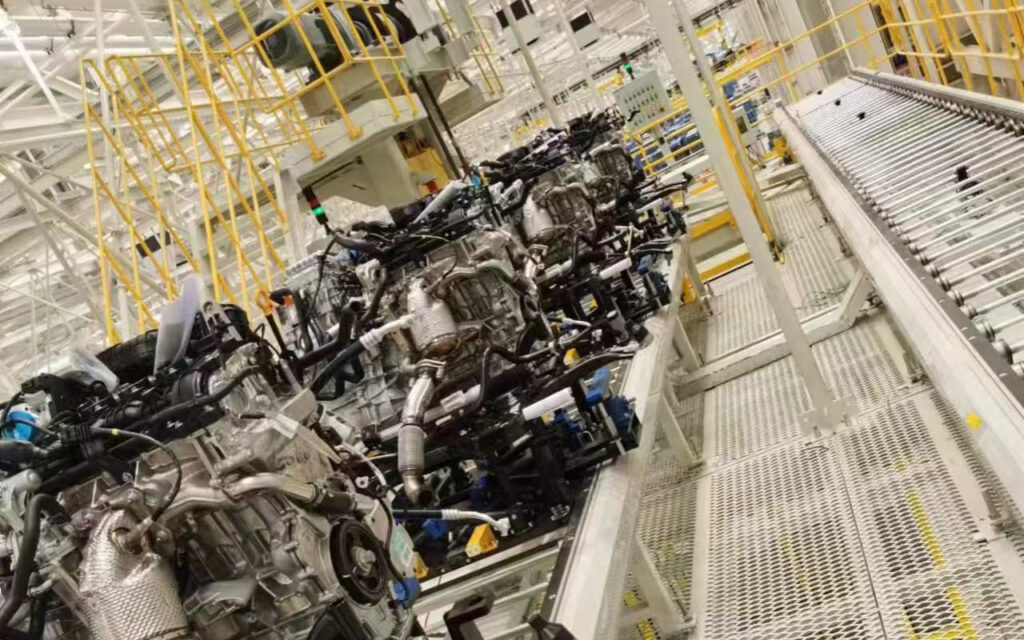
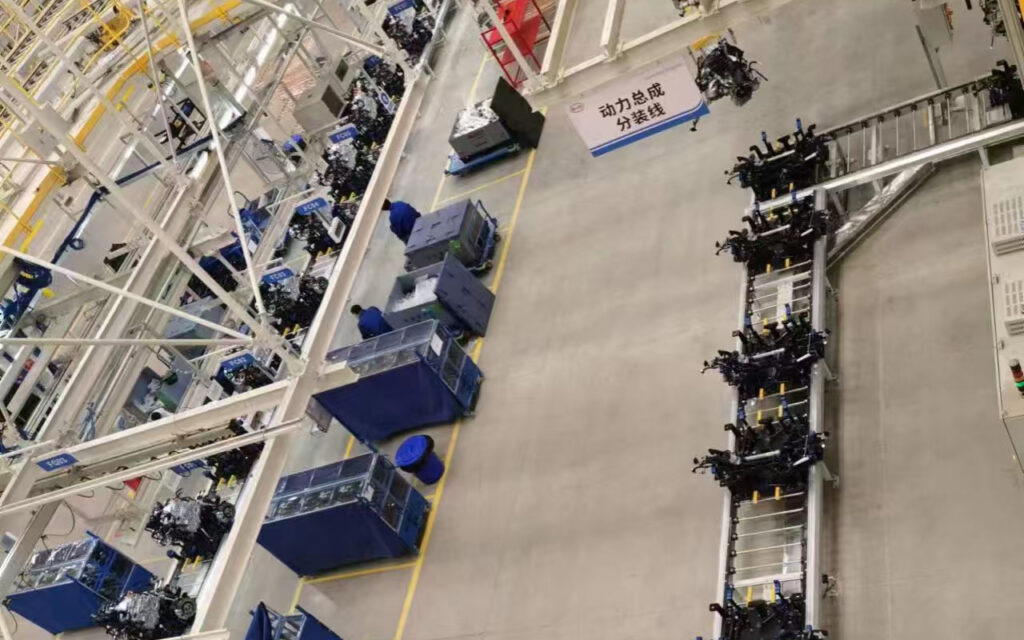
Modern automotive assembly lines often require pallets and components to move between parallel conveyor sections, production lanes, buffer areas, and different processing stations. While a standard conveyor provides continuous transportation along one direction, it cannot independently move a pallet sideways between two separate conveyor paths.
A cross transfer system solves this requirement by moving pallets or other loads laterally from one conveyor to another. As a result, manufacturers can create more flexible production layouts while reducing unnecessary conveyor length and manual material handling.
Cross transfer systems are particularly useful in automotive assembly and component manufacturing, where production lines may contain parallel workstations, bypass routes, buffer areas, inspection stations, and return conveyor loops.
Depending on the application, a cross transfer can use rollers, chains, belts, lifting platforms, or other mechanical transfer mechanisms. In addition, the system can be integrated with PLC controls, sensors, pallet identification, and MES-based production management.
What Is a Cross Transfer System?
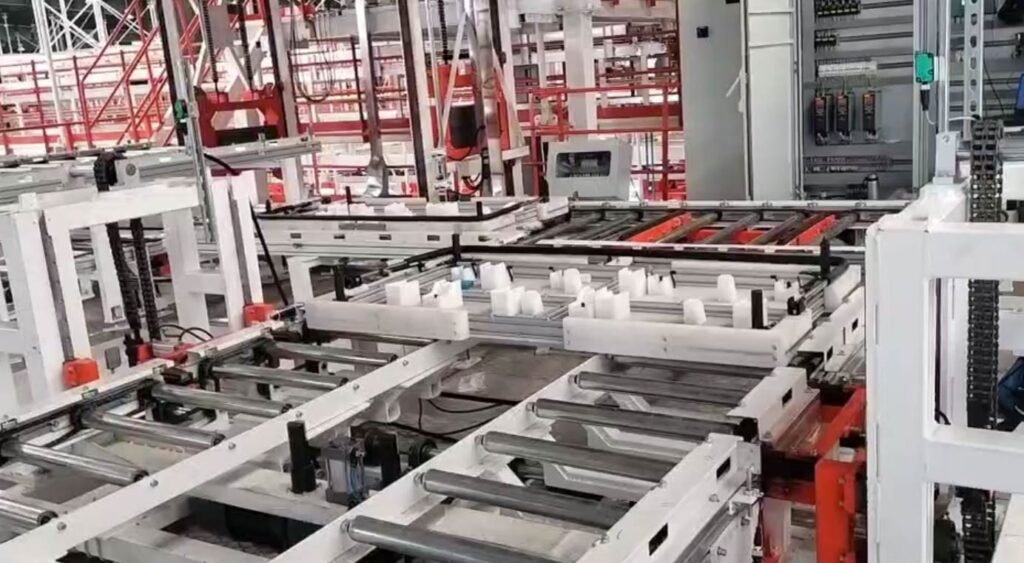
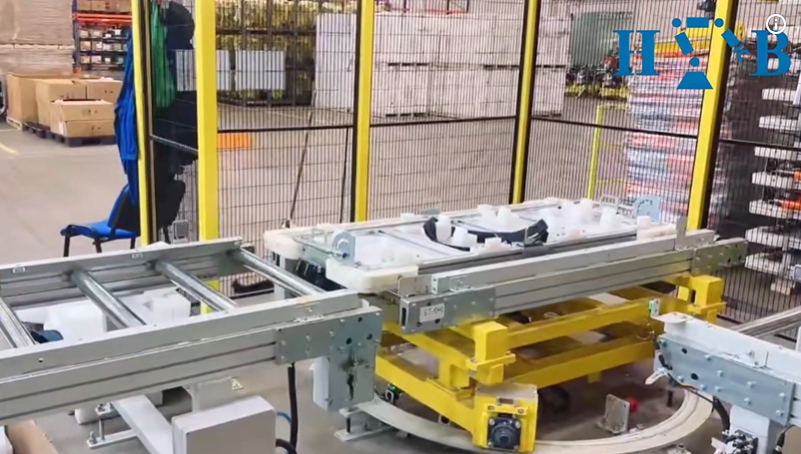
A cross transfer system is an automated material handling mechanism that moves a pallet, fixture, or workpiece from one conveyor line to another conveyor line in a direction perpendicular to the primary conveyor flow.
For example, a pallet may travel along Conveyor A. When it reaches the transfer station, the cross transfer mechanism moves it sideways onto Conveyor B.
The basic movement can therefore be represented as:
Main Conveyor → Cross Transfer → Parallel Conveyor
Unlike a conventional conveyor, the cross transfer mechanism must coordinate two different movement directions.
First, the pallet arrives at the transfer position. Then, the system establishes the correct position and moves the pallet laterally. After that, the receiving conveyor takes over transportation.
This arrangement provides a compact method for connecting parallel production routes.
Why Are Cross Transfer Systems Used in Automotive Manufacturing?
Automotive factories often have complex layouts because different processes require different equipment, access areas, buffer zones, and production routes.
A cross transfer system provides greater flexibility when designing these layouts.
Connecting Parallel Production Lines
Two parallel conveyors can be connected without requiring a long conveyor loop.
For example, a pallet may be transferred from an assembly lane to an inspection lane when a specific process requires additional testing.
Creating Production Bypass Routes
A production line may need to bypass a workstation under certain production conditions.
In this case, the cross transfer can move the pallet to an alternative conveyor path.
This is particularly useful when multiple product variants follow different process sequences.
Connecting Assembly and Inspection Areas
After an assembly process, selected pallets may need to enter an inspection or testing area.
A cross transfer can provide the physical connection between the assembly conveyor and the inspection conveyor.
Supporting Buffer Systems
Cross transfers can connect production lines with buffer conveyors.
As a result, pallets can be temporarily stored or accumulated without extending the main production conveyor excessively.
Connecting Forward and Return Conveyors
In a closed-loop pallet system, the production conveyor and empty pallet return conveyor may run in parallel.
A cross transfer can move pallets between these two circuits.
Cross Transfer vs. Transfer Machine
A cross transfer is a specific type of transfer machine.
The broader term transfer machine can refer to equipment that moves products or pallets between different positions using horizontal, vertical, rotary, or other movements.
A cross transfer system, by contrast, normally refers specifically to lateral movement between parallel conveyor lines.
Therefore, a cross transfer can be considered one configuration within the larger category of automated transfer equipment.
This distinction is useful when designing an automotive material handling system because the required movement determines the appropriate mechanical configuration.
Main Types of Cross Transfer Systems
Different mechanisms can be used depending on pallet weight, conveyor configuration, transfer distance, and cycle time.
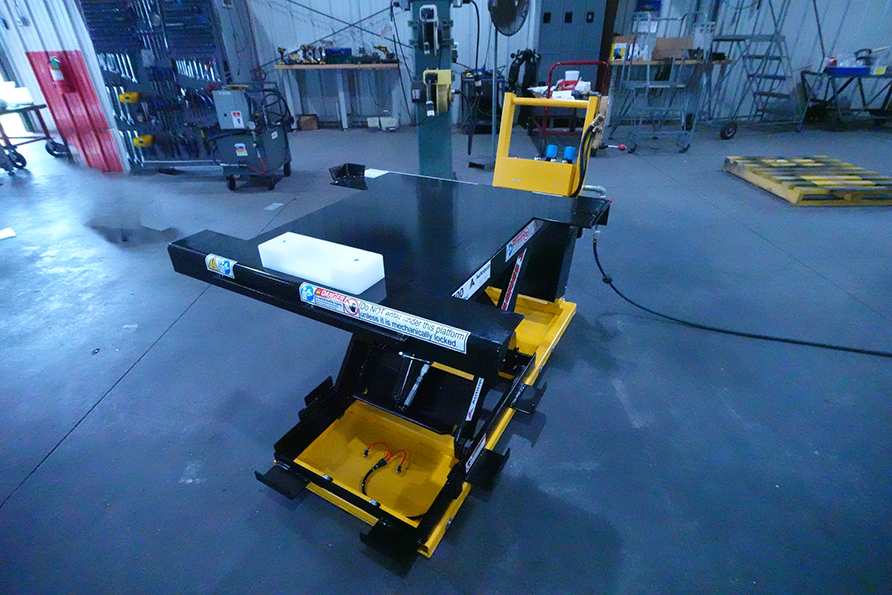
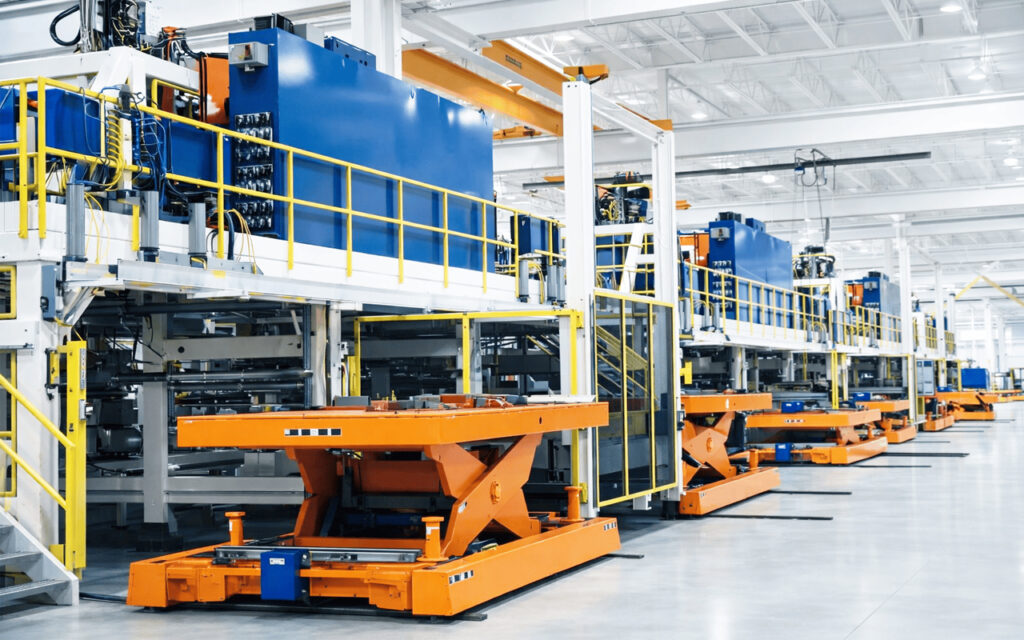
Lift-and-Transfer Cross Conveyor
A lift-and-transfer system raises the pallet above the original conveyor and then moves it horizontally.
The lifting action separates the pallet from the original transport path.
Once the pallet has reached the required height, the transfer mechanism moves it toward the receiving conveyor.
This configuration is suitable when the original and receiving conveyors have different operating levels.
Chain Cross Transfer
Chain-driven mechanisms can transfer pallets laterally between conveyor lines.
They are commonly used for relatively heavy automotive pallets because the chain can provide a robust load transfer method.
The chain configuration should be selected according to pallet support points and required transfer distance.
Roller Cross Transfer
Roller mechanisms can be used when the pallet has a suitable flat support surface.
The rollers can move the pallet laterally while maintaining relatively smooth transportation.
However, the pallet bottom structure must be compatible with the roller arrangement.
Fork-Type Cross Transfer
Fork mechanisms can engage the pallet from below and move it laterally.
This configuration can be useful when the pallet has defined fork access points.
The fork design must provide sufficient support during acceleration and deceleration.
Multi-Position Cross Transfer
Some systems need to transfer pallets to more than one parallel line.
In this situation, the transfer mechanism may have multiple stopping positions.
The PLC can select the destination according to the production sequence or pallet identification.
Main Components of a Cross Transfer System
Although the mechanical structure varies by application, several components are commonly used.
Transfer Frame
The frame supports the lifting and transfer mechanisms.
Because the equipment may handle heavy automotive pallets, the frame must maintain sufficient rigidity during repeated operation.
Lifting Mechanism
Some cross transfers must first raise the pallet away from the original conveyor.
The lifting mechanism can use:
- Pneumatic cylinders
- Electric actuators
- Servo systems
- Motor-driven mechanisms
The appropriate solution depends on pallet weight, lifting height, cycle time, and positioning requirements.
Lateral Transfer Mechanism
The lateral movement can be provided by:
- Chains
- Rollers
- Belts
- Forks
- Linear actuators
The mechanism should provide sufficient traction and support throughout the transfer.
Guides
Mechanical guides help maintain pallet alignment.
They are particularly important when the transfer distance is relatively long or when the pallet has a high center of gravity.
Positioning Stops
Stops establish the transfer start and end positions.
In addition, they can prevent the pallet from moving beyond the intended transfer area.
Sensors
Sensors confirm pallet presence and transfer status.
Typical sensors include:
- Photoelectric sensors
- Proximity sensors
- Position sensors
- Limit switches
- Pallet detection sensors
The PLC uses these signals to control the transfer sequence.
How a Cross Transfer System Works
A typical operating cycle includes several coordinated stages.
Step 1: Pallet Arrival
The pallet travels along the primary conveyor toward the cross transfer station.
A sensor detects the pallet.
Step 2: Pallet Positioning
The conveyor stops the pallet at the designated transfer position.
At this point, the PLC checks whether the receiving conveyor is available.
Step 3: Pallet Securing
If required, a stopper or locating mechanism secures the pallet before transfer.
This prevents unwanted movement during the lateral operation.
Step 4: Lifting
For lift-and-transfer configurations, the mechanism raises the pallet above the original conveyor.
Once the required lift position is confirmed, the lateral transfer can begin.
Step 5: Lateral Transfer
The transfer mechanism moves the pallet toward the receiving conveyor.
Sensors monitor the transfer position.
Step 6: Receiving Position Confirmation
The system confirms that the pallet has reached the receiving position.
The receiving conveyor must be ready before the pallet is released.
Step 7: Lowering
If the system uses a lifting mechanism, the pallet is lowered onto the receiving conveyor.
Step 8: Transfer Confirmation
The PLC confirms that the pallet is correctly positioned on the receiving conveyor.
After that, the cross transfer returns to its standby position.
Step 9: Conveyor Restart
The receiving conveyor transports the pallet to the next process.
This sequence ensures that the pallet does not enter the receiving conveyor before the transfer operation is complete.
Cross Transfer in Automotive Pallet Handling
Cross transfer systems are particularly useful when combined with pallet-based production.
A typical pallet handling layout may include:
Pallet Destacker → Main Conveyor → Assembly Station → Cross Transfer → Inspection Conveyor → Main Conveyor
The cross transfer provides a controlled connection between the different conveyor sections.
Meanwhile, another cross transfer can return the pallet to the main production route after inspection.
This creates a flexible material handling network without requiring every process to be arranged in a single straight line.
Cross Transfer for Engine Assembly Lines
Engine assembly lines may contain several specialized stations.
For example, a production line may include:
- Engine loading
- Component installation
- Press fitting
- Torque tightening
- Leak testing
- Inspection
- Functional testing
Not every engine needs to follow exactly the same route.
For example, a specific engine variant may require an additional inspection process.
The cross transfer can move that pallet to a parallel inspection conveyor while other pallets continue through the standard production route.
This arrangement supports flexible production without requiring a completely separate production line.
Cross Transfer for Transmission Assembly
Transmission assembly can also benefit from lateral pallet movement.
A transmission pallet may travel through the main assembly line and then be transferred to a dedicated testing area.
After the test, the pallet can return to the main production route.
As a result, the testing process can operate in parallel with assembly without significantly extending the main conveyor.
Cross Transfer for Axle Assembly
Axle and driveline production often involves relatively heavy components.
The cross transfer must therefore be designed according to the combined weight of:
- Product
- Pallet
- Fixture
- Additional tooling
Furthermore, the center of gravity should be considered because an uneven load can affect transfer stability.
For heavy-duty applications, robust frames and high-capacity transfer mechanisms may be required.
Cross Transfer for EV Powertrain Production
Electric motors, reducers, and electric drive units can also be transported using dedicated pallets.
A cross transfer can connect assembly, inspection, testing, and buffer areas.
For example:
Assembly → Cross Transfer → Inspection → Cross Transfer → Functional Test
This arrangement allows individual processes to be organized in parallel.
Therefore, the production line can make better use of available factory space while maintaining controlled pallet circulation.
Cross Transfer and Robotic Workstations
Robotic workstations may be positioned alongside the main conveyor rather than directly on the main production path.
A cross transfer can move the pallet into the robot’s working area.
After the robot completes the operation, another transfer mechanism can return the pallet to the main conveyor.
This arrangement can be useful when the robot requires additional operating space or when several robotic cells share a common material handling system.
Cross Transfer and Lift-and-Locate Systems
Cross transfer and lift-and-locate systems perform different functions.
The cross transfer changes the pallet’s transportation route.
The lift-and-locate system establishes the pallet’s precise process position.
They can therefore be used together.
A typical sequence is:
Main Conveyor → Cross Transfer → Workstation Conveyor → Stopper → Lift-and-Locate → Assembly Process
In this configuration, the cross transfer determines where the pallet goes, while the lift-and-locate unit determines how accurately it is positioned for processing.
Cross Transfer and Pallet Stackers
A cross transfer can also connect the production conveyor to a pallet storage system.
For example:
Production Conveyor → Cross Transfer → Empty Pallet Return → Pallet Stacker
After the product is unloaded, the empty pallet can be moved laterally to the return conveyor.
The pallet stacker can then accumulate multiple empty pallets vertically.
Later, a pallet destacker can release individual pallets back into the production system.
This creates a complete closed-loop pallet circulation system.
PLC Control and Interlocking
The PLC controls the cross transfer and coordinates it with the surrounding conveyors.
Typical control signals include:
- Pallet present
- Transfer ready
- Receiving conveyor ready
- Lift-up position
- Lift-down position
- Transfer position
- Pallet transferred
- Safety circuit status
- Machine fault
The PLC should prevent the cross transfer from operating if the receiving conveyor is unavailable.
Similarly, the receiving conveyor should not start moving the pallet until the transfer operation has been confirmed.
This interlocking helps prevent pallet collisions and transfer errors.
RFID and Pallet Identification
When several production routes are available, pallet identification can improve process control.
An RFID tag can be installed on the pallet.
The system can identify the pallet before the transfer station and determine its required destination.
For example, Product A may need to move to Inspection Line 1, while Product B may continue directly to the next assembly station.
The PLC or higher-level control system can use the pallet ID to determine the appropriate transfer route.
Cross Transfer and MES Integration
An advanced cross transfer system can exchange production information with MES.
The system may communicate information such as:
- Pallet ID
- Product ID
- Current station
- Transfer status
- Production route
- Inspection status
- Error status
As a result, the physical pallet movement can be coordinated with the digital production record.
However, the exact communication architecture should be determined according to the customer’s MES platform and factory automation standards.
Cycle Time Requirements
Cycle time is an important parameter when selecting a cross transfer.
The complete transfer cycle may include:
- Pallet arrival
- Conveyor stop
- Pallet securing
- Lifting
- Lateral transfer
- Position confirmation
- Lowering
- Pallet release
- Transfer mechanism reset
The actual transfer movement may take only a few seconds. However, the complete cycle must also include positioning, sensor confirmation, and communication with the surrounding equipment.
Therefore, the cross transfer should be evaluated according to the complete production cycle rather than only the lateral movement speed.
Load Capacity and Center of Gravity
Automotive pallets can carry relatively heavy products and fixtures.
The cross transfer must therefore be designed according to the maximum operating load.
Important parameters include:
- Pallet weight
- Product weight
- Fixture weight
- Total load
- Load distribution
- Center of gravity
- Acceleration
- Transfer distance
In particular, an off-center load can create additional forces during acceleration and deceleration.
For this reason, load distribution should be considered during mechanical design.
Transfer Accuracy
Transfer accuracy is important when the receiving conveyor connects directly to a precision workstation.
The pallet must arrive within the acceptable position range.
Guide rails, mechanical stops, locating components, and sensors can be used to improve positioning.
If higher precision is required, the cross transfer can be combined with a dedicated locating mechanism after the pallet reaches the receiving conveyor.
This allows the transfer mechanism to focus on transportation while the positioning system handles process accuracy.
Safety Considerations
Cross transfer equipment contains moving mechanisms that can create pinch and collision hazards.
Safety measures may include:
- Safety fencing
- Interlocked access doors
- Emergency stop buttons
- Safety light curtains
- Safety scanners
- Mechanical travel limits
- Anti-drop mechanisms
- Safety PLC
- Warning indicators
In addition, the safety system should consider the adjacent conveyors and production equipment.
For example, access to the transfer area should be restricted while the mechanism is moving.
The final safety design should be based on a machine risk assessment and the applicable customer and market requirements.
Maintenance of Cross Transfer Systems
Regular maintenance is important because cross transfers typically perform repeated movement cycles.
Key maintenance points include:
- Transfer chains
- Rollers
- Bearings
- Guide rails
- Lifting components
- Motors
- Gearboxes
- Pneumatic cylinders
- Sensors
- Mechanical stops
- Fasteners
- Safety devices
Over time, mechanical wear can affect transfer accuracy.
Therefore, maintenance personnel should periodically inspect alignment, chain tension, lubrication, sensor position, and fastening conditions.
For high-cycle production lines, maintenance intervals should be linked to actual operating cycles whenever practical.
Common Cross Transfer Problems
Pallet Does Not Transfer Completely
This may result from insufficient drive force, incorrect pallet support, mechanical obstruction, or incorrect positioning.
Pallet Misalignment
Misalignment can occur when guides are incorrectly adjusted or pallet dimensions vary beyond the expected tolerance.
Transfer Collision
A collision may occur if the receiving conveyor is not ready or if the control signals are not properly interlocked.
Sensor Detection Errors
Incorrect sensor alignment or contamination can cause the PLC to receive an incorrect pallet position signal.
Excessive Mechanical Wear
High cycle rates, poor lubrication, incorrect alignment, or excessive load can accelerate wear on chains, rollers, bearings, and guides.
For this reason, preventive maintenance should be incorporated into the production line management plan.
How to Select a Cross Transfer System
Before selecting a cross transfer, automotive manufacturers should define the complete application.
Important parameters include:
- Pallet dimensions
- Pallet weight
- Product weight
- Fixture weight
- Maximum load
- Center of gravity
- Transfer distance
- Conveyor height
- Transfer direction
- Required cycle time
- Positioning accuracy
- Number of destination conveyors
- Product variants
- PLC architecture
- Safety requirements
Once these parameters are defined, the appropriate transfer mechanism and drive technology can be selected.
Customized Cross Transfer Solutions from Hongbo Automation
Cross transfer equipment is normally customized because conveyor layouts, pallet dimensions, product weights, and production routes vary between automotive factories.
Hongbo Automation develops automated material handling and transfer equipment for automotive assembly and component production lines.
A cross transfer system can be designed according to:
- Pallet dimensions
- Product and fixture weight
- Conveyor height
- Transfer distance
- Production takt time
- Required transfer accuracy
- Number of conveyor lines
- Production routing
- PLC architecture
- RFID requirements
- MES communication
- Safety requirements
The equipment can also be integrated with pallet conveyors, pallet stackers, pallet destackers, lift-and-locate systems, robotic workstations, inspection stations, and other automotive assembly equipment.
As a result, the cross transfer becomes part of a complete automated material handling solution rather than a standalone conveyor component.
Conclusion
Cross transfer systems provide an effective method for moving automotive pallets between parallel conveyor lines.
They are particularly useful when a production facility requires flexible routing, inspection bypasses, parallel processing, buffer connections, or closed-loop pallet circulation.
Because automotive pallets can carry heavy products and dedicated fixtures, the transfer system must be designed according to the actual load, center of gravity, cycle time, conveyor interface, and positioning requirements.
When integrated with pallet conveyors, lift-and-locate systems, stackers, destackers, RFID, PLC controls, and MES, cross transfer equipment can provide a flexible foundation for automated material handling.
For automotive manufacturers and component suppliers, a properly engineered cross transfer system can simplify production line layouts while maintaining reliable pallet flow between different manufacturing processes.
Frequently Asked Questions
What is a cross transfer system?
A cross transfer system is an automated mechanism that moves pallets or products laterally between parallel conveyor lines.
What is the difference between a cross transfer and a conveyor?
A conveyor normally transports a product along its primary direction. In contrast, a cross transfer changes the product’s transportation route, usually by moving it perpendicular to the original conveyor direction.
Where are cross transfers used in automotive manufacturing?
They can be used between assembly lines, inspection stations, testing areas, buffer conveyors, robotic cells, and empty pallet return systems.
Can a cross transfer handle heavy automotive pallets?
Yes. The frame, drive system, lifting mechanism, and transfer components can be engineered according to the combined weight of the pallet, fixture, and product.
Can a cross transfer connect multiple production lines?
Yes. Depending on the mechanical configuration, one transfer system can serve multiple parallel conveyor destinations.
Can RFID control the transfer route?
Yes. RFID can identify the pallet, while the PLC or higher-level control system can use that information to determine the required production route.
Can a cross transfer work with a lift-and-locate system?
Yes. The cross transfer can move the pallet to the required conveyor, while the lift-and-locate system provides the final positioning required for assembly or inspection.
Does Hongbo manufacture customized cross transfer equipment?
Yes. Hongbo Automation can design cross transfer systems according to pallet specifications, load requirements, conveyor layout, cycle time, transfer distance, control architecture, and production requirements.