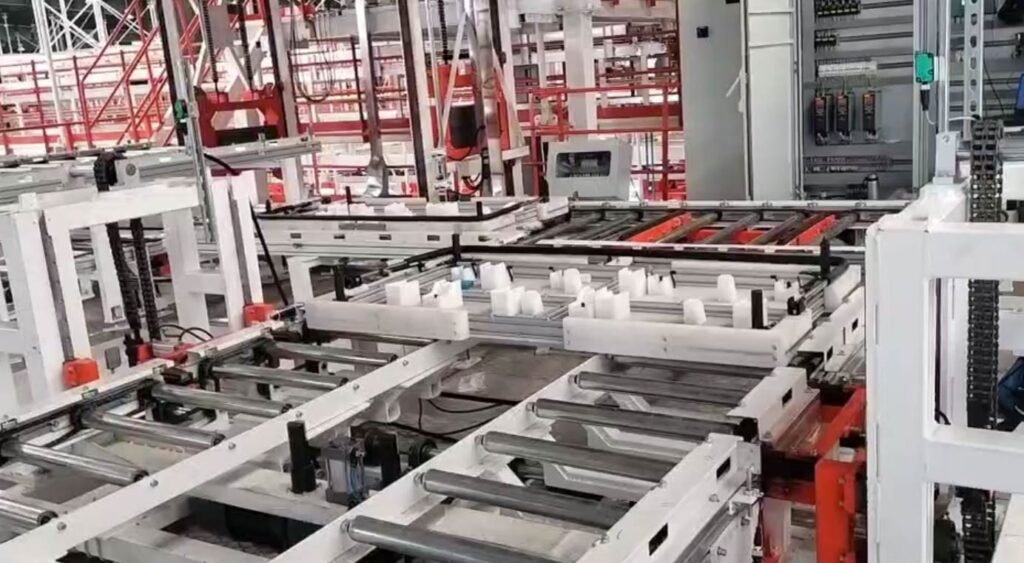
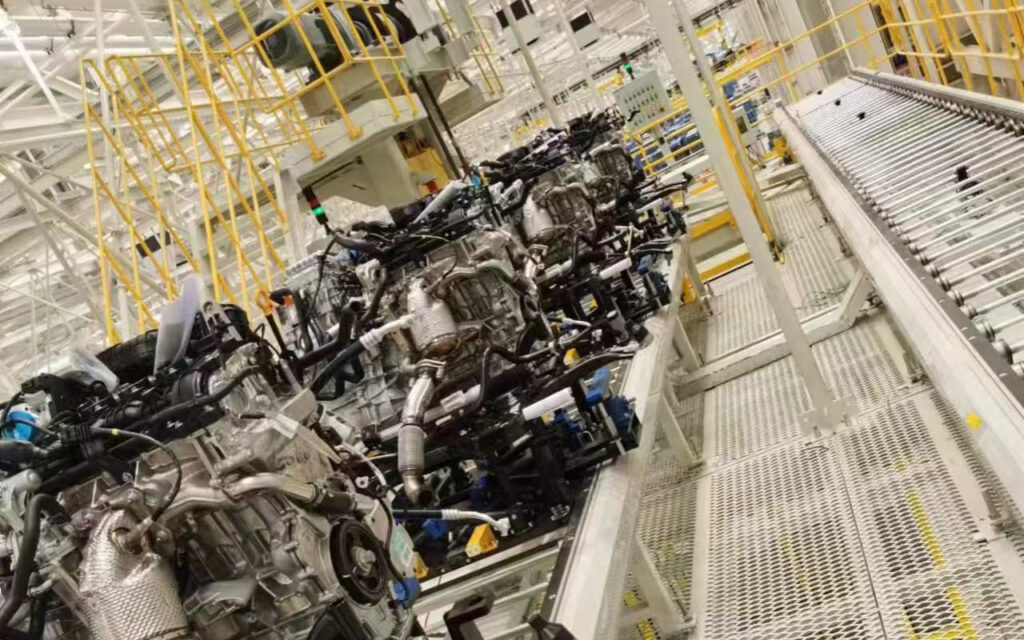
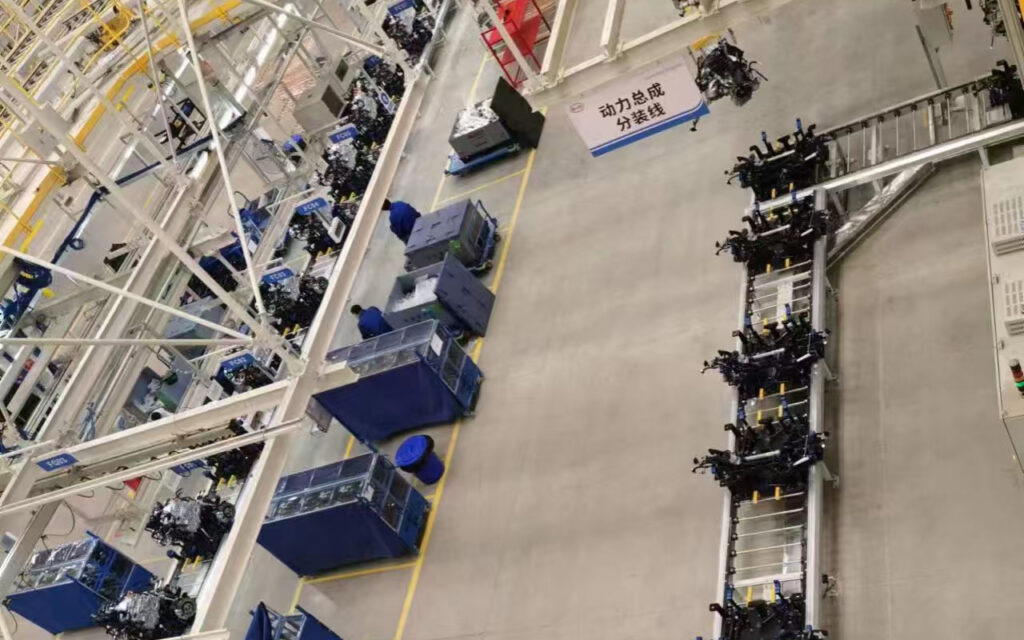
Pallet handling is an important part of automated automotive assembly. When production lines use reusable pallets to carry components and fixtures between workstations, the pallets must be supplied to the production line at the required rate and in the correct position.
A pallet destacker system automatically separates individual pallets from a vertical stack and transfers them into the production line. This allows multiple pallets to be stored in a compact area while providing a controlled supply of pallets to downstream equipment.
In automotive manufacturing, pallet destackers are commonly integrated with pallet conveyors, transfer machines, lift-and-locate systems, assembly stations, inspection equipment, and PLC-based control systems.
The equipment must be designed around the actual pallet dimensions, pallet weight, fixture configuration, required cycle time, stacking method, and production line layout.
What Is a Pallet Destacker System?
A pallet destacker is an automated machine that separates pallets from a stacked group and supplies them individually to a conveyor or production station.
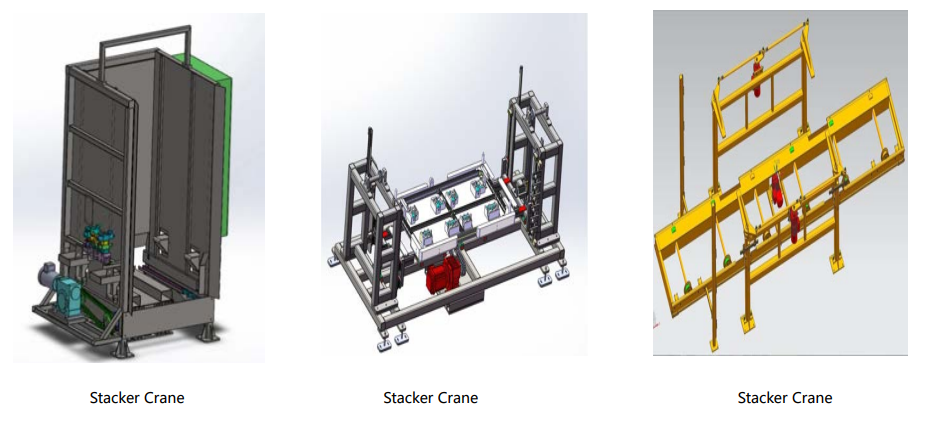
A typical pallet destacker performs three basic functions:
- Receive or hold a stack of pallets.
- Separate one pallet from the stack.
- Transfer the separated pallet into the production flow.
The destacking process can be performed using lifting mechanisms, forks, grippers, chains, rollers, or other mechanical arrangements.
The appropriate mechanism depends on the pallet structure and the required production cycle.
A typical pallet destacker may include:
- Structural frame
- Pallet storage area
- Lifting mechanism
- Separation mechanism
- Pallet transfer mechanism
- Rollers or chains
- Mechanical guides
- Positioning devices
- Sensors
- Motor or pneumatic actuators
- PLC control system
- Safety protection
The complete machine is normally designed as part of the pallet handling system rather than as an isolated piece of equipment.
Why Are Pallet Destackers Used in Automotive Manufacturing?
Automotive production lines often require a continuous supply of pallets or fixture carriers.
Manual pallet loading can introduce additional labor requirements and can make pallet supply dependent on operator availability.
An automated pallet destacker provides a controlled method for feeding pallets into the production system.
Automated Pallet Feeding
A stack of pallets can be prepared in advance and loaded into the destacker.
The machine then releases pallets individually according to the production requirement.
This allows the pallet supply process to operate together with the automated production line.
Reduced Manual Handling
The destacker eliminates the need for operators to repeatedly separate and place individual pallets onto the conveyor.
This is particularly useful when pallets are heavy or when the production cycle requires frequent pallet feeding.
Space-Efficient Pallet Storage
Vertical pallet stacking allows several pallets to occupy a relatively small floor area.
The destacker converts the vertical stack into a controlled horizontal pallet flow.
Stable Production Flow
The pallet destacker can communicate with downstream equipment and release a pallet only when the receiving station is ready.
This helps prevent unnecessary pallet accumulation and reduces the possibility of conveyor congestion.
Pallet Destacker vs. Pallet Stacker
A pallet stacker and pallet destacker perform complementary functions.
A pallet stacker collects individual pallets and forms a vertical stack.
A pallet destacker separates pallets from a stack and feeds them individually into the production line.
In a closed-loop pallet system, both machines may be used.
A simplified material flow can be represented as:
Production Line → Empty Pallet Return → Pallet Stacker → Pallet Storage → Pallet Destacker → Production Line
The stacker handles pallet accumulation, while the destacker handles pallet supply.
Depending on the factory layout, the two systems may be installed in different areas of the production line.
Pallet Destacker Applications in Automotive Production
Pallet destackers can support many types of automotive assembly and component production.
Engine Assembly
Engine components or partially assembled engines may be carried on dedicated pallets through multiple assembly processes.
When an empty pallet is returned, the pallet handling system can stack it for storage. A destacker can later supply individual pallets back to the engine assembly line.
Transmission Assembly
Transmission housings, gear assemblies, shafts, and other components can be mounted on dedicated fixtures.
The pallet destacker can supply empty carrier pallets to the production line before the next assembly cycle.
Axle and Driveline Assembly
Large automotive assemblies may require robust pallets with dedicated fixtures.
Because these pallets can be relatively heavy, automated pallet feeding can reduce manual handling.
Steering and Suspension Component Assembly
Component assembly lines may use smaller fixture pallets.
A destacker can automatically supply pallets to the production line and coordinate pallet availability with the upstream and downstream stations.
EV Powertrain Assembly
Electric motors, reducers, and electric drive units can also be transported using dedicated pallets.
The pallet handling system can be designed according to the product’s dimensions, fixture requirements, and production sequence.
Main Components of a Pallet Destacker
The design of the destacker depends on the pallet and production requirements.
Structural Frame
The frame supports the pallet stack and handling mechanisms.
It must be capable of supporting the maximum stack weight while maintaining alignment during repeated operation.
For automotive applications, structural rigidity is important because small frame deformation can affect pallet positioning.
Pallet Separation Mechanism
The separation mechanism is the core of the destacker.
Its function is to separate one pallet from the stack without disturbing the remaining pallets.
Possible mechanisms include:
- Fork mechanisms
- Lifting plates
- Pneumatic clamps
- Mechanical fingers
- Servo-driven lifting mechanisms
- Chain-driven transfer mechanisms
The appropriate design depends on how the pallets are constructed and how they contact each other when stacked.
Lifting Mechanism
A lifting system may be used to position the pallet stack at the required separation height.
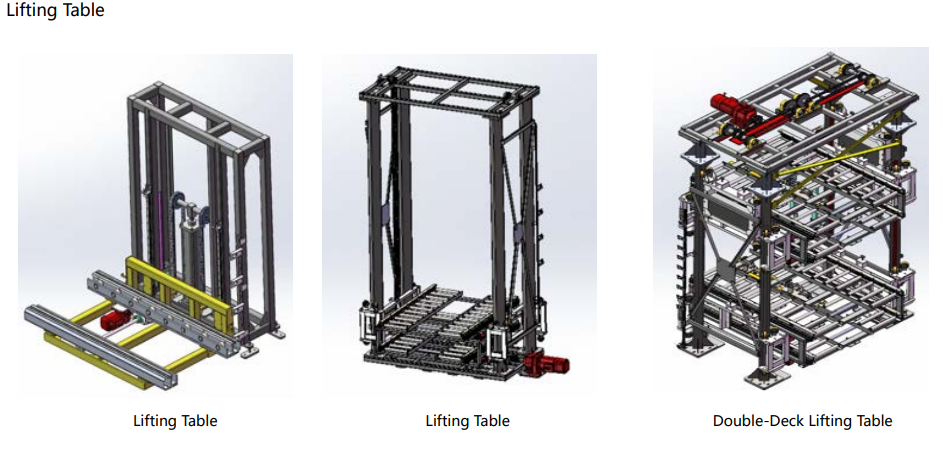
Possible drive technologies include:
- Servo motor
- Geared motor
- Pneumatic cylinder
- Hydraulic cylinder
- Electric actuator
The drive system should be selected according to pallet weight, lifting height, required speed, and cycle frequency.
Pallet Transfer Mechanism
After separation, the individual pallet needs to be transferred into the production line.
Rollers, chains, belts, or other mechanisms may be used depending on the pallet design.
The transfer mechanism should maintain stable pallet movement and prevent unintended rotation or lateral displacement.
Guides and Locating Devices
Guides help maintain pallet alignment during lifting and transfer.
Mechanical stops and locating components can establish the correct pallet position before it enters the conveyor system.
Sensors
Sensors confirm the position and status of pallets.
Typical sensors include:
- Photoelectric sensors
- Proximity sensors
- Limit switches
- Position sensors
- Stack-height sensors
- Pallet presence sensors
The PLC uses these signals to determine when the next operation can begin.
How a Pallet Destacker Works
A typical automatic pallet destacking cycle consists of several stages.
Step 1: Pallet Stack Loading
A stack of pallets is placed into the designated storage position.
The loading method may be manual, forklift-based, or connected to another automated handling system.
Step 2: Stack Detection
Sensors confirm the presence and position of the pallet stack.
The PLC checks whether the machine is ready to begin the destacking sequence.
Step 3: Pallet Positioning
The lifting or positioning mechanism moves the pallet stack to the required separation position.
Step 4: Pallet Separation
The separation mechanism supports or holds the upper pallets while allowing the bottom pallet, or designated individual pallet, to be released.
The exact sequence depends on the mechanical design.
Step 5: Individual Pallet Transfer
The separated pallet is transferred onto the downstream conveyor.
The transfer system confirms that the pallet has reached the required position.
Step 6: Position Confirmation
Sensors verify that the pallet has left the destacker correctly.
If the pallet is not detected at the expected position, the PLC can stop the sequence and generate an alarm.
Step 7: Next Pallet Cycle
The remaining pallet stack is repositioned and the next pallet is prepared for separation.
The process continues until the stack is empty or the production line no longer requires another pallet.
Pallet Separation Methods
Different pallet structures require different separation methods.
Fork-Type Separation
Fork mechanisms support pallets at defined locations.
The fork can move into a suitable opening beneath the pallet and lift or support it during the separation process.
This method requires the pallet to have compatible structural features.
Clamp-Type Separation
Clamping mechanisms can hold the pallet at specific contact points.
They can be pneumatic or electrically actuated depending on the required cycle and control architecture.
The contact surfaces should be designed to avoid pallet damage.
Lift-and-Transfer Separation
A lifting platform can raise the pallet stack to a specified height while a transfer mechanism moves the individual pallet.
This configuration can provide controlled movement when precise pallet positioning is required.
Mechanical Finger Separation
Mechanical fingers can engage dedicated pallet features and separate pallets from the stack.
This method can be compact, but the pallet geometry must be carefully considered during equipment design.
Pallet Design Requirements
Pallet destacking performance depends heavily on pallet design.
Important parameters include:
- Overall dimensions
- Pallet weight
- Bottom structure
- Stacking interfaces
- Fork access
- Guide surfaces
- Locating holes
- Contact points
- Surface condition
- Maximum deformation
If pallets are not designed for reliable stacking and separation, even a well-engineered destacker may experience operating problems.
For new production projects, pallet design and destacker design should therefore be developed together.
Pallet Fixture Considerations
Automotive pallets often carry dedicated fixtures rather than products directly.
The fixture may include:
- Locating pins
- Clamps
- Supports
- Product-specific nests
- Identification components
- Sensor targets
If the pallet remains empty during destacking, the machine only needs to handle the pallet.
If the fixture remains attached to the pallet, the destacker must be designed for the combined pallet and fixture configuration.
The center of gravity and total height should also be considered.
Pallet Destacker and Pallet Conveyor Integration
The destacker normally connects directly to a pallet conveyor.
A typical configuration is:
Pallet Stack → Destacker → Pallet Conveyor → Production Workstation
The conveyor may use rollers, chains, belts, or another suitable transport mechanism.
The interface between the destacker and conveyor must account for:
- Conveyor height
- Pallet dimensions
- Transfer direction
- Pallet support points
- Conveyor speed
- Required positioning
- Product clearance
A mechanical mismatch at this interface can result in pallet jams or positioning errors.
Pallet Destacker and Transfer Machine Integration
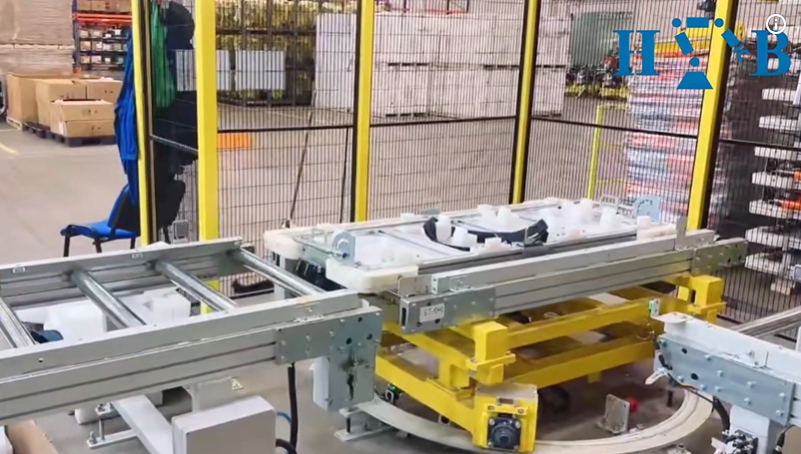
A transfer machine can be used when the pallet must change direction or move between different conveyor sections.
For example:
Pallet Destacker → Pallet Conveyor → Transfer Machine → Assembly Line
The destacker supplies the pallet.
The conveyor transports it to the transfer point.
The transfer machine moves it to another production line or conveyor.
This configuration is useful when the factory layout requires multiple production routes.
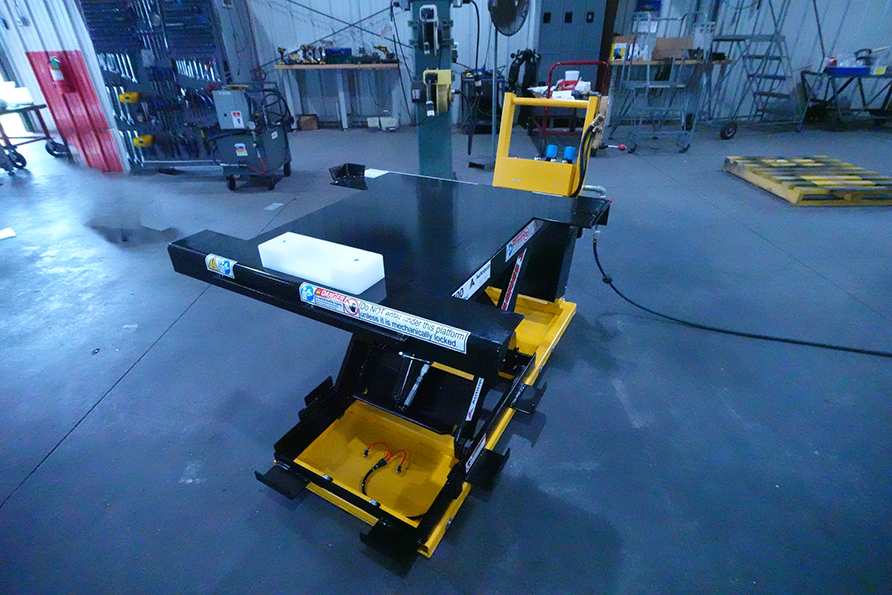
Pallet Destacker and Lift-and-Locate Integration
The destacker normally handles pallet feeding, while the lift-and-locate system handles precision positioning at the workstation.
A typical production sequence may be:
Destacker → Pallet Conveyor → Stopper → Lift-and-Locate → Assembly Operation
The pallet is transported until it reaches the workstation.
The stopper establishes the approximate position.
The lift-and-locate mechanism then raises and precisely locates the pallet for the assembly process.
This separation of transportation and precision positioning is common in automated assembly systems.
Pallet Destacker and Robotic Assembly
Robotic assembly requires a stable and repeatable product position.
The pallet destacker itself does not normally provide final robot positioning. Instead, it supplies the pallet to the production line.
Once the pallet reaches the robotic workstation, a dedicated fixture or lift-and-locate system can establish the required reference.
This arrangement allows each machine to perform a clearly defined function:
- Destacker: pallet supply
- Conveyor: pallet transport
- Positioning system: precise locating
- Robot: assembly operation
- Inspection system: quality verification
PLC Control Architecture
The pallet destacker is typically controlled by a PLC.
The PLC manages the machine sequence and exchanges status information with surrounding equipment.
Typical signals include:
- Pallet present
- Stack available
- Destacker ready
- Pallet separation complete
- Conveyor ready
- Downstream station ready
- Lift position
- Safety circuit status
- Machine fault
The PLC can prevent the destacker from releasing a pallet if the downstream conveyor is occupied.
This helps maintain controlled pallet flow.
Sensor-Based Control
Reliable pallet detection is essential for automatic operation.
Sensors may be installed at several locations to confirm:
- Stack presence
- Pallet position
- Pallet separation
- Conveyor arrival
- Transfer completion
- Lift position
Sensor redundancy may be considered for critical positions.
For example, a pallet may need to be confirmed at both the destacker output and conveyor input before the next cycle begins.
Pallet Identification and Traceability
In production environments where pallets carry different fixtures or products, identification can be useful.
RFID or barcode systems can identify individual pallets or carriers.
The control system can then associate the pallet with information such as:
- Pallet ID
- Product model
- Fixture type
- Production order
- Current workstation
- Process status
When connected to an MES, this information can contribute to production traceability.
The actual implementation depends on the customer’s control and information system architecture.
Cycle Time Requirements
Pallet destacker cycle time must be compatible with production demand.
For a high-volume automotive line, the destacker may need to supply pallets at short intervals.
The complete cycle should include:
- Pallet detection
- Positioning
- Separation
- Lifting
- Transfer
- Confirmation
- Reset
The design should ensure that the destacker does not become a bottleneck in the overall pallet circulation system.
If the downstream process requires one pallet every 20 seconds, for example, the pallet feeding system must have sufficient capacity to meet that demand under actual operating conditions.
Buffer Capacity
The number of pallets stored in the destacker or associated buffer should be determined from the production process.
A larger buffer can provide greater independence between pallet preparation and production consumption.
However, excessive buffer capacity increases equipment size and may not provide meaningful production benefits.
Capacity should therefore be calculated from:
- Production takt time
- Pallet consumption rate
- Pallet return rate
- Shift requirements
- Planned downtime
- Buffer strategy
- Factory space
Safety Design
Pallet destackers involve vertical movement and potentially heavy loads.
The equipment should therefore incorporate appropriate safeguarding.
Depending on the design, this may include:
- Safety fencing
- Interlocked doors
- Emergency stop devices
- Safety light curtains
- Safety scanners
- Mechanical travel limits
- Load monitoring
- Anti-drop mechanisms
- Safety PLC
- Controlled restart
The exact safety architecture should be determined through a machine risk assessment and according to the applicable requirements in the destination market.
Maintenance of Pallet Destackers
Regular maintenance is necessary for stable pallet separation.
Important inspection points include:
- Lifting mechanism
- Separation fingers or forks
- Chains
- Rollers
- Bearings
- Guides
- Sensors
- Pneumatic components
- Motors
- Gearboxes
- Fasteners
- Safety devices
Wear on mechanical separation components can affect pallet positioning and increase the risk of failed separation.
Sensor alignment should also be checked because incorrect detection can interrupt the automatic sequence.
Common Pallet Destacker Problems
Several problems can occur if the machine is not correctly matched to the pallet.
Pallets Fail to Separate
Possible causes include insufficient clearance, damaged pallet surfaces, incorrect separation height, or pallet deformation.
Pallet Misalignment
Misalignment can result from incorrect guide adjustment, worn components, or inconsistent pallet dimensions.
Pallet Jamming
Jamming may occur when the pallet does not enter the conveyor correctly or when the transfer height is incorrect.
Sensor Detection Errors
Dirty, damaged, or incorrectly positioned sensors can cause false detection or failure to detect a pallet.
Excessive Mechanical Wear
Incorrect chain tension, inadequate lubrication, misalignment, or excessive load can accelerate component wear.
These issues should be considered during both mechanical design and commissioning.
How to Select a Pallet Destacker
Before specifying a pallet destacker, automotive manufacturers should define the complete pallet handling requirement.
Important parameters include:
- Pallet length and width
- Pallet height
- Pallet weight
- Maximum stack height
- Number of pallets per stack
- Required destacking cycle time
- Conveyor height
- Pallet transfer direction
- Fixture configuration
- Required positioning accuracy
- Available installation space
- PLC and communication requirements
- Product traceability requirements
- Safety requirements
- Maintenance access
Providing accurate information at the beginning of the project allows the equipment supplier to select an appropriate separation and transfer mechanism.
Custom Pallet Destacker Systems from Hongbo Automation
Automotive pallet systems are often application-specific because pallet dimensions, fixtures, production processes, and factory layouts vary between manufacturers.
Hongbo Automation develops customized pallet handling equipment for automotive assembly and automotive component production lines.
A pallet destacker can be designed according to:
- Pallet dimensions
- Pallet weight
- Stack capacity
- Production takt time
- Conveyor height
- Pallet transfer direction
- Fixture configuration
- Positioning requirements
- PLC architecture
- RFID or barcode identification
- MES integration
- Safety requirements
The destacker can be integrated with pallet conveyors, transfer machines, lift-and-locate systems, robotic workstations, inspection equipment, and other production line equipment.
The objective is to create a coordinated pallet circulation system rather than a standalone pallet handling machine.
Conclusion
Pallet destacker systems provide an automated method for separating and feeding pallets into automotive production lines.
They are particularly useful where reusable pallets and dedicated fixtures are circulated between multiple assembly, inspection, and testing stations.
The performance of a destacker depends on accurate matching between the machine and the pallet. Pallet geometry, weight, stacking characteristics, separation method, transfer mechanism, cycle time, sensor arrangement, and control architecture all need to be considered during the engineering process.
When integrated with pallet conveyors, transfer machines, lift-and-locate systems, robots, and MES-based production tracking, a pallet destacker can become an important part of an automated automotive material handling system.
For automotive manufacturers and component suppliers, a customized pallet destacking solution can provide controlled pallet feeding while reducing manual handling and supporting continuous production.
Frequently Asked Questions
What is a pallet destacker?
A pallet destacker is an automated machine that separates individual pallets from a vertical stack and transfers them into a production or material handling system.
What is the difference between a pallet stacker and destacker?
A pallet stacker combines individual pallets into a vertical stack, while a pallet destacker separates pallets from a stack and supplies them individually.
Where are pallet destackers used in automotive manufacturing?
They can be used in engine, transmission, axle, steering, suspension, powertrain, EV component, and other automated assembly applications where reusable pallets are circulated through production.
Can a pallet destacker handle heavy pallets?
Yes. The lifting and separation mechanisms can be engineered for heavy pallets and fixtures. The frame, drive system, guides, and safety components must be sized according to the actual load.
Can a pallet destacker work with a pallet conveyor?
Yes. A destacker can be directly integrated with roller, chain, or other pallet conveyor systems, provided that the mechanical and control interfaces are properly designed.
Can different pallet types be handled?
This depends on the equipment configuration. Multiple pallet types may require adjustable guides, different programs, pallet identification, or separate handling positions.
Can a pallet destacker be integrated with MES?
Yes. When equipped with RFID or barcode identification, the pallet handling system can exchange pallet status and identification information with an MES or other production management system.
Does Hongbo manufacture customized pallet destackers?
Yes. Hongbo Automation can develop pallet destacker systems according to pallet specifications, production cycle, conveyor layout, fixture requirements, PLC architecture, safety requirements, and other project-specific conditions.