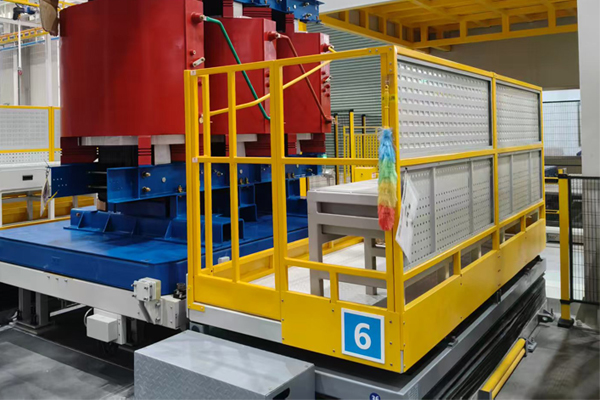
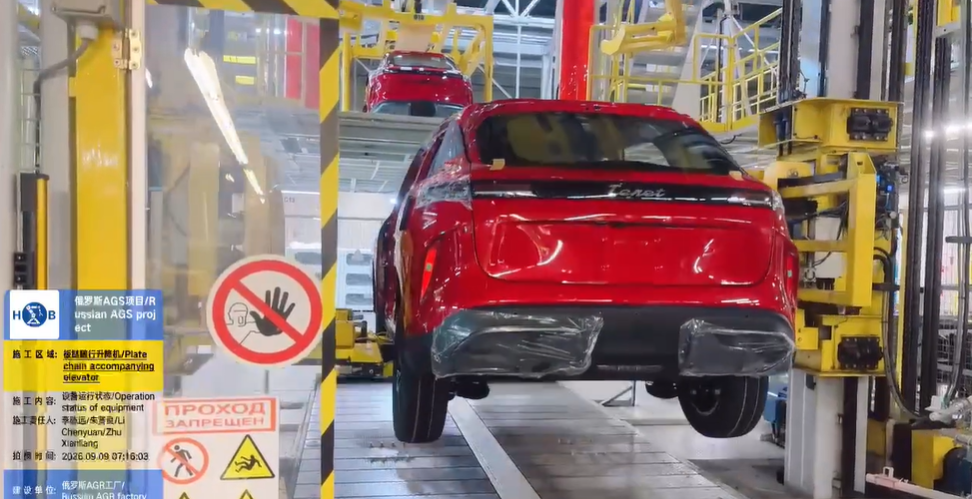
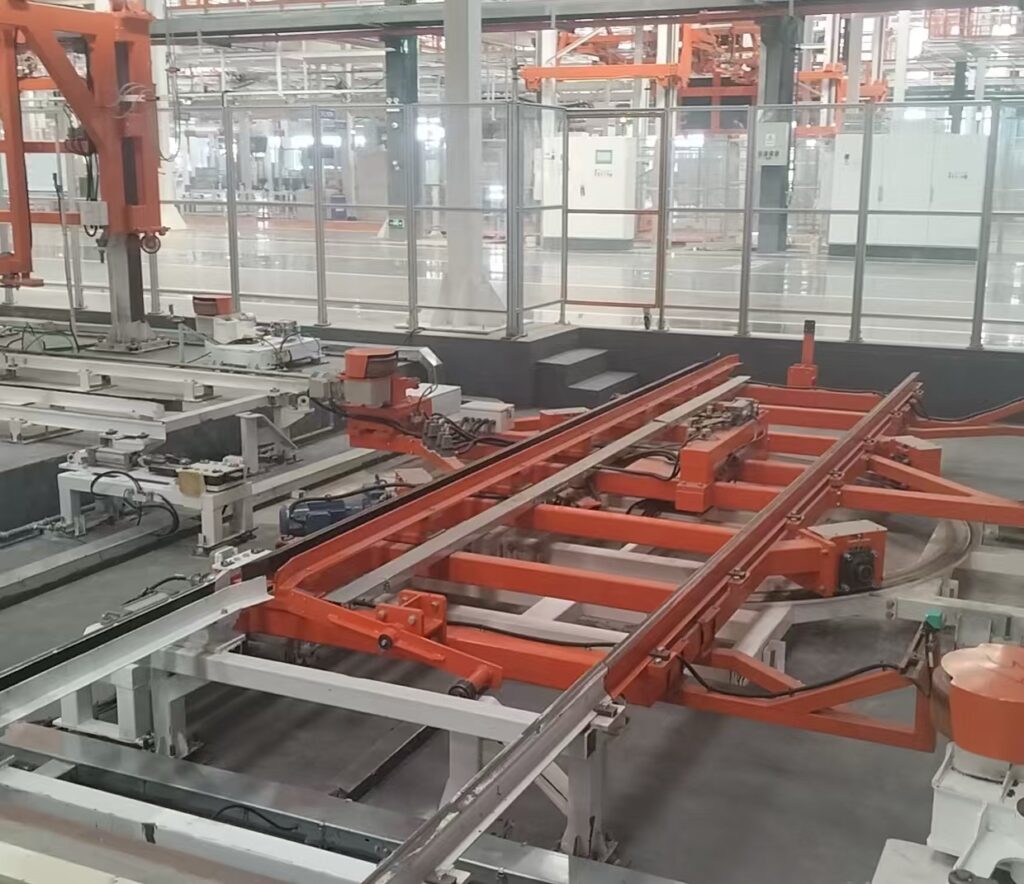
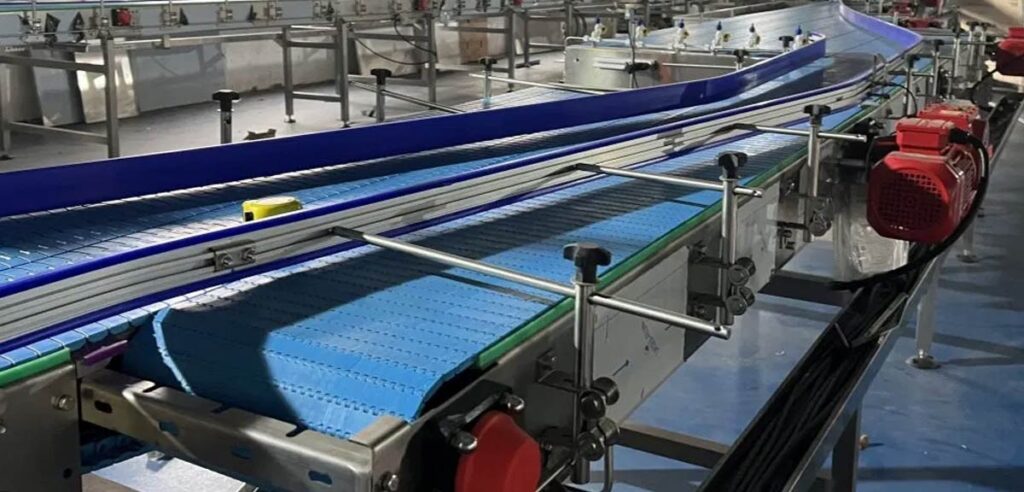
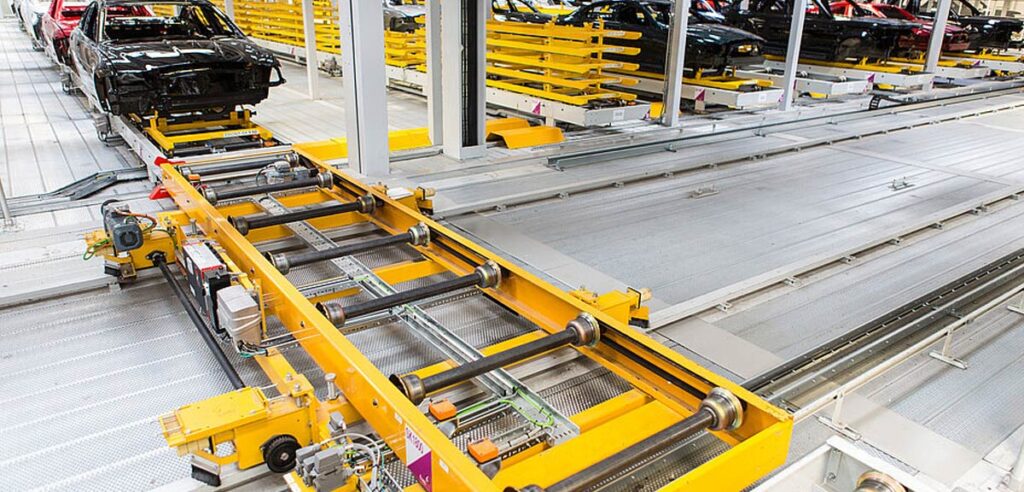
Cross transfer systems are used in automated automotive production lines to move pallets, components, or workpieces between parallel conveyor lines.
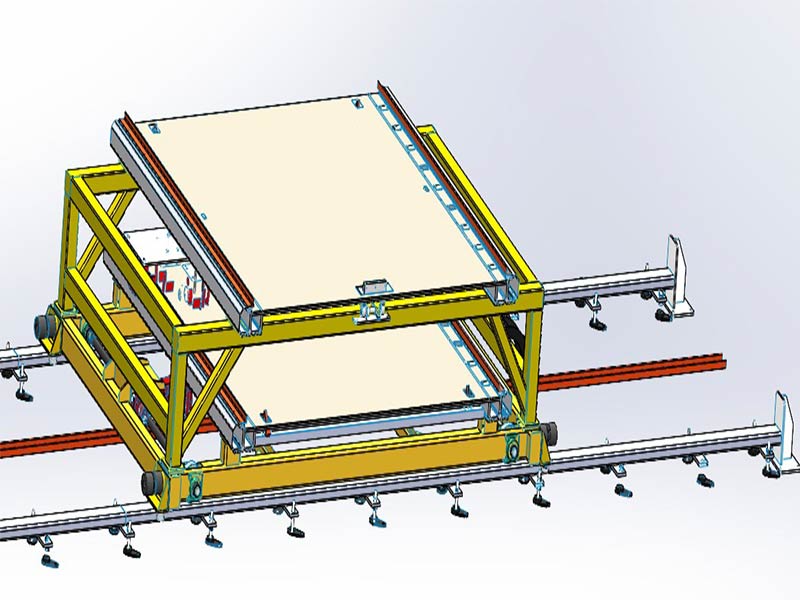
In a conventional production line, material normally travels in one primary direction. However, modern automotive factories often require more complex material flows. A product may need to move from one assembly line to another, bypass a workstation, enter a parallel process, or change direction before continuing to the next operation.
A cross transfer system provides this horizontal transfer function while maintaining controlled and repeatable product movement.
When integrated with pallet conveyors, lift-and-locate units, robots, PLC controls, and production tracking systems, cross transfer equipment can become an important part of an automated automotive material handling system.
What Is a Cross Transfer System?
A cross transfer system is a mechanical device used to move a pallet or workpiece laterally from one conveyor path to another.
The transfer direction is normally perpendicular to the primary conveying direction.
For example, a pallet may travel along Conveyor A and then be transferred sideways to Conveyor B.
A typical sequence can be represented as:
Main Conveyor → Stop → Transfer → Secondary Conveyor → Continue Production
The exact mechanism depends on the product, pallet weight, conveyor type, required transfer distance, and production cycle time.
A cross transfer system may use:
- Lift-and-transfer mechanisms
- Chain transfer units
- Roller transfer units
- Belt transfer mechanisms
- Motor-driven transfer platforms
- Pneumatic lifting mechanisms
- Servo-driven transfer systems
- Dedicated transfer machines
The system can be designed as an independent machine or integrated directly into a larger conveyor line.
Why Cross Transfer Is Important in Automotive Manufacturing
Automotive production lines rarely consist of a single straight conveyor.
Factory layouts must accommodate buildings, columns, equipment, production areas, inspection stations, storage areas, and different manufacturing processes.
As a result, material flow often needs to change direction.
A cross transfer system allows engineers to create more flexible production layouts without requiring the entire production line to follow one continuous path.
This can provide several advantages.
Flexible Production Line Layout
Cross transfer systems allow parallel conveyor sections to be connected.
This can make it easier to design production lines around existing factory structures.
Reduced Material Handling Distance
Instead of sending a pallet through a long loop, the pallet can move directly to the required production area.
Connection Between Production Lines
A cross transfer can connect different assembly lines or process areas.
For example, a component assembly line may feed a main assembly line through a dedicated transfer section.
Automated Product Routing
When combined with product identification and PLC control, the system can automatically determine where a pallet should go.
This is particularly useful for multi-model production.
Basic Structure of a Cross Transfer System
A cross transfer machine normally consists of several mechanical and control components.
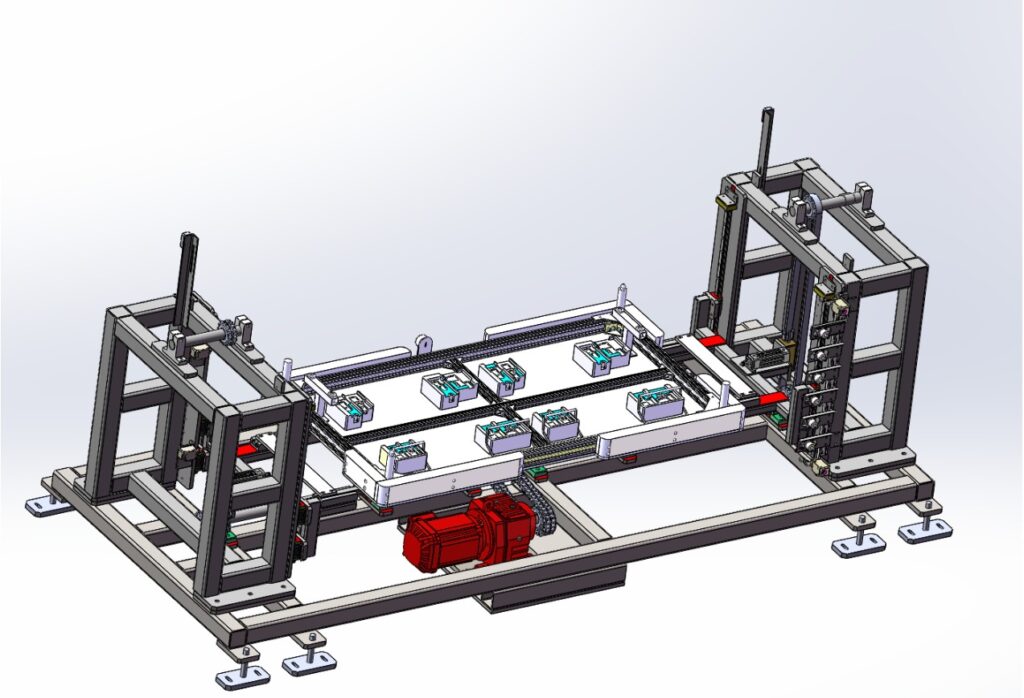
Transfer Frame
The transfer frame provides the structural foundation for the mechanism.
It must support the pallet, product, fixtures, motors, and moving components while maintaining sufficient rigidity.
For heavy automotive applications, structural strength is particularly important.
Transfer Mechanism
The transfer mechanism moves the pallet from one conveyor to another.
Depending on the design, it may use chains, rollers, belts, wheels, or other mechanical components.
Lifting Mechanism
Some cross transfer systems first lift the pallet away from the primary conveyor.
Once the pallet is raised to the required height, the transfer mechanism moves it horizontally.
The pallet is then lowered onto the destination conveyor.
This type of arrangement is useful when the two conveyor paths need to remain mechanically independent.
Drive System
The drive system provides the horizontal movement required for the transfer.
The motor and gearbox should be selected according to:
- Pallet weight
- Product weight
- Transfer distance
- Acceleration
- Cycle time
- Conveyor resistance
- Required positioning accuracy
Sensors
Sensors provide feedback to the PLC control system.
Typical sensors may detect:
- Pallet arrival
- Pallet position
- Lift position
- Transfer position
- Destination conveyor status
- Product presence
- Mechanical limit positions
These signals are used to control and verify the transfer sequence.
How a Cross Transfer System Works
The exact sequence depends on the equipment configuration, but a typical pallet cross transfer cycle includes several stages.
Step 1: Pallet Arrival
The pallet travels along the primary conveyor toward the transfer station.
A sensor detects the pallet and sends the signal to the PLC.
Step 2: Pallet Positioning
The pallet reaches the predefined transfer position.
A stopper or positioning mechanism prevents further movement.
Step 3: Lifting
If the system uses a lift-and-transfer configuration, the pallet is raised from the primary conveyor.
The PLC confirms that the lift has reached its upper position.
Step 4: Horizontal Transfer
The transfer mechanism moves the pallet laterally toward the destination conveyor.
Depending on the application, this movement may be driven by a chain, roller, belt, electric actuator, or servo system.
Step 5: Destination Position Confirmation
Sensors verify that the pallet has reached the required transfer position.
Step 6: Lowering
The pallet is lowered onto the destination conveyor when the system uses a lifting transfer mechanism.
Step 7: Release
The destination conveyor accepts the pallet and moves it toward the next production station.
The transfer mechanism then returns to its initial position.
Cross Transfer vs. Straight Conveyor
A straight conveyor moves products along a fixed path.
A cross transfer adds another degree of movement by allowing products to move between parallel conveyor paths.
This distinction becomes important when designing complex automotive production lines.
A straight conveyor is generally suitable when:
- Product flow is linear
- Workstations are arranged sequentially
- There is sufficient factory space
A cross transfer becomes useful when:
- Parallel lines need to be connected
- Products need to change production routes
- A workstation needs to be bypassed
- Multiple lines share common equipment
- Factory space requires a non-linear layout
Cross transfer systems therefore provide greater flexibility in production line architecture.
Cross Transfer in Pallet Conveyor Systems
Cross transfer equipment is frequently used together with pallet conveyor systems.
The pallet provides a standardized carrier for the product, while the cross transfer moves the pallet between conveyor sections.
This combination allows the production line to maintain the same fixture and product reference throughout different material handling operations.
For example:
Pallet Conveyor → Cross Transfer → Parallel Pallet Conveyor → Assembly Station
The same pallet can continue carrying the product without requiring manual unloading and reloading.
This reduces handling operations and helps maintain product traceability.
Applications in Automotive Assembly
Cross transfer systems can be used in a variety of automotive manufacturing environments.
Engine Assembly Lines
Engine assembly lines may contain multiple parallel process areas.
A cross transfer system can move engine pallets between these areas according to the production sequence.
Potential applications include:
- Engine block assembly
- Cylinder head assembly
- Crankshaft assembly
- Piston assembly
- Final engine assembly
- Inspection
- Leak testing
- End-of-line testing
The transfer system can be integrated with lift-and-locate stations at individual workstations.
Transmission Assembly
Transmission production often requires multiple processes with different equipment configurations.
Cross transfers can connect parallel conveyor sections and provide flexible routing between assembly stations.
This can be useful when several production operations need to share inspection or testing equipment.
Powertrain Assembly
Powertrain assembly lines often contain heavy products and multiple automated workstations.
A cross transfer system can provide a controlled method of moving pallets between parallel production areas.
The system can be engineered according to the product weight, pallet dimensions, transfer distance, and required cycle time.
Automotive Component Assembly
Cross transfer systems are also suitable for component manufacturing.
Potential applications include:
- Axle assembly
- Steering system assembly
- Suspension component assembly
- Brake assembly
- Motor assembly
- Reducer assembly
- EV drive unit assembly
Cross Transfer for Heavy Automotive Products
Heavy products require particular attention during transfer.
An engine, transmission, axle, or EV drive unit may have a substantial combined pallet and product weight.
The transfer mechanism therefore needs sufficient load capacity and structural rigidity.
Important design parameters include:
- Maximum payload
- Pallet weight
- Product center of gravity
- Transfer stroke
- Conveyor height
- Lift stroke
- Acceleration and deceleration
- Mechanical rigidity
- Positioning accuracy
The lifting and transfer mechanisms should also be evaluated for dynamic loading rather than considering only the static product weight.
Transfer Distance and Conveyor Layout
The required transfer distance is determined by the relative positions of the two conveyor lines.
A short transfer may only require a compact mechanism installed between adjacent conveyors.
A longer transfer may require a dedicated transfer platform or guided transfer structure.
The engineering design should consider:
- Conveyor center distance
- Available floor space
- Equipment clearance
- Operator access
- Maintenance access
- Safety guarding
- Transfer cycle time
The objective is to achieve the required material flow without making the transfer mechanism unnecessarily large or complex.
Positioning Accuracy
Not every cross transfer application requires the same positioning accuracy.
For simple material movement, the main requirement may be reliable pallet transfer.
For automated assembly, however, the destination pallet may need to reach a defined workstation position.
In these applications, the cross transfer should work together with the downstream positioning system.
For example:
Cross Transfer → Pallet Conveyor → Stopper → Lift-and-Locate → Assembly
The cross transfer handles transportation between lines, while the lift-and-locate mechanism establishes the final manufacturing reference.
Separating these functions can simplify the overall system architecture.
Cross Transfer and Multi-Model Production
Modern automotive plants often manufacture several product variants on shared equipment.
A cross transfer system can support this approach by routing pallets according to product information.
For example, an RFID reader can identify the pallet and product model.
The PLC can then determine the appropriate destination.
One model may be routed to Conveyor A, while another model may be routed to Conveyor B.
This provides a flexible material flow without requiring manual sorting.
RFID and Pallet Tracking
Cross transfers can be integrated with pallet identification systems.
An RFID tag can be mounted on the pallet.
When the pallet reaches the transfer station, the system reads its identification information.
The production control system can then determine:
- Product model
- Production order
- Current process
- Destination
- Previous process status
- Required operation
This makes the cross transfer part of the production traceability system.
It also reduces the risk of sending a product to the wrong production route.
PLC Control and Transfer Interlocking
Reliable cross transfer operation requires coordination between multiple machines.
The PLC may need to communicate with:
- Upstream conveyor
- Downstream conveyor
- Lift mechanism
- Transfer drive
- Stopper
- Sensors
- Robot systems
- MES
- Safety systems
Before a transfer begins, the PLC should verify that the destination conveyor is ready.
For example, the transfer may only start when:
- Pallet is detected.
- Pallet is correctly positioned.
- Destination conveyor is available.
- Transfer mechanism is in the home position.
- Safety conditions are satisfied.
After the transfer, sensors confirm that the pallet has reached the destination.
This type of interlocking prevents collisions and incorrect material flow.
Cross Transfer Integration with Robots
Cross transfer systems normally operate upstream or downstream of robotic workstations rather than directly replacing robot positioning mechanisms.
For example:
Pallet Conveyor → Cross Transfer → Pallet Conveyor → Robot Workstation
The cross transfer moves the pallet to the correct production area.
The pallet conveyor then transports it to the robot station.
Finally, a lift-and-locate mechanism establishes the precise position required for the robot operation.
This layered approach separates material movement, routing, and precision positioning.
Safety Considerations
Cross transfer systems contain moving equipment and can create pinch, crush, and collision hazards.
Safety design should therefore be incorporated into the system architecture.
Depending on the application, safety measures may include:
- Guarding
- Safety doors
- Safety light curtains
- Safety scanners
- Emergency stop devices
- Mechanical end stops
- Anti-drop mechanisms
- Safety interlocks
- Controlled restart logic
The safety system should account for both normal automatic operation and maintenance activities.
Where robots or operators work near the transfer system, the safety zones should be coordinated with the surrounding equipment.
Maintenance of Cross Transfer Equipment
Regular maintenance helps maintain transfer accuracy and system reliability.
Important inspection points include:
- Transfer chains
- Rollers
- Bearings
- Guide rails
- Motors
- Gearboxes
- Lifting cylinders
- Sensors
- Mechanical stops
- Locating components
- Fasteners
- Electrical connections
Lubrication requirements should be defined for applicable mechanical components.
The transfer mechanism should also be inspected for abnormal noise, vibration, uneven movement, and excessive mechanical clearance.
Early detection of these conditions can help prevent unplanned production downtime.
How to Select a Cross Transfer System
The correct cross transfer design depends on the complete production requirement.
Before selecting the equipment, engineers should determine:
- What is the pallet and product weight?
- What are the pallet dimensions?
- What is the required transfer distance?
- What is the conveyor height?
- What is the required cycle time?
- How frequently will transfers occur?
- What positioning accuracy is required?
- Are multiple product models involved?
- Is RFID or barcode tracking required?
- Will the transfer connect to robotic workstations?
- What PLC and MES interfaces are required?
- What safety functions are required?
These parameters determine the appropriate mechanical structure, drive system, lifting method, sensors, controls, and overall equipment configuration.
Custom Cross Transfer Solutions
A cross transfer system should be designed according to the actual conveyor layout and production process.
Standard transfer equipment may be appropriate for simple applications, but automotive production lines often have specific requirements related to pallet dimensions, payload, line height, transfer distance, and cycle time.
A customized cross transfer can integrate:
- Pallet conveyor
- Lift mechanism
- Transfer mechanism
- Precision positioning
- Stopper
- Product detection
- RFID identification
- PLC control
- MES communication
- Safety system
The transfer unit can therefore become an integrated part of the complete production line.
Hongbo Cross Transfer Solutions
Hongbo Automation provides customized conveyor and material handling equipment for automotive manufacturing applications.
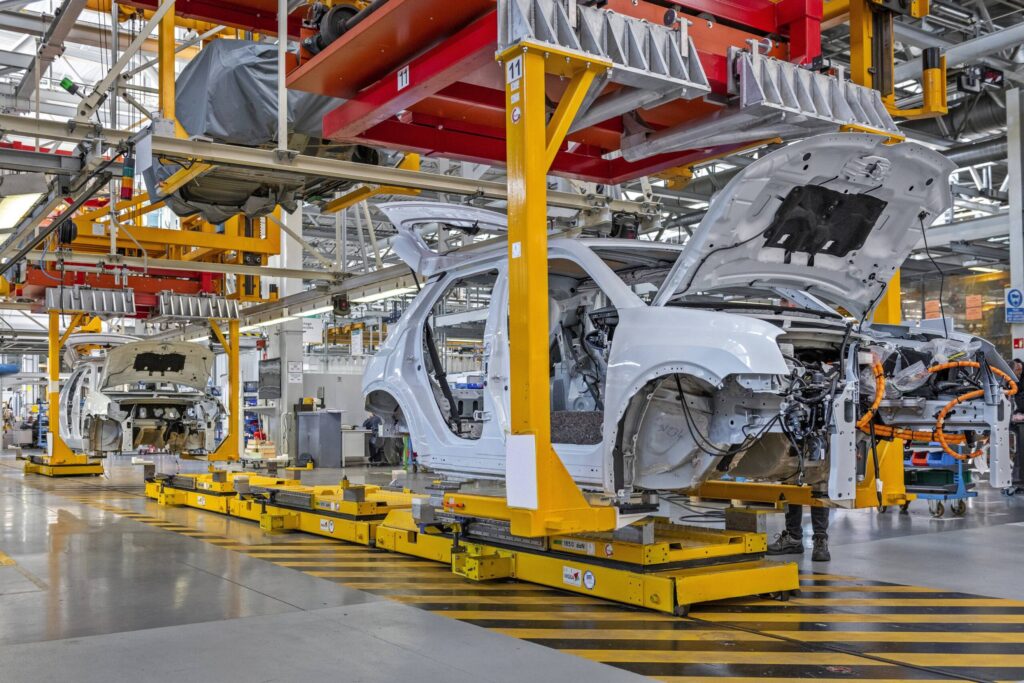
Cross transfer systems can be designed to connect parallel conveyor lines and provide controlled pallet transfer within automotive assembly and component production facilities.
The system can be engineered according to product weight, pallet dimensions, transfer distance, conveyor height, takt time, positioning requirements, and factory layout.
Hongbo cross transfer equipment can also be integrated with pallet conveyors, lift-and-locate systems, robotic workstations, assembly equipment, testing systems, PLC controls, and production traceability systems.
This approach allows the material handling system to be developed around the complete manufacturing process rather than treating each conveyor or transfer machine as an independent piece of equipment.
Conclusion
Cross transfer systems provide an effective way to move pallets and automotive components between parallel conveyor lines.
They are particularly useful when production layouts require multiple material flow paths, flexible routing, shared workstations, or connections between different assembly areas.
When combined with pallet conveyors, lift-and-locate systems, RFID tracking, PLC control, and automated production equipment, cross transfer technology can support flexible and traceable automotive manufacturing.
The most suitable system depends on the product, pallet, payload, transfer distance, cycle time, positioning requirements, and overall factory layout.
A well-engineered cross transfer is therefore not simply a mechanism for changing direction. It is part of the material flow architecture of the entire automotive production line.
Frequently Asked Questions
What is a cross transfer system?
A cross transfer system moves pallets or workpieces laterally between parallel conveyor lines, normally in a direction perpendicular to the main conveyor flow.
What is a cross transfer used for in automotive production?
It can connect parallel production lines, change product routing, bypass workstations, connect different assembly areas, and transfer pallets between manufacturing processes.
Can a cross transfer handle heavy automotive products?
Yes. The transfer structure, drive system, lifting mechanism, and guides can be engineered according to the combined pallet and product payload.
Can cross transfer equipment work with pallet conveyors?
Yes. Cross transfer systems are commonly integrated with pallet conveyor systems to provide automated movement between different conveyor sections.
Does a cross transfer provide precision positioning?
Its primary function is material transfer. When higher positioning accuracy is required at the production workstation, a downstream lift-and-locate system can provide the final precision reference.
Can cross transfer systems support multiple vehicle or component models?
Yes. With pallet identification, flexible fixtures, and PLC/MES control, different product models can be routed through different production paths automatically.
Can Hongbo customize cross transfer equipment?
Yes. Hongbo can develop cross transfer systems according to pallet dimensions, payload, transfer distance, conveyor layout, cycle time, positioning requirements, and production automation architecture.