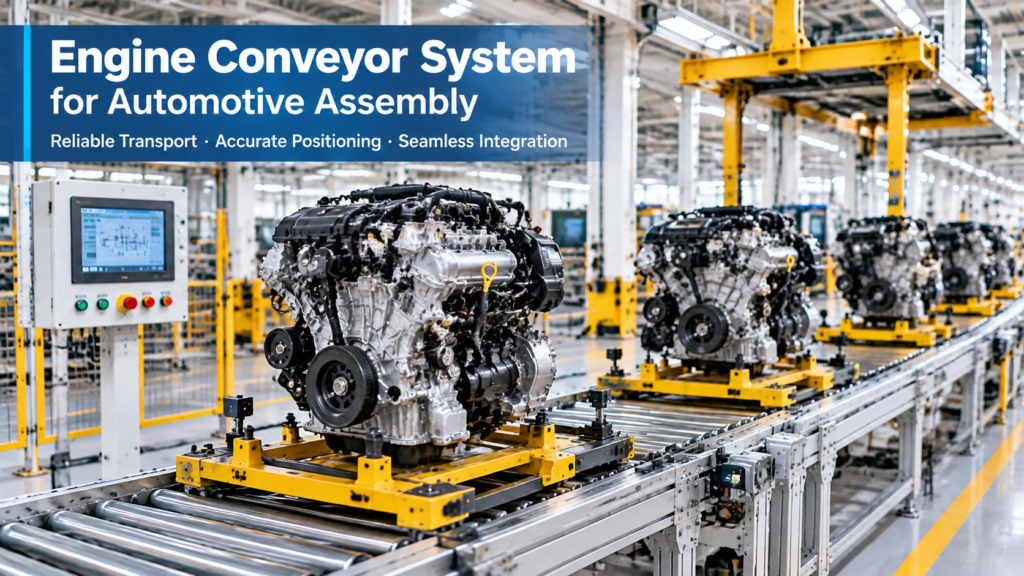
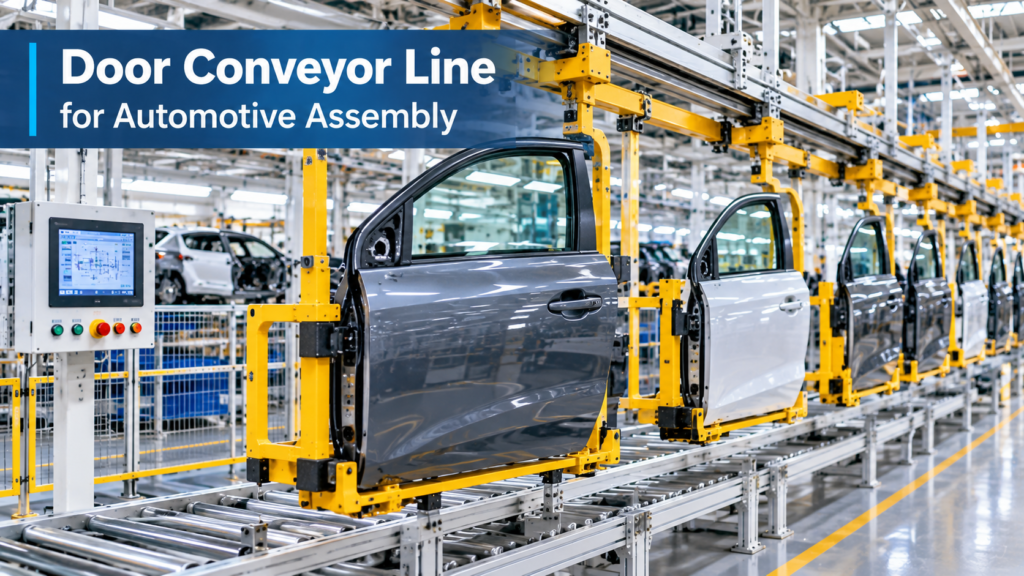
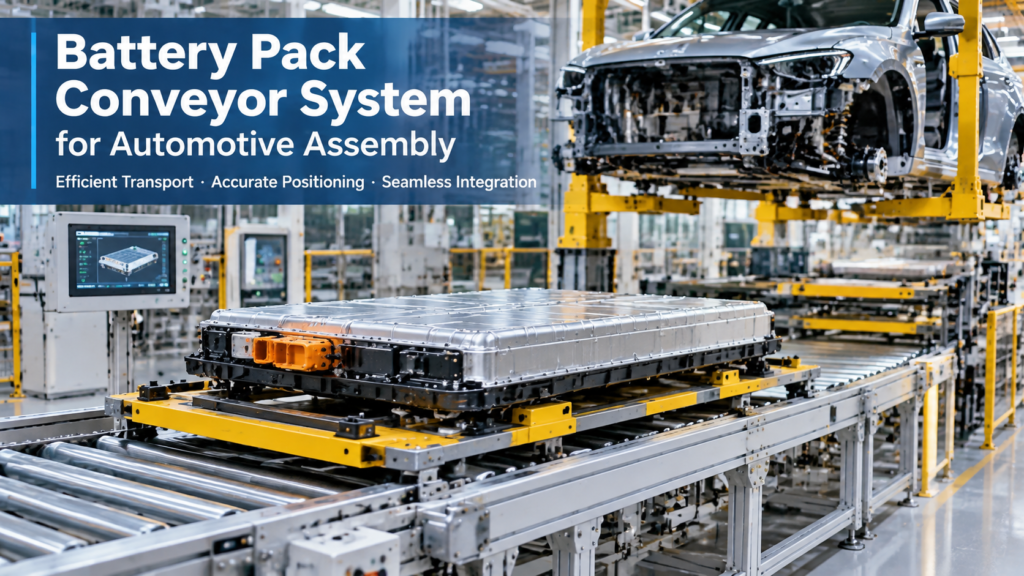
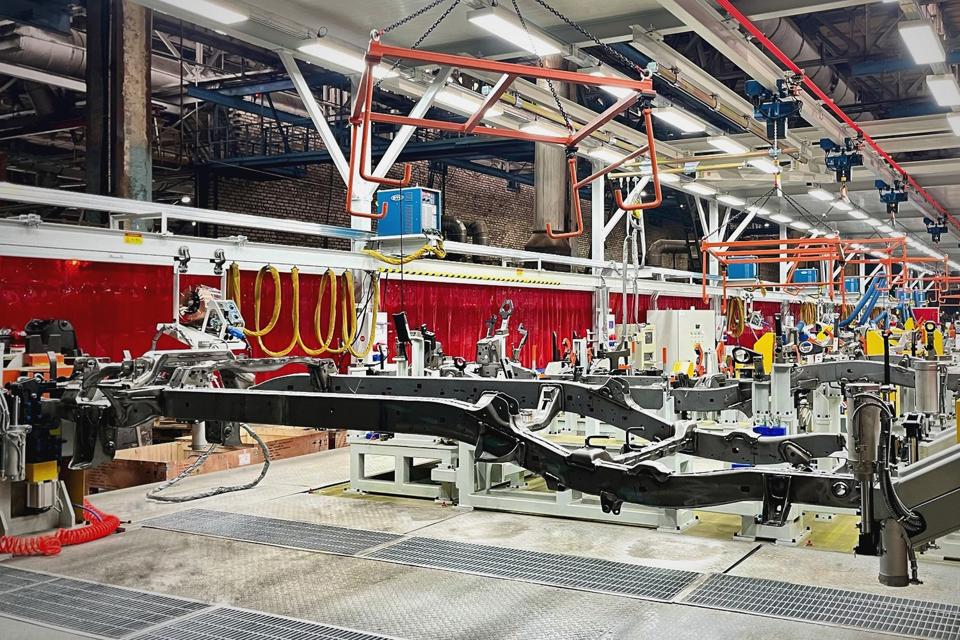
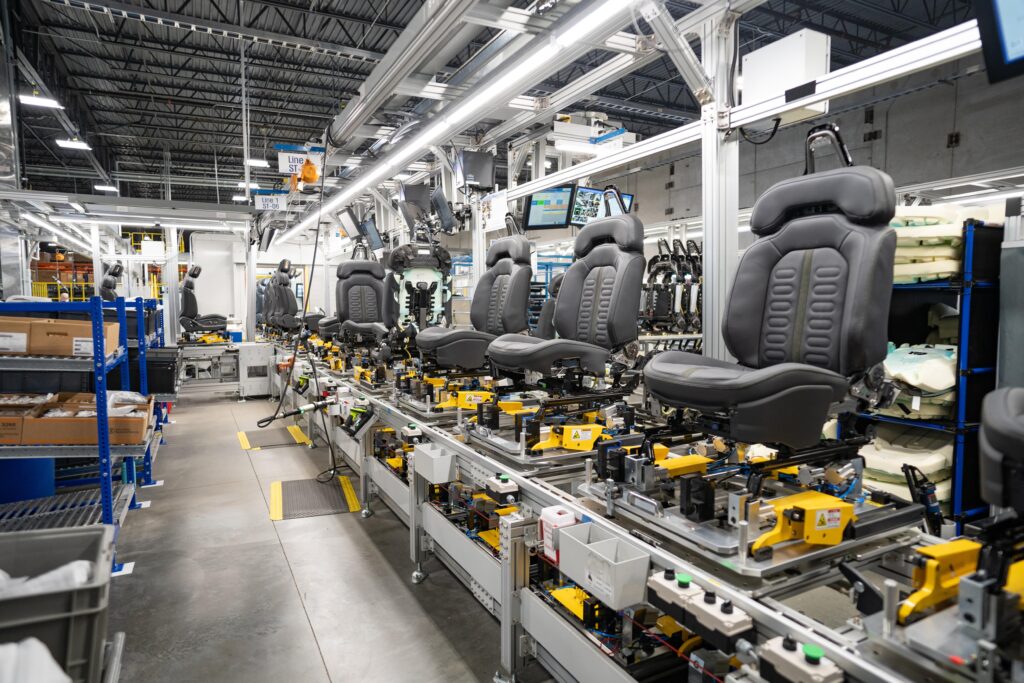
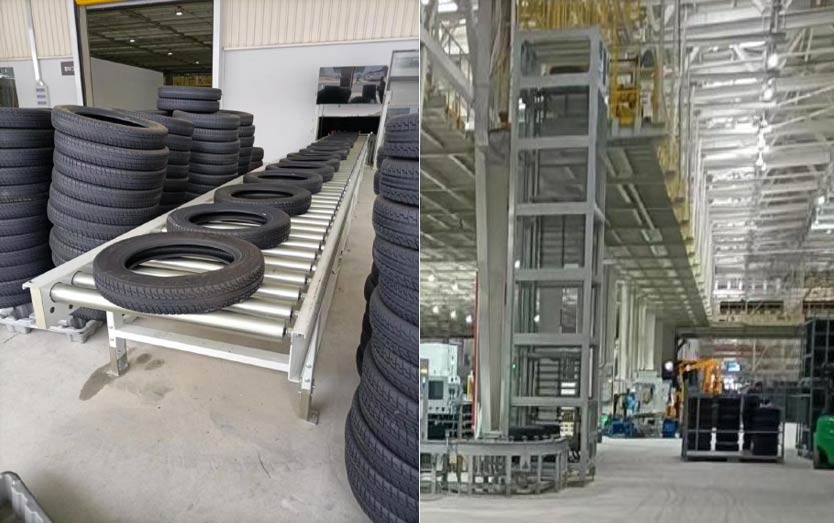
In automotive manufacturing, the instrument panel is a major interior component that must be delivered to the vehicle assembly station at the right time and in the correct configuration. An instrument panel conveyor line provides a controlled transportation route between dashboard assembly, inspection, temporary storage, and final vehicle installation.
Watch our instrument panel conveyor line working:
Unlike conveyors designed for small components, an instrument panel conveyor system must accommodate relatively large and often irregularly shaped assemblies. Depending on the vehicle model, the instrument panel may include structural supports, ventilation outlets, wiring harnesses, displays, and other integrated components. Therefore, the conveying solution must protect the assembly while maintaining stable positioning and reliable material flow.
Modern automotive plants may also produce multiple vehicle models on the same line. As a result, instrument panel delivery often requires coordination between production sequencing, buffer management, identification systems, and final assembly operations.
This article explains the main types of instrument panel conveyor lines, their operating principles, and the key engineering considerations for automotive manufacturers planning a new production line or upgrading an existing system.
What Is an Instrument Panel Conveyor Line?
An instrument panel conveyor line is a material-handling system designed to transport dashboard or instrument panel assemblies between production and installation areas.
Depending on the manufacturing process, the system may serve one or more purposes:
- Transport completed instrument panels from an assembly area to final vehicle assembly
- Connect dashboard assembly stations with inspection or testing stations
- Provide temporary buffering between upstream production and downstream installation
- Deliver different instrument panel variants according to the vehicle production sequence
- Position instrument panels for manual or automated handling
- Connect separate production areas through powered conveyor or transfer equipment
A typical system may incorporate powered roller conveyors, chain conveyors, dedicated pallets, locating fixtures, accumulation sections, lifting units, cross-transfer devices, sensors, and PLC-based controls.
However, not every project requires all these components. A short conveyor connecting two adjacent workstations may need only a simple powered conveying arrangement, whereas a larger production facility may require several routes, buffer zones, and automated transfer stations.
The design should therefore begin with the assembly’s dimensions, weight, handling requirements, production rate, and destination rather than selecting conveyor equipment before the process is understood.
Why Instrument Panel Conveying Matters in Automotive Manufacturing
Instrument panels are often installed during vehicle interior assembly, where available space can be limited and several operations must be completed within a defined production cycle. Reliable delivery is therefore essential for maintaining production flow.
1. Maintain a Reliable Supply of Assemblies
The instrument panel must arrive when the vehicle reaches the installation workstation. If supply is delayed, the installation operation may be interrupted. Conversely, delivering too many assemblies too early can create congestion around the line.
A dedicated conveyor system establishes a defined route between the supply area and the installation point. When combined with suitable buffering and release logic, it can help coordinate upstream assembly output with downstream vehicle demand.
2. Protect Instrument Panels During Transportation
Instrument panels can contain visible surfaces, decorative trim, electronic displays, and other components that require careful handling. Uncontrolled movement or unsuitable support arrangements may lead to scratches, deformation, or damage to installed parts.
A suitable conveyor system should provide stable support and prevent unwanted movement during transportation, stopping, and transfer. Depending on the assembly design, dedicated pallets or fixtures may be needed to protect vulnerable surfaces and maintain the required orientation.
Protective covers and handling restrictions may also be necessary, particularly when assemblies move through areas with frequent operator access or other material-handling activities.
3. Support Mixed-Model Production
Different vehicle models may use instrument panels with different dimensions, trim finishes, electronic configurations, and mounting features.
A conveyor line can support a defined range of variants through compatible carriers, identification systems, and routing controls. Where sequence-based delivery is required, production data can be used to associate each instrument panel with its intended vehicle or assembly station.
Nevertheless, the control strategy must define how the system identifies the assembly, validates the destination, and handles mismatches. Conveyor transportation alone does not guarantee correct model sequencing.
4. Reduce Unnecessary Manual Handling
Instrument panels can be awkward to carry because of their size and shape. Repeated manual transportation may increase operator workload and create additional opportunities for handling damage.
Powered conveying reduces the need to move each assembly manually over long distances. It also creates more predictable handover points for operators, lifting equipment, or automated handling devices.
The appropriate automation level depends on production volume, available space, labor requirements, and the complexity of the assembly process.
Common Types of Instrument Panel Conveyor Lines
The most suitable conveyor technology depends on the assembly’s support requirements, transportation route, production rate, and downstream interface.
1. Pallet Conveyor Systems
Pallet conveyors are useful when instrument panels need to be supported on dedicated carriers throughout transportation and processing.
A pallet can incorporate locating features designed around the instrument panel’s structure. This arrangement helps maintain a consistent orientation and provides a defined interface with the conveyor and handling equipment.
Depending on the load and layout, the conveying mechanism may use rollers, chains, or other suitable technologies. Pallet conveyors can also be combined with accumulation zones and transfer units to connect multiple workstations.
During design, engineers should consider pallet dimensions, load distribution, locating accuracy, return logistics, and access to the instrument panel during assembly or inspection.
2. Roller Conveyor Systems
Powered roller conveyors transport compatible pallets or carriers along a defined horizontal route. They are commonly considered for straight conveying sections and for connecting assembly, inspection, and buffer areas.
A zoned roller conveyor can control the movement of individual carriers based on downstream availability. This is useful when the system must temporarily hold assemblies without stopping the entire route.
The roller arrangement must match the pallet geometry and load characteristics. If the instrument panel is transported directly rather than on a dedicated carrier, the contact surfaces and support points require particular attention to avoid damage or unstable movement.
3. Chain Conveyor Systems
Chain conveyors can transport pallets or fixtures through production areas where robust load movement is required.
In an instrument panel assembly application, a chain conveyor may connect several process stations or move carriers between different sections of the line. The final design depends on the load, pallet construction, conveying speed, and stopping requirements.
Engineers should evaluate drive capacity, chain loading, wear, lubrication, noise, and maintenance access. Where accurate positioning is required, separate locating or stopping devices may be necessary at the workstation.
4. Lift-and-Transfer Systems
An instrument panel conveyor route may need to change direction or connect parallel conveying sections. Lift-and-transfer equipment can raise a loaded carrier, move it to another route, and lower it into position.
This configuration can help accommodate factory layout constraints and connect different process areas without requiring one continuous straight conveyor.
The system must coordinate with upstream and downstream equipment. Important design factors include the loaded carrier weight, lifting stroke, transfer distance, cycle time, positioning requirements, and safety interlocks.
5. Automated Transfer and Positioning Equipment
Some applications require the instrument panel to be presented at a repeatable location for inspection, robotic handling, or installation preparation.
In these cases, the conveyor may be integrated with locating fixtures, lifting devices, or automated handling equipment. Sensors confirm carrier presence and positioning conditions before the next operation begins.
The mechanical and control interfaces must be defined together. In particular, engineers should consider the assembly’s orientation, required positioning accuracy, handling clearance, and the recovery sequence if a transfer operation fails.
How an Instrument Panel Conveyor Line Works
Although the layout varies between factories, a typical system follows a sequence of loading, transportation, buffering, identification, and delivery.
Step 1: Assembly Loading
Completed instrument panels enter the conveyor system from an assembly or inspection area. Loading may be performed manually, with lifting assistance, or through an automated handling device.
The loading station should provide stable support and sufficient clearance for operators or equipment. If dedicated pallets are used, the assembly must be correctly located before the carrier is released.
Step 2: Transportation and Monitoring
The conveyor moves the instrument panel toward the next designated location. Sensors monitor carrier presence and provide feedback to the PLC control system.
If the next section is unavailable, the system can hold the carrier at a defined stopping point. Once the downstream section is ready, transportation can resume according to the programmed sequence.
This approach helps manage material flow without requiring all conveyor sections to operate continuously.
Step 3: Buffering and Sequencing
A buffer separates instrument panel production from final assembly demand. It provides temporary storage when upstream and downstream processes operate at different rates.
Where different instrument panel variants are produced, identification and sequencing may be required. Barcode or RFID devices can be used to read assembly or carrier information, while the control system manages routing and release according to the defined production rules.
The buffer must be sized according to actual demand and layout constraints. It should provide sufficient flexibility without allowing excessive inventory to accumulate around the line.
Step 4: Transfer to the Vehicle Assembly Area
When the instrument panel is required, the system releases the corresponding assembly toward the installation area.
The final delivery point may include a transfer unit, lifting platform, or dedicated presentation fixture. The assembly must arrive in an orientation that allows the next operation to proceed without unnecessary manual repositioning.
For sequence-sensitive production, the system should verify the intended destination before releasing the assembly.
Step 5: Carrier Return and System Recovery
If reusable pallets or fixtures are used, the system may include a return route for empty carriers. The return arrangement should be planned alongside the loaded-assembly route to avoid congestion.
The control system should also define how to recover from common faults, such as a blocked conveyor zone, incorrect carrier identification, or a transfer unit that fails to complete its cycle.
Clear fault messages and documented recovery procedures help maintenance personnel restore operation while maintaining the required safety conditions.
Key Design Considerations for an Instrument Panel Conveyor Line
Assembly Dimensions and Handling Requirements
Instrument panels vary considerably in size, weight, shape, and component configuration. The conveyor and carrier design must accommodate the full range of assemblies specified for the project.
Engineers should identify fragile surfaces, protruding components, wiring connections, and areas that must remain accessible during transportation. The support arrangement should prevent excessive movement while avoiding unnecessary contact with sensitive surfaces.
Production Rate and Buffer Capacity
The system must deliver assemblies at a rate that supports the downstream installation process. Capacity calculations should include loading time, transfer cycles, stopping behavior, buffer occupancy, and recovery from minor interruptions.
A conveyor with adequate nominal speed may still fail to meet production demand if transfer equipment or loading stations create bottlenecks. Therefore, the complete process sequence should be reviewed before the final capacity is established.
Carrier and Fixture Design
Dedicated carriers can provide repeatable support and reduce the risk of handling damage. However, the carrier must be designed around the actual assembly geometry and the required handling method.
For mixed-model production, the project team should determine whether a common carrier can support all specified variants or whether interchangeable locating features or separate carriers are required.
Carrier weight, dimensions, return logistics, maintenance, and storage should also be considered.
Factory Layout and Routing
The conveyor layout should minimize unnecessary transportation while preserving operator access and maintenance space.
Designers should consider building columns, existing equipment, pedestrian routes, material supply paths, and emergency access. Where the conveyor connects multiple production areas, transfer points and buffer locations should be selected to avoid interfering with adjacent operations.
Controls and Production-System Integration
PLC-based control coordinates conveyor motors, sensors, stops, lifting devices, and transfer units. Where required, the system can also interface with barcode readers, RFID devices, MES, or other production information systems.
The control design should specify how assemblies are identified, how destinations are assigned, and what happens if data is missing or incorrect. It should also define equipment-ready signals, interlocks, alarms, and restart procedures.
Safety and Maintenance
The system may contain moving rollers, chains, lifting mechanisms, and transfer equipment. A suitable risk assessment should identify hazards during normal production, loading, fault recovery, and maintenance.
Depending on the application, protective measures may include guarding, interlocked access points, emergency stops, and safe isolation procedures. Maintenance access should be included in the layout so that motors, sensors, bearings, and transfer mechanisms can be inspected and replaced efficiently.
Instrument Panel Conveyor Line vs. Manual Handling
Manual handling may be sufficient for a small production area or a low-volume process. However, as production volume, transportation distance, or sequencing complexity increases, a dedicated conveyor system can offer operational advantages.
| Evaluation Factor | Manual Handling | Instrument Panel Conveyor Line |
|---|---|---|
| Transportation | Depends on operators and handling equipment | Follows a defined conveying route |
| Delivery consistency | Can vary with workload and distance | Can use controlled release and routing logic |
| Assembly protection | Depends on handling methods | Can use dedicated carriers and locating fixtures |
| Buffer management | Relies on available floor space and manual organization | Can use designated accumulation zones |
| Sequence control | Requires disciplined manual procedures | Can support identification and automated routing |
| Initial investment | Generally lower for simple operations | Higher due to equipment and integration |
| Best-fit application | Low-volume or flexible work areas | Repetitive, higher-volume, or sequence-sensitive production |
The decision should be based on the production process, required delivery rate, available space, handling risks, and expected operating life. Automation should be introduced where its operational benefits justify the investment and maintenance requirements.
Common Challenges in Instrument Panel Conveyor Projects
Damage to Sensitive Surfaces
Instrument panels may include decorative trim, displays, and other components that are vulnerable to impact or abrasion. Poorly designed support points can increase the risk of damage during movement.
To reduce this risk, engineers should define approved contact areas, carrier locating features, and handling restrictions. The system should be validated using representative assemblies before production release.
Incorrect Assembly Sequencing
In mixed-model production, the wrong instrument panel arriving at a workstation can interrupt the installation process.
The control strategy should define identification, sequence validation, destination assignment, and exception handling. If an assembly cannot be verified, the system should follow a defined hold or verification procedure rather than releasing it automatically.
Insufficient Buffer Capacity
An undersized buffer may allow short upstream interruptions to affect final assembly. Conversely, excessive buffering consumes floor space and may make material tracking more difficult.
Buffer sizing should reflect production demand, upstream replenishment behavior, expected interruptions, and the available installation area.
Poor Transfer Coordination
Transfer units and lifting devices can become bottlenecks if their cycle times or control interfaces are not aligned with the conveyor.
The project team should define interface conditions, equipment-ready signals, transfer completion feedback, and fault-recovery procedures before commissioning.
How to Select an Instrument Panel Conveyor Line Supplier
Selecting a supplier requires an assessment of both mechanical equipment and system integration capabilities.
Automotive manufacturing experience: The supplier should understand instrument panel handling, final assembly logistics, and the requirements of mixed-model production.
Mechanical engineering capability: The supplier should be able to design suitable conveyors, carriers, fixtures, and transfer mechanisms based on the actual assembly geometry.
Controls integration: The proposal should explain how conveyors, sensors, identification equipment, and downstream workstations communicate.
Layout and capacity planning: The design should address production rate, buffer capacity, delivery routes, maintenance access, and operator safety.
Installation and commissioning support: The project scope should define installation responsibilities, controls commissioning, interface testing, documentation, and operator handover.
Before requesting a quotation, manufacturers should prepare the instrument panel dimensions and weights, required production rate, available factory layout, loading and unloading conditions, assembly variants, and interface requirements. These inputs help the supplier develop a more accurate technical proposal.
Instrument Panel Conveyor Solutions from Hongbo Automation
Hongbo Automation provides automotive assembly-line and material-handling solutions designed around manufacturing process requirements. For instrument panel conveyor projects, the system concept can be developed according to the assembly characteristics, required throughput, plant layout, and interfaces with adjacent production equipment.
Depending on the project scope, a solution may include powered conveyors, dedicated pallets, accumulation sections, transfer equipment, lifting units, and PLC-based control integration.
For applications involving multiple vehicle models, the engineering process should also address identification, delivery sequencing, and the relationship between instrument panel supply and final assembly demand.
The objective is to develop a system that supports stable material flow while maintaining practical installation, operation, and maintenance conditions. Each project should be evaluated individually so that the equipment configuration matches the actual process rather than relying on an assumed standard arrangement.
Frequently Asked Questions About Instrument Panel Conveyor Lines
What is an instrument panel conveyor line used for?
It transports dashboard assemblies between manufacturing, inspection, buffering, and final vehicle assembly areas. Depending on the process, it may also support identification, sequencing, and positioning.
Which conveyor type is suitable for instrument panel transportation?
Roller conveyors, chain conveyors, and pallet conveyor systems may all be suitable. The best option depends on the assembly dimensions, support requirements, transportation route, production rate, and downstream interfaces.
Can an instrument panel conveyor line support multiple vehicle models?
Yes. A system can be designed for a defined range of instrument panel variants through suitable carriers, fixtures, identification methods, and routing controls. The supported range must be established during engineering.
How can a conveyor system help protect instrument panels?
Dedicated carriers, appropriate support points, controlled acceleration and stopping, and carefully designed transfer interfaces can reduce unwanted movement and contact with sensitive surfaces.
Can the conveyor system be integrated with MES?
Where required, the system can exchange production or identification data with MES or other plant-level systems. The interface should define the information exchanged, timing, validation rules, and fault-handling procedures.
What information is needed to design an instrument panel conveyor line?
Key inputs include assembly dimensions and weights, carrier requirements, production rate, factory layout, delivery sequence, loading and unloading conditions, automation requirements, and interfaces with adjacent equipment.
Conclusion
An instrument panel conveyor line helps automotive manufacturers transport dashboard assemblies through production and deliver them to final assembly workstations in a controlled manner. By combining suitable conveying equipment with protective carriers, controlled buffering, reliable transfer mechanisms, and coordinated controls, the system can support more predictable material flow.
The most effective design depends on the assembly’s geometry, handling sensitivity, production rate, and factory layout. When these factors are defined early, a properly engineered conveyor line can reduce unnecessary handling, improve delivery consistency, and support the broader efficiency of automotive final assembly.