Seat Conveyor Line for Automotive Assembly: Design, Types, and Applications
In automotive manufacturing, efficient seat delivery is an important part of final assembly logistics. A seat conveyor line transports automotive seats from receiving areas, buffer zones, or preparation stations to the designated vehicle assembly workstations. By coordinating seat movement with vehicle production, the system helps maintain a steady material supply and reduces unnecessary manual handling.
Modern automotive plants must also accommodate different vehicle models, seat configurations, and production sequences. Consequently, a seat conveyor line needs to do more than move seats from one location to another. It must provide reliable transportation, controlled accumulation, accurate positioning, and effective coordination with downstream assembly operations.
Depending on the factory layout and production requirements, the system may combine roller conveyors, chain conveyors, pallet transfer equipment, lifting units, and automated overhead conveying systems. The appropriate configuration depends on seat dimensions, load characteristics, delivery frequency, available space, and the level of automation required.
This article explains how seat conveyor lines work, which conveyor technologies are commonly used, and what automotive manufacturers should consider when planning a new system or upgrading an existing production line.
What Is a Seat Conveyor Line?
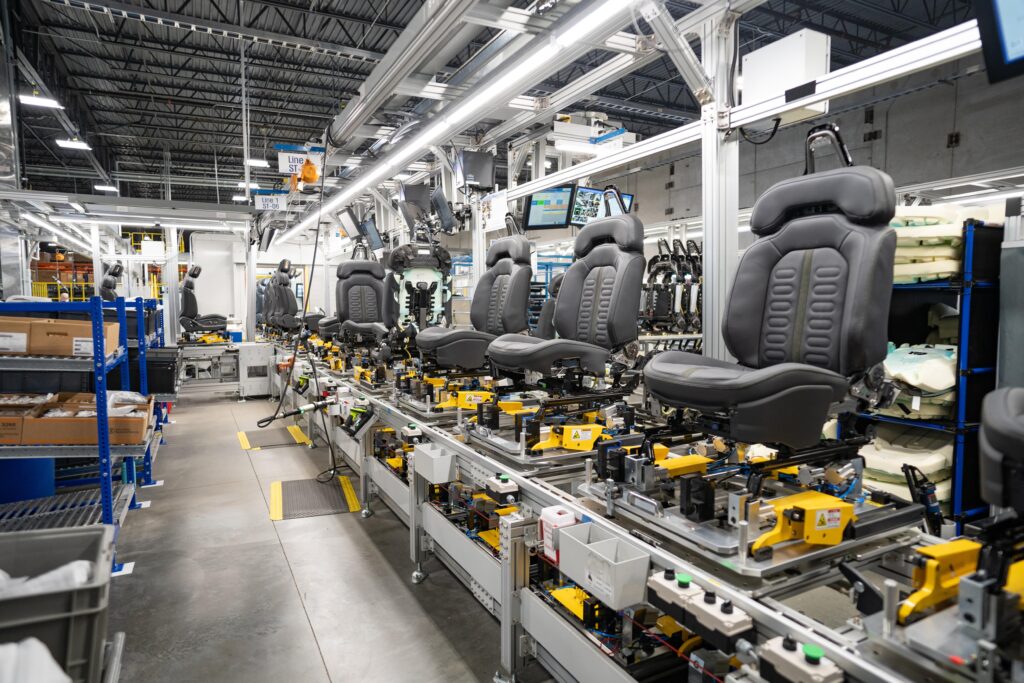
A seat conveyor line is an industrial material-handling system designed to transport automotive seats or seat assemblies between production, storage, and vehicle assembly areas.
The term can refer to two related applications. The first is a seat manufacturing conveyor line, where seats move between assembly, inspection, and testing stations. The second is a seat delivery conveyor line, which transports completed seats from a supplier’s production or logistics area to the final assembly line of an automotive plant.
Although these applications have different process requirements, both depend on controlled transportation, stable load support, and reliable coordination between upstream and downstream operations.
A typical seat conveyor line may include:
- Powered roller or chain conveyors
- Pallets and seat-specific locating fixtures
- Accumulation and buffering sections
- Lifting and lowering units
- Cross-transfer and direction-changing equipment
- Overhead conveyors or suspended carriers, where suitable
- Automated loading and unloading stations
- Sensors, PLC controls, and safety devices
- Identification and tracking interfaces, where required
For example, a seat delivery system may receive completed seats at a logistics unloading area, transport them through a buffer zone, and release them to the assembly line according to the required vehicle sequence.
By contrast, a seat manufacturing line may circulate dedicated pallets through assembly and inspection stations, allowing operators and automated equipment to complete different operations at defined locations.
Therefore, the first step in designing a seat conveyor line is to identify whether the primary objective is seat manufacturing, internal logistics, just-in-time delivery, or a combination of these functions.
Why Automotive Plants Need a Dedicated Seat Conveyor Line
Automotive seats are relatively bulky components, and their delivery must be coordinated with the vehicle assembly process. If the transportation method does not match production demand, seats may accumulate in work areas or arrive too late for installation.
A dedicated seat conveyor line helps manufacturers establish a more organized material flow.
Maintain Continuous Seat Supply
Final assembly operations require seats to be available when vehicles reach the relevant workstation. A conveyor system can establish a defined transportation route from the receiving area to the installation point, reducing dependence on repeated manual movement.
In addition, controlled accumulation allows the system to hold a limited quantity of seats when upstream delivery and downstream assembly operate at different instantaneous rates. This buffer can help absorb short interruptions without requiring the entire logistics process to stop immediately.
However, buffer capacity should be based on actual production conditions. Excessive accumulation occupies valuable floor space and may conceal problems in the upstream supply process.
Support Just-in-Time and Just-in-Sequence Delivery
Automotive plants often use just-in-time (JIT) logistics to reduce unnecessary inventory. In mixed-model production, just-in-sequence (JIS) delivery can also be important because different vehicles may require different seat configurations.
A seat conveyor line can support these strategies by controlling the release of seats according to the production sequence. Where required, barcode or RFID identification can be linked to production data to help verify seat identity and delivery destination.
The conveyor itself does not determine the correct sequence automatically. The identification method, production information, routing rules, and exception-handling logic must be designed as part of the complete system.
Reduce Manual Transportation
Repeatedly moving large seat assemblies between logistics areas and workstations can increase operator workload and create congestion. Automated or powered conveying reduces the need for operators to transport each seat manually.
As a result, personnel can focus more on material verification, installation, and other production activities. Furthermore, a planned conveyor route can help separate material movement from pedestrian access and other factory traffic.
The level of automation should still match the plant’s requirements. Some applications benefit from a fully automated delivery system, while others may use powered conveyors with manual loading and unloading.
Improve Material Flow and Floor-Space Utilization
Without a dedicated route, seat storage and transportation can compete with other activities for floor space. A conveyor layout helps define where seats enter the system, where they accumulate, and how they reach the installation area.
Where floor space is limited, overhead conveying may provide an alternative to floor-mounted transportation. However, overhead systems require suitable building structures, maintenance access, and carefully planned loading and unloading interfaces.
The best layout is the one that balances transportation efficiency, accessibility, safety, and maintainability.
Common Types of Seat Conveyor Lines
Different conveyor technologies serve different purposes. A seat manufacturing line may prioritize stable pallet positioning at assembly stations, whereas a seat delivery system may emphasize high-volume transportation, buffering, and sequence-based distribution.
1. Roller Conveyor Systems
Roller conveyors use rotating rollers to transport seats or seat carriers along a defined path. Depending on the load and application, the rollers may be powered directly or incorporated into a zoned conveying arrangement.
Roller conveyors are suitable for horizontal transportation and can be combined with accumulation sections, transfer units, and automated loading stations.
When seats are transported on pallets, the pallet dimensions, underside geometry, and load distribution must be compatible with the conveyor design. If the seats are conveyed directly, the contact surface must provide adequate support without damaging upholstery or exposed components.
Roller conveyors are often a practical choice for straight transportation sections and interfaces between different material-handling devices.
2. Chain Conveyor Systems
Chain conveyors are commonly considered when the application requires robust transportation of pallets or fixtures carrying relatively heavy assemblies.
In a seat assembly line, a pallet may support the seat throughout several processing stations. Chain-based conveying can move these pallets between work areas while maintaining a defined transportation route.
The final design depends on the required load, pallet construction, conveying speed, stopping accuracy, and maintenance conditions. Engineers should also consider chain wear, lubrication requirements, noise, and access for inspection.
For applications involving precise station positioning, the chain conveyor may be combined with mechanical stops, locating devices, or lifting-and-positioning units.
3. Pallet Conveyor Systems
Pallet conveyors are particularly useful when the seat must remain securely positioned throughout assembly or testing.
A dedicated pallet can incorporate locating features that accommodate a seat frame or a particular family of seat configurations. The pallet then travels through the required stations, where operators or automated equipment perform assembly, adjustment, inspection, or other operations.
Depending on the design, the system may use roller, chain, or modular conveyor technology. Transfer units can move pallets between parallel sections, while accumulation zones provide temporary storage between process steps.
Pallet-based transportation also supports traceability when pallet identification is connected to the control system. Nevertheless, the fixture must be designed around the actual seat geometry and production variants, rather than assuming that one locating arrangement will fit every seat.
4. Overhead Seat Conveyor Systems
An overhead conveyor transports seats using suspended carriers or dedicated fixtures supported by an overhead track or powered conveying system.
This configuration can be useful when floor space is restricted or when seats need to travel over existing production and logistics areas. It may also connect a receiving area with several downstream delivery points.
However, overhead conveying requires careful consideration of building structure, suspended load, carrier stability, vertical clearance, maintenance access, and safe loading and unloading.
The design should also account for the movement of people and other equipment beneath the conveyor. Overhead transportation is therefore best selected after evaluating the complete plant layout and the operational requirements of the seat delivery process.
5. Lift-and-Transfer Systems
Seat conveyor lines frequently need to change elevation, transfer loads between parallel routes, or present seats at a specific workstation height.
Lift-and-transfer equipment can raise a pallet, move it to another conveyor section, and lower it into the required position. Depending on the layout, cross-transfer units may also redirect seat carriers toward different delivery branches.
These devices help connect conveyor sections without requiring a single continuous route through the entire factory.
To achieve reliable operation, engineers should define the required load capacity, lifting stroke, positioning tolerance, cycle time, and control interlocks. The equipment must also be integrated with upstream and downstream conveyor logic to prevent conflicting movements.
How a Seat Conveyor Line Works
Although individual systems vary, a seat delivery conveyor line generally follows a sequence of receiving, identification, transportation, buffering, and final delivery.
Step 1: Seat Receiving and Loading
Completed seats enter the system from a manufacturing area, warehouse, or supplier receiving point. Depending on the project, loading may be manual or automated.
The loading station must provide sufficient access for operators or handling equipment. It should also ensure that seats are placed securely on their carriers before transportation begins.
Where different seat models share the same system, identification may be performed at this stage so that each seat can be associated with the appropriate production order or delivery destination.
Step 2: Controlled Transportation
Once the loading condition has been confirmed, the conveyor moves the seat toward the next designated section.
Sensors can detect carrier presence, monitor zone occupancy, and confirm whether downstream equipment is ready to receive the load. Based on these signals, the PLC controls conveyor movement and stopping conditions.
Zoned control is particularly useful where seats must accumulate temporarily. Instead of allowing every section to run continuously, the system can release loads according to downstream availability.
Step 3: Buffering and Sequence Management
A buffer separates the receiving process from final assembly, helping accommodate short-term differences between seat arrival and vehicle demand.
For sequence-sensitive applications, the control system must preserve the relationship between seat identity and delivery order. Barcode scanning, RFID, or integration with higher-level production systems may be used, depending on the traceability requirements.
If a seat is identified incorrectly or the expected delivery position is unavailable, the system should follow a predefined exception procedure. This may involve holding the seat, redirecting it to a verification point, or requesting operator intervention.
Step 4: Transfer to the Assembly Area
When the downstream workstation requires a seat, the system releases the corresponding carrier toward the designated delivery point.
The final transfer may involve a roller conveyor, a lift unit, a cross-transfer mechanism, or an overhead conveyor unloading station. At the delivery point, the seat must be positioned so that it can be retrieved or installed without unnecessary adjustment.
For JIS delivery, the system must also ensure that the correct seat reaches the correct vehicle sequence position. This requires coordination between production data, conveyor routing, and workstation readiness.
Step 5: Empty Carrier Return
Where seats are transported on reusable pallets or carriers, the system may include a return route for empty carriers.
Depending on the layout, empty pallets can be returned through a dedicated conveyor, a shared conveying route, or another material-handling method. Stacking equipment may also be incorporated where empty pallets need to be accumulated for storage or return.
The return arrangement should be planned alongside the loaded-seat route. Otherwise, empty carriers may accumulate in delivery areas or interfere with incoming material flow.
Key Design Considerations for a Seat Conveyor Line
A reliable seat conveyor line depends on coordinated mechanical design, production planning, controls, and safety engineering.
Seat Dimensions and Load Capacity
Seat assemblies differ in size, mass, center of gravity, and structural configuration. Front seats, rear bench assemblies, and other seat variants may require different support arrangements.
The system should be designed around the maximum expected load and the complete range of product dimensions. Where pallets or fixtures are used, their own weight must be included in the load calculation.
Engineers should also consider whether the seat can be transported in its normal installation orientation or whether a different orientation is required to fit the available route.
Production Rate and Conveyor Capacity
The conveyor must support the required seat delivery rate without creating unnecessary accumulation or interrupting downstream assembly.
Capacity calculations should include loading and unloading time, transfer cycles, stopping behavior, buffer occupancy, and the impact of minor equipment interruptions. Nominal conveyor speed alone is not enough to establish whether the system can meet production demand.
For a mixed-model line, engineers should also account for changes in seat type and handling requirements between consecutive vehicles.
Pallet and Fixture Design
Pallets and fixtures must support the seat securely throughout transportation and processing. Their locating features should prevent unwanted movement while allowing operators or automated equipment to access the required assembly points.
If several seat variants share the same conveyor, the fixture strategy must be defined carefully. Depending on the product range, the project may use a common pallet, interchangeable locating elements, or separate fixtures for different configurations.
Factory Layout and Delivery Routes
The layout determines the length of the conveyor, the location of buffers, and the number of transfer points required.
A practical design should consider existing production equipment, building columns, pedestrian walkways, emergency access, maintenance zones, and future expansion. It should also account for how seats enter the system and how empty carriers leave the delivery area.
Where overhead and floor-mounted conveying are combined, the transition points require particular attention because they affect both equipment coordination and material flow.
Control System and Traceability
PLC-based controls coordinate conveyor motors, sensors, stops, lifting devices, and transfer units. The control logic should define normal operating sequences as well as the response to equipment faults.
Where the application requires seat identification or sequence-based delivery, the system may interface with barcode readers, RFID devices, MES, or other production information systems.
These interfaces should be specified early in the project. The engineering team needs to define the information exchanged, the timing of each transaction, and the response when identification or communication fails.
Safety and Maintenance
Seat conveyor systems can contain moving chains, rollers, lifting mechanisms, transfer units, and suspended loads. Risk assessment should therefore be completed as part of the design process.
Depending on the application, protective measures may include guarding, interlocked access points, emergency stops, safe maintenance isolation, and clearly defined operating modes.
Maintenance access is equally important. Motors, sensors, bearings, chains, and lifting mechanisms should be accessible for inspection and replacement. Clear alarm messages and documented recovery procedures can also reduce troubleshooting time.
Seat Conveyor Line for Manufacturing vs. Final Assembly Delivery
Although both applications transport automotive seats, their primary engineering objectives differ.
| Evaluation Factor | Seat Manufacturing Conveyor | Seat Delivery Conveyor |
|---|---|---|
| Main purpose | Move seats through assembly and inspection processes | Deliver completed seats to vehicle assembly |
| Typical transport method | Pallet conveyor, chain conveyor, or roller conveyor | Floor-mounted or overhead conveyor, depending on layout |
| Positioning requirement | May require accurate positioning at each processing station | Requires reliable positioning at receiving and delivery points |
| Product tracking | Can track assembly progress and inspection results | Can support seat identification and vehicle-sequence matching |
| Buffering objective | Balance different manufacturing operations | Separate seat supply from vehicle assembly demand |
| Main integration points | Assembly tools, inspection stations, testing equipment | Receiving, logistics, production sequencing, and final assembly |
| Empty carrier handling | Pallet circulation through the manufacturing line | Return or accumulation of reusable delivery carriers |
The correct configuration depends on the actual application. Some factories require only transportation from the seat supplier to the vehicle assembly line, while others need an integrated solution that includes internal seat manufacturing, buffering, and final delivery.
Common Challenges in Seat Conveyor Line Projects
Incorrect Seat Positioning
Seats have complex shapes, and unstable positioning can make unloading or installation more difficult. This is particularly important when carriers are used to present seats to automated handling equipment.
To reduce the risk, the carrier and fixture should be designed around the actual seat geometry, while stopping devices and transfer mechanisms should be validated under representative operating conditions.
Insufficient Buffer Capacity
A buffer that is too small may allow short upstream interruptions to affect final assembly. Conversely, an oversized buffer may occupy excessive space and complicate seat tracking.
Buffer capacity should be determined from the required delivery interval, expected interruptions, replenishment behavior, and available floor space.
Incorrect Sequence Delivery
In mixed-model production, delivering the wrong seat configuration can disrupt assembly and require manual correction.
A robust design should define identification, sequence validation, destination assignment, and exception handling. The system should not rely solely on an assumed arrival order if upstream operations can introduce delays or reordering.
Poor Coordination Between Conveyor Sections
A transfer unit may be mechanically capable of moving a seat but still cause delays if upstream and downstream controls are not properly synchronized.
Therefore, interface signals, equipment-ready conditions, fault responses, and restart procedures should be agreed upon before commissioning.
Difficult Maintenance Access
Conveyors routed through confined areas or elevated structures can be difficult to inspect and repair. This can increase downtime when components require adjustment or replacement.
The layout should provide practical access to drive units, sensors, transfer mechanisms, and other maintenance points. Where overhead conveying is used, safe access for inspection must be included in the engineering plan.
How to Select a Seat Conveyor Line Supplier
Selecting a supplier requires an evaluation of both equipment capability and system integration experience.
Automotive application experience: The supplier should understand seat handling, final assembly logistics, product variation, and the importance of coordinating material delivery with vehicle production.
Mechanical engineering capability: The supplier should be able to design conveyors, pallets, fixtures, lifting devices, and transfer units around the actual load and layout requirements.
Controls integration: A qualified integrator should define how conveyor sections, sensors, identification equipment, and downstream workstations communicate.
Layout and capacity planning: The proposal should address production rate, buffer capacity, transportation routes, loading conditions, and maintenance access.
Safety and maintainability: The design should include appropriate protective measures, clear operating procedures, and practical maintenance access.
Installation and commissioning support: The supplier should be able to coordinate mechanical installation, electrical work, controls commissioning, interface testing, and operator handover.
Before requesting a quotation, manufacturers should prepare the available plant layout, seat dimensions and weights, required throughput, loading and unloading conditions, delivery sequence, and interface requirements. These details help establish a more accurate technical scope.
Seat Conveyor Line Solutions from Hongbo Automation
Hongbo Automation provides automotive assembly-line and material-handling solutions for manufacturing environments. For seat conveyor line projects, the system concept can be developed according to the required production flow, seat characteristics, factory layout, and interfaces with adjacent equipment.
Depending on the project scope, an engineered solution may include powered conveyors, pallet handling, accumulation sections, transfer equipment, lifting units, and PLC-based control integration.
For seat delivery applications, particular attention should be given to the route from receiving and buffering areas to the vehicle assembly line. Where production sequencing is required, the identification and control strategy should also be defined so that the delivery process supports the plant’s operational requirements.
Each project should be evaluated individually. Conveyor type, carrier design, buffer capacity, and automation level should be selected according to the actual application rather than based on a standard configuration alone.
For automotive manufacturers planning a new assembly facility or upgrading an existing material-handling system, early coordination between production engineering, logistics, and the system integrator can help identify interface requirements and reduce implementation risks.
Frequently Asked Questions About Seat Conveyor Lines
What is a seat conveyor line used for?
A seat conveyor line transports automotive seats between manufacturing, storage, receiving, and vehicle assembly areas. Depending on the application, it may also support buffering, seat identification, sequence management, and empty carrier return.
Which conveyor type is suitable for automotive seats?
Roller conveyors, chain conveyors, pallet conveyors, and overhead conveyors can all be suitable for specific applications. The selection depends on seat dimensions, load characteristics, transportation route, required throughput, positioning needs, and available factory space.
Can a seat conveyor line support different vehicle models?
Yes. A system can be designed to handle multiple seat variants through suitable pallets, fixtures, identification methods, and routing logic. However, the actual range of supported variants must be established during engineering.
What is the difference between JIT and JIS seat delivery?
Just-in-time (JIT) delivery focuses on supplying seats when they are needed, helping limit unnecessary inventory. Just-in-sequence (JIS) delivery additionally requires seats to arrive in the sequence corresponding to vehicle production. JIS applications therefore place greater emphasis on identification, sequence validation, and routing control.
Can a seat conveyor line use overhead transportation?
Yes. Overhead conveying can be considered when floor space is limited or when seats need to travel between separated production areas. The design must account for suspended loads, building structure, clearance, safe access, and the loading and unloading interfaces.
What information is needed to design a seat conveyor line?
Key information includes seat dimensions and weights, required production rate, plant layout, loading and unloading conditions, conveyor route, buffer requirements, product variants, automation level, and any identification or production-system interfaces.
Conclusion
A seat conveyor line is an important part of automotive manufacturing logistics, helping move seats through production processes or deliver completed assemblies to vehicle installation stations. By combining suitable conveying equipment with stable carriers, controlled buffering, reliable transfer mechanisms, and well-defined control interfaces, manufacturers can establish a more organized and predictable seat supply process.
The most effective design depends on the application’s specific requirements. Seat manufacturing lines may prioritize pallet positioning and process integration, while final assembly delivery systems may focus on transportation capacity, sequence accuracy, and coordination with vehicle production.
With appropriate engineering and system integration, a seat conveyor line can support smoother material flow, reduce unnecessary handling, and improve the coordination between seat supply and automotive assembly operations.