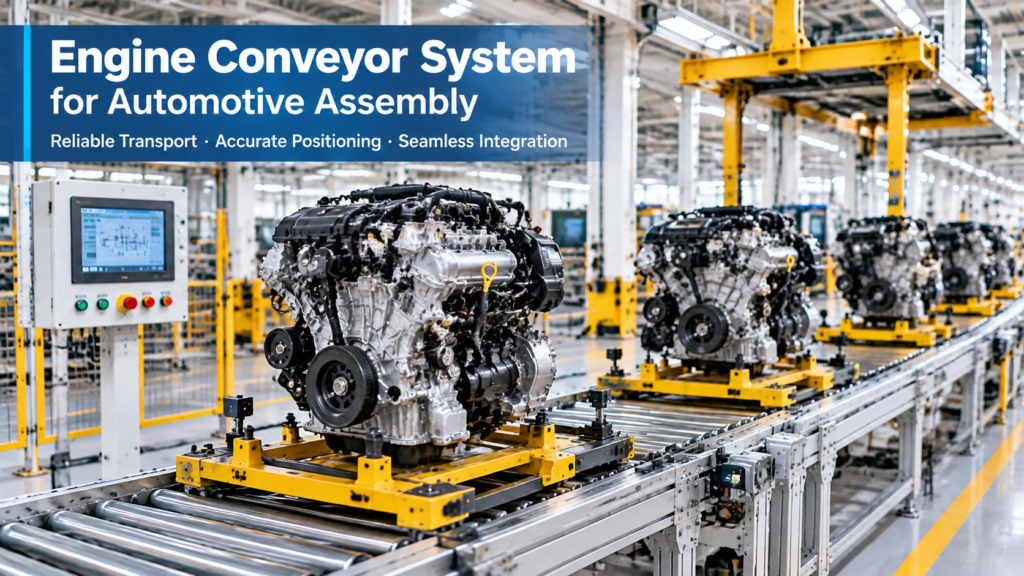
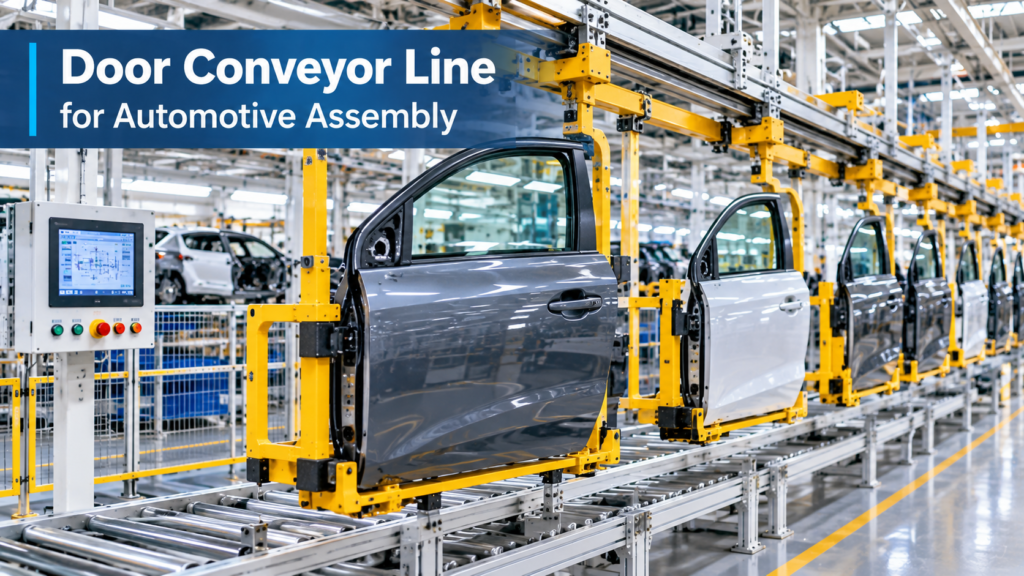
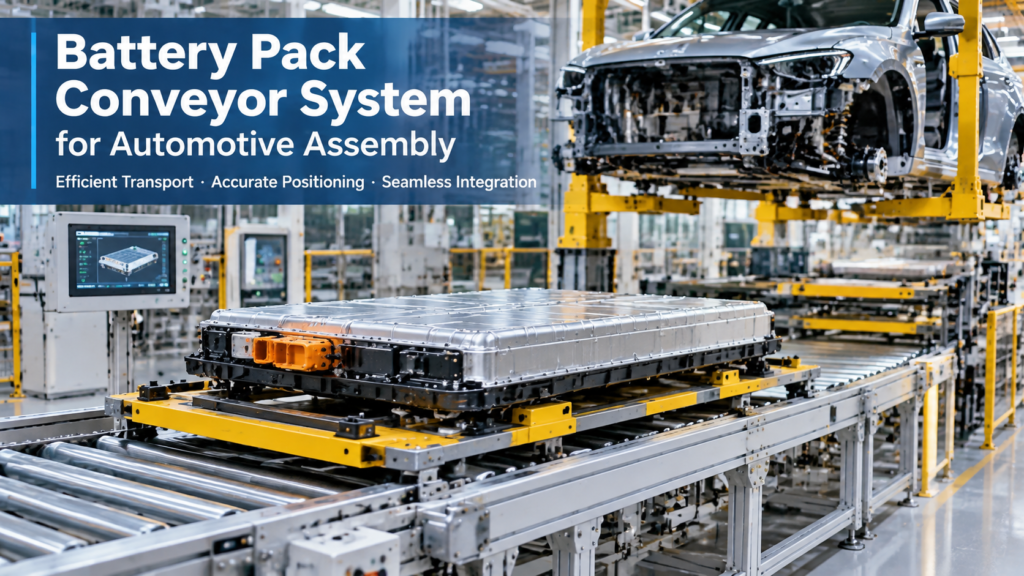
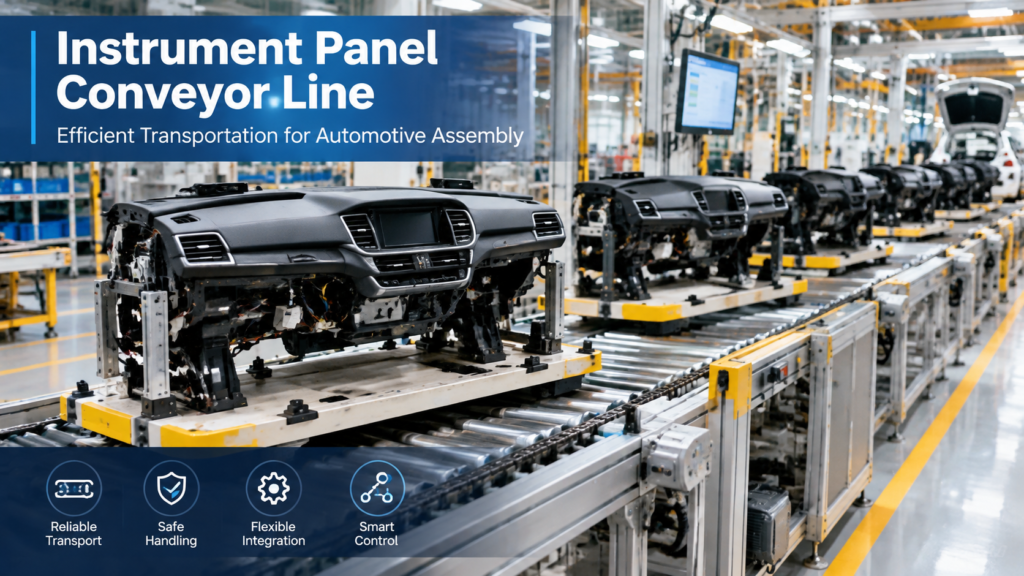
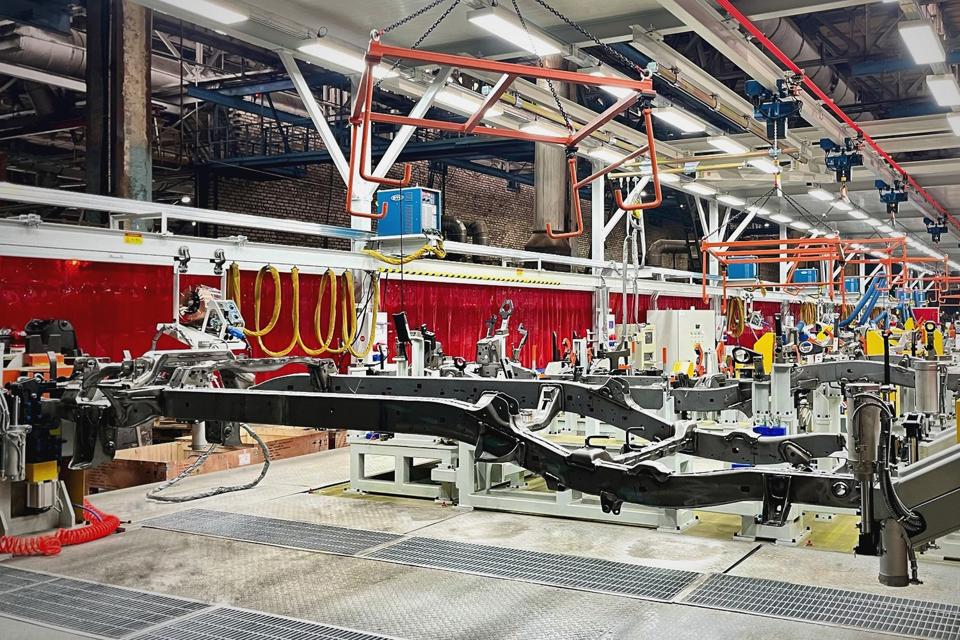
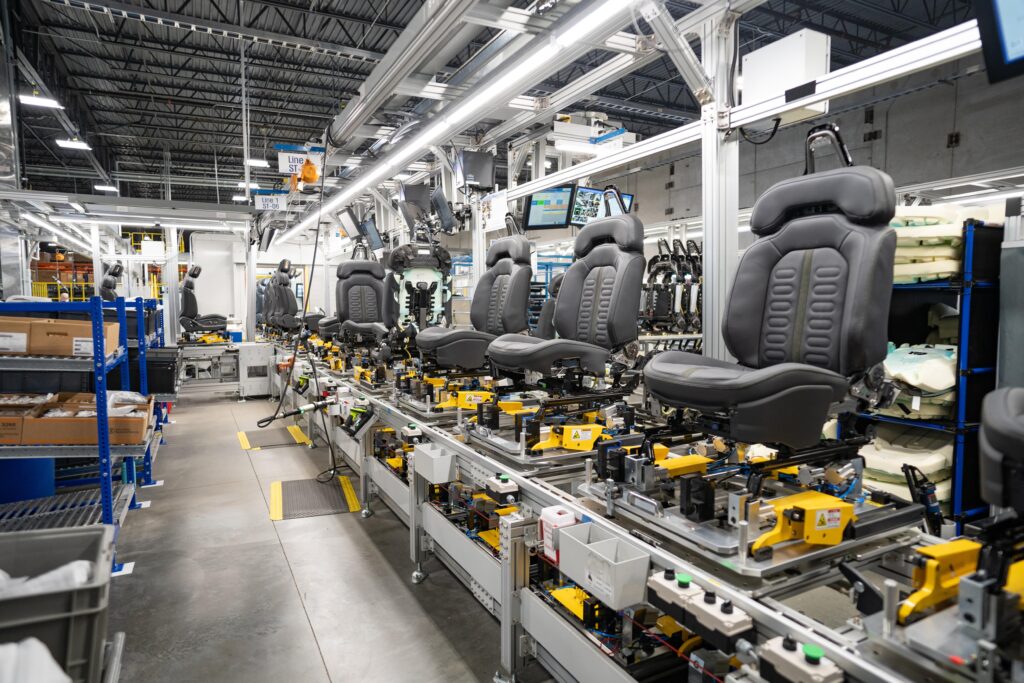
An automotive assembly line material handling system coordinates the movement of components, subassemblies, pallets, and finished products throughout a vehicle manufacturing facility. Rather than relying on a single conveyor or handling machine, an integrated system combines material transport equipment, positioning mechanisms, automated vehicles, storage buffers, and control systems to support a continuous production flow.
For automotive manufacturers, effective material handling is essential because production stations must receive the correct components at the right time and in the right sequence. If material delivery falls behind the assembly process, workstations may become idle. Conversely, excessive work-in-process (WIP) inventory can occupy valuable floor space and make production control more difficult. Therefore, a well-designed material handling system must balance throughput, flexibility, positioning accuracy, safety, and production requirements.
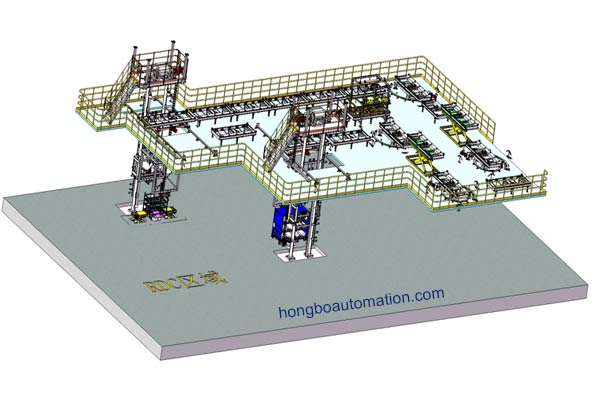
This article explains the main types of automotive material handling equipment, how these systems work together, and what manufacturers should consider when planning an automated assembly line.
What Is an Automotive Assembly Line Material Handling System?
An automotive assembly line material handling system is an integrated arrangement of equipment and controls used to transport, position, buffer, and deliver materials between manufacturing operations. Depending on the production process, it may handle individual components, engine blocks, transmission housings, axles, battery packs, seats, chassis modules, or complete vehicle assemblies.
Unlike a standalone conveyor, a complete material handling system considers the entire production flow. For example, a transmission assembly line may require pallets to move between manual assembly stations, automated tightening equipment, press-fitting machines, inspection stations, and end-of-line testing equipment. The system must also manage pallet positioning, workstation access, empty pallet return, and communication with production controls.
Consequently, material handling design involves more than selecting transport equipment. It requires coordination between mechanical engineering, electrical controls, workstation layout, production planning, and safety engineering.
Main Types of Automotive Material Handling Systems
Automotive factories use different handling technologies according to component weight, transport distance, required positioning accuracy, production volume, and model variety. In many applications, several technologies operate together rather than independently.
1. Conveyor Systems
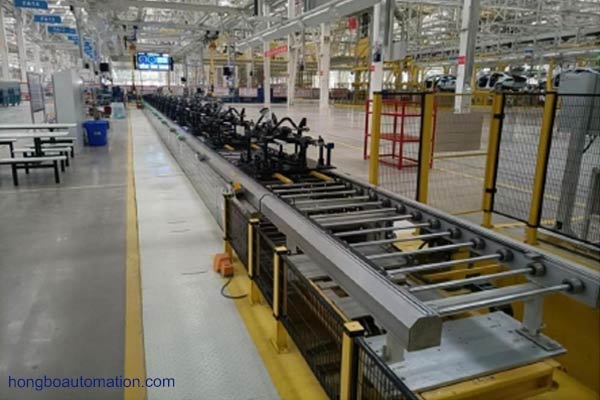
Conveyors provide a fixed route for transporting components or pallets between production stations. They are widely used where material follows a defined sequence and production requires predictable, repeatable movement.
Common conveyor types include:
- Pallet conveyor systems: Transport components mounted on dedicated pallets or fixtures through assembly and inspection stations.
- Roller conveyors: Move pallets, containers, or compatible workpieces along horizontal routes.
- Chain conveyors: Support applications requiring robust transport and, depending on the design, heavier loads.
- Slat conveyors: Carry products or fixtures on connected slats, making them suitable for selected automotive production and material transport applications.
- Vertical conveyor systems: Transfer pallets or materials between different production levels.
- Overhead conveyors: Move compatible components above floor-level work areas to preserve floor space.
The appropriate conveyor depends on the load, routing, accumulation requirements, environmental conditions, and required cycle time. For instance, a pallet conveyor may be suitable for a transmission assembly line, while an overhead system may be more appropriate for certain seat or body-component handling operations.
2. Pallet Handling Systems
Pallet handling systems manage the circulation of production pallets and fixtures throughout an assembly line. They may include pallet conveyors, stackers, destackers, pallet dispensers, buffers, and return mechanisms.
A pallet provides a repeatable interface between the workpiece and the production equipment. As a result, the same pallet can carry a component through multiple operations while maintaining a defined reference for positioning and identification.
For example, a powertrain assembly line may use dedicated pallets to transport engine or transmission assemblies between stations. At an automated workstation, a lift-and-locate mechanism raises and positions the pallet so that tightening, pressing, or inspection equipment can operate within the required tolerances.
In addition, empty pallet recovery is important for maintaining continuous operation. A properly designed system returns unused pallets to the appropriate loading point rather than allowing them to accumulate at the end of the line.
3. Transfer Machines and Cross Transfer Systems
Transfer equipment moves components or pallets between conveyor sections, workstations, or parallel production routes. Depending on the arrangement, a transfer machine may use lifting mechanisms, rollers, chains, forks, or other engineered mechanisms.
A cross transfer system is particularly useful when pallets must move laterally between parallel conveyors. For example, a production line may use cross transfers to divert a pallet to a secondary inspection station or connect two parallel assembly sections.
These systems can also support routing changes, buffer access, and pallet circulation. However, the transfer sequence must be coordinated with conveyor occupancy, workstation status, and safety interlocks to prevent collisions or unintended movement.
4. AGV and AMR Material Handling Systems
Automated guided vehicles (AGVs) and autonomous mobile robots (AMRs) transport materials along routes that may change according to production demand.
AGVs commonly follow a defined guidance or navigation arrangement, whereas AMRs generally use onboard sensing and navigation capabilities to adapt their movements within a configured operating environment. Actual capabilities depend on the vehicle, navigation technology, and fleet management system.
In automotive manufacturing, these vehicles can deliver components from storage areas to line-side stations, move assemblies between production zones, and support flexible logistics for multiple product variants.
Compared with fixed conveyors, AGVs and AMRs can offer greater route flexibility. Nevertheless, their performance depends on traffic management, charging arrangements, floor conditions, load interfaces, pedestrian safety, and the reliability of material dispatching. Therefore, mobile robots are not automatically the best choice for every application.
5. Robotic Material Handling Systems
Industrial robots provide automated handling when components require precise orientation, controlled movement, or integration with another production operation. Typical applications include loading and unloading machines, transferring components between fixtures, and moving parts into assembly or inspection stations.
For example, a robot may pick up a component from a conveyor, position it in a press-fitting machine, and transfer it to a downstream inspection station after processing. In other applications, robotic handling supports the installation of automotive subassemblies or the loading of parts into automated testing equipment.
Robot selection must account for payload, reach, cycle time, tool design, component geometry, and required repeatability. Moreover, robot motion must be coordinated with the conveyor and workstation controls to maintain a reliable production sequence.
6. Lift Tables and Vertical Material Handling Equipment
Lift tables and vertical conveyors accommodate height differences between production equipment, conveyor levels, and working platforms. They are useful when components must move between floors or when pallets need to reach a specific workstation elevation.
A lift table may also form part of a lift-and-locate system. In this configuration, the mechanism raises the pallet and establishes a defined position for an assembly, tightening, or inspection operation.
The design must consider load capacity, center of gravity, lifting stroke, positioning requirements, mechanical stability, and guarding. Where a lifting device interacts with a moving conveyor, control interlocks must ensure that the pallet is correctly positioned before lifting begins.
7. Buffer and Storage Systems
Buffers temporarily hold materials or workpieces between production operations. They help separate upstream and downstream processes so that a short interruption at one station does not immediately stop the entire line.
Depending on the application, buffers may use conveyor accumulation, indexed pallet positions, dedicated storage lanes, or automated storage equipment.
However, additional buffer capacity does not necessarily improve production performance. Excessive accumulation can hide process problems, increase WIP, and complicate material tracking. For this reason, buffer capacity should be based on expected cycle-time variation, equipment availability, replenishment lead time, and the required level of production continuity.
How Material Handling Systems Work in an Automotive Factory
A typical automotive material flow begins with component storage and continues through line-side delivery, assembly, inspection, and downstream processing. The exact sequence depends on the product and factory layout, but the main functions can be organized into several stages.
Stage 1: Component Supply and Line-Side Delivery
Components are received from storage, supermarkets, or upstream production areas. Depending on the material flow strategy, delivery may use forklifts, tugger trains, AGVs, AMRs, conveyors, or a combination of these methods.
At this stage, the main objective is to supply the correct part to the correct workstation without obstructing production or creating excessive inventory. Therefore, the system should define replenishment frequency, container or pallet interfaces, delivery routes, and the handling method for empty containers.
Stage 2: Workpiece Loading and Positioning
Components enter the assembly process either individually or on dedicated pallets. The handling system moves each workpiece to the required station, where stops, locating pins, clamps, lift tables, or other mechanisms establish the necessary position.
This distinction is important because transport accuracy and process positioning accuracy are not the same. A conveyor may deliver a pallet to a general station location, while a separate locating mechanism establishes the precise reference needed for machining, pressing, tightening, or inspection.
Stage 3: Assembly and Automated Processing
During production, the material handling system coordinates with assembly equipment, industrial robots, fastening systems, and inspection devices. The controls must ensure that each operation begins only when the required workpiece, tooling, and safety conditions are confirmed.
For example, an engine assembly line may combine pallet conveyors, automatic bolt tightening, press-fitting equipment, vision inspection, and leak testing. In this arrangement, the handling system manages movement and positioning, while individual machines perform the manufacturing operations.
Stage 4: Inspection and Downstream Transfer
After assembly, components may pass through dimensional inspection, functional testing, leak testing, or other end-of-line checks. Depending on the production strategy, the system can route workpieces to rework stations, additional inspection, or the next manufacturing process.
Routing decisions should be based on verified machine status and inspection results. Otherwise, a failed component may enter the next process without the required disposition.
Stage 5: Pallet Return and Material Replenishment
After a component leaves a pallet, the pallet may be returned, buffered, cleaned, or prepared for another production cycle. Meanwhile, upstream stations continue supplying materials according to production demand.
A complete design must account for both loaded and empty movement. Without an effective return route, empty pallets can become a bottleneck even when the main production conveyor has sufficient capacity.
Fixed Conveyors vs. AGVs and AMRs
The choice between fixed and mobile handling equipment depends on the stability of the production route and the level of flexibility required.
| Design factor | Fixed conveyor systems | AGV and AMR systems |
|---|---|---|
| Transport route | Generally fixed | Can support configurable routes |
| Production volume | Well suited to stable, repetitive flows | Useful for flexible or distributed flows |
| Layout changes | May require mechanical modifications | Routes may be adjusted within system limits |
| Floor space | Requires dedicated conveyor space | Requires travel lanes and safe operating areas |
| Traffic management | Mainly managed through conveyor controls | Requires vehicle coordination and traffic management |
| Best-fit applications | Continuous or indexed production lines | Material delivery between areas and flexible logistics |
These approaches are not mutually exclusive. In many automotive factories, fixed conveyors handle repetitive movement inside an assembly line, while AGVs or AMRs supply components from storage areas and connect separate production zones.
A hybrid arrangement can therefore combine the predictable throughput of fixed equipment with the routing flexibility of mobile systems. The key is to define clear interfaces, responsibilities, and control logic between each transport method.
Key Design Considerations for Automotive Material Handling
1. Production Takt Time and Throughput
The handling system must support the required production rate without creating unnecessary delays between workstations. Designers should consider station cycle times, transfer duration, accumulation logic, loading and unloading time, and expected equipment availability.
For indexed production lines, the transfer sequence must fit the planned production cycle. For asynchronous systems, the design must also account for variable station times, buffer capacity, and routing constraints.
2. Payload and Workpiece Characteristics
Load capacity should be calculated using the total handled mass, including the component, pallet, fixture, and any tooling carried by the transport device. In addition, the design should consider center of gravity, dimensions, contact surfaces, and load stability during acceleration or transfer.
For heavy components such as engines, axles, and battery assemblies, the structure, drive system, lifting mechanism, and safety devices must be selected for the actual operating conditions rather than nominal component weight alone.
3. Positioning Accuracy and Repeatability
Different operations require different levels of positioning performance. General material transport may tolerate a wider positional range, whereas robotic assembly, precision pressing, and automated inspection may require a dedicated locating mechanism.
Consequently, engineers should specify the positioning requirements at the workstation interface and determine whether mechanical stops, locating pins, clamping fixtures, sensors, or servo positioning are needed.
4. Factory Layout and Material Flow
A good layout minimizes unnecessary transport, avoids crossing traffic where possible, and provides sufficient access for maintenance and material replenishment. Designers should also consider aisle width, pedestrian routes, emergency access, loading areas, and future expansion.
For example, a compact assembly line may use vertical conveyors to connect different levels, while a high-volume powertrain line may rely on a defined pallet conveyor loop with cross transfers and accumulation zones.
5. PLC, MES, WMS, and Traceability
The programmable logic controller (PLC) typically manages equipment sequences, sensors, actuators, interlocks, and local transport logic. Higher-level systems may provide production scheduling, material requests, workpiece identification, inventory visibility, and process traceability.
A manufacturing execution system (MES) can associate production records with a component or pallet identifier, while a warehouse management system (WMS) may coordinate inventory and replenishment activities. However, these systems have different responsibilities, so the integration architecture should define data ownership, communication interfaces, and fault-handling behavior.
Barcode or RFID identification can help track pallets and materials through the production process. When a routing decision depends on product identity or inspection status, the control system must validate the relevant data before authorizing the next movement.
6. Safety and Maintenance
Material handling equipment introduces mechanical movement, lifting hazards, pinch points, and potential interactions between vehicles and pedestrians. Accordingly, the design should incorporate appropriate guarding, emergency stops, interlocks, safe access provisions, and risk-assessed protective devices.
For AGV and AMR applications, additional considerations include obstacle detection, traffic control, operating zones, charging arrangements, and recovery procedures. Maintenance planning should also address drive components, sensors, rollers, chains, lifting mechanisms, locating devices, and control-system diagnostics.
Automotive Applications of Integrated Material Handling Systems
Integrated material handling solutions are used across many automotive production processes, although the equipment configuration varies with component size, process sequence, and required automation level.
- Engine assembly lines: Pallet conveyors, lift-and-locate stations, transfer equipment, and robotic loading can support assembly, tightening, pressing, and testing.
- Transmission assembly lines: Dedicated pallets and positioning systems transport housings and assemblies between mechanical assembly, measurement, and functional inspection stations.
- Axle and chassis production: Heavy-duty conveyors, transfer devices, lifting equipment, and AGVs can support the movement of large components and subassemblies.
- Electric vehicle production: Battery pack, electric drive unit, and motor assembly operations may require load-rated pallets, controlled transfers, precision positioning, and traceability.
- Seat and interior component lines: Conveyors and automated delivery systems can supply bulky components to assembly stations while coordinating production sequence and replenishment.
- Inspection and testing lines: Conveyors, buffers, and routing mechanisms move workpieces through inspection equipment and direct them to the appropriate downstream process.
In each case, the material handling architecture should reflect the manufacturing process rather than force every application into the same equipment configuration.
How to Select an Automotive Material Handling System
Before selecting equipment, manufacturers should define the production requirements and map the material flow from the point of supply to the final destination. This helps identify where fixed conveyors, mobile robots, buffers, or dedicated transfer mechanisms provide the greatest value.
A practical evaluation should include:
- Product and load requirements: Identify component dimensions, total handled mass, fixture design, and handling constraints.
- Production targets: Define takt time, required throughput, shift patterns, and expected production mix.
- Routing and layout: Map transport distances, station locations, height changes, access routes, and possible traffic conflicts.
- Positioning requirements: Establish the accuracy and repeatability required at each workstation.
- Automation scope: Determine where conveyors, AGVs, AMRs, robots, or manual handling are appropriate.
- Control and traceability: Define PLC sequences, identification methods, communication interfaces, and MES or WMS requirements.
- Safety and maintenance: Assess operating risks, service access, spare parts, diagnostics, and planned maintenance.
- Expansion and lifecycle costs: Consider future models, production changes, energy consumption, equipment availability, and the cost of modifications.
After these requirements are defined, the supplier can develop the equipment layout, operating sequence, control concept, and interface specifications. This approach reduces the risk of selecting equipment that meets individual component specifications but does not perform effectively as part of the complete production system.
Automotive Material Handling Solutions from Hongbo Automation
Hongbo Automation provides automotive production line equipment and integrated automation solutions for vehicle manufacturers and automotive component producers. Depending on the project scope, a material handling system can combine pallet conveyors, cross transfer systems, vertical conveyors, lift tables, pallet handling equipment, and dedicated transfer machines.
For powertrain and automotive parts production, these systems can be integrated with assembly stations, robotic handling, press-fitting equipment, tightening systems, and inspection processes. The final configuration depends on workpiece characteristics, production targets, factory layout, automation requirements, and the customer’s control-system specifications.
Rather than treating each handling device as an isolated machine, system planning should establish how materials move through the entire production process, how pallets are returned, how workstations exchange status signals, and how production data is tracked. This integrated approach helps manufacturers develop a material handling architecture suited to their manufacturing requirements.
Frequently Asked Questions
What is an automotive material handling system?
An automotive material handling system is a combination of equipment and controls used to transport, position, store, and deliver components or assemblies throughout an automotive manufacturing facility. It may include conveyors, pallet handling equipment, transfer machines, AGVs, AMRs, robots, and buffer systems.
What is the difference between a conveyor system and a material handling system?
A conveyor system is one type of material handling equipment that moves materials along a defined route. A complete material handling system may also include conveyors, lifting devices, pallet stackers, robots, mobile vehicles, storage buffers, identification technology, and integrated controls.
Are AGVs or AMRs better than conveyors for automotive production?
Neither option is universally better. Fixed conveyors are often suitable for stable, repetitive production flows, whereas AGVs and AMRs can support more flexible material delivery and connections between production areas. A hybrid system may be appropriate when the factory needs both predictable line-side transport and adaptable logistics.
How does pallet handling improve automotive assembly?
Pallet handling provides a consistent interface for transporting components between stations. With suitable fixtures and locating mechanisms, it also supports repeatable positioning, automated processing, pallet identification, and empty pallet recovery.
Can material handling equipment be integrated with MES?
Yes. Depending on the control architecture, PLC-based equipment can exchange relevant production and identification data with an MES. Integration may support workpiece tracking, production status reporting, routing decisions, and traceability, provided that communication interfaces and data responsibilities are clearly defined.
What information is needed to design an automotive material handling system?
The main inputs include workpiece dimensions and mass, pallet and fixture details, production takt time, station layout, transfer distances, positioning requirements, automation scope, safety constraints, and communication requirements. With these inputs, engineers can evaluate equipment types, capacity, routing, control logic, and future expansion needs.
Conclusion
An effective automotive assembly line material handling system integrates transport, positioning, buffering, pallet circulation, and production control into a coordinated manufacturing process. Conveyors, transfer machines, pallet handling equipment, AGVs, AMRs, and robots each serve different purposes; therefore, the best solution depends on how materials must move, how accurately they must be positioned, and how the production line operates.
By defining material flow and control requirements before selecting individual machines, automotive manufacturers can develop a system that supports production throughput, traceability, safety, and future expansion.