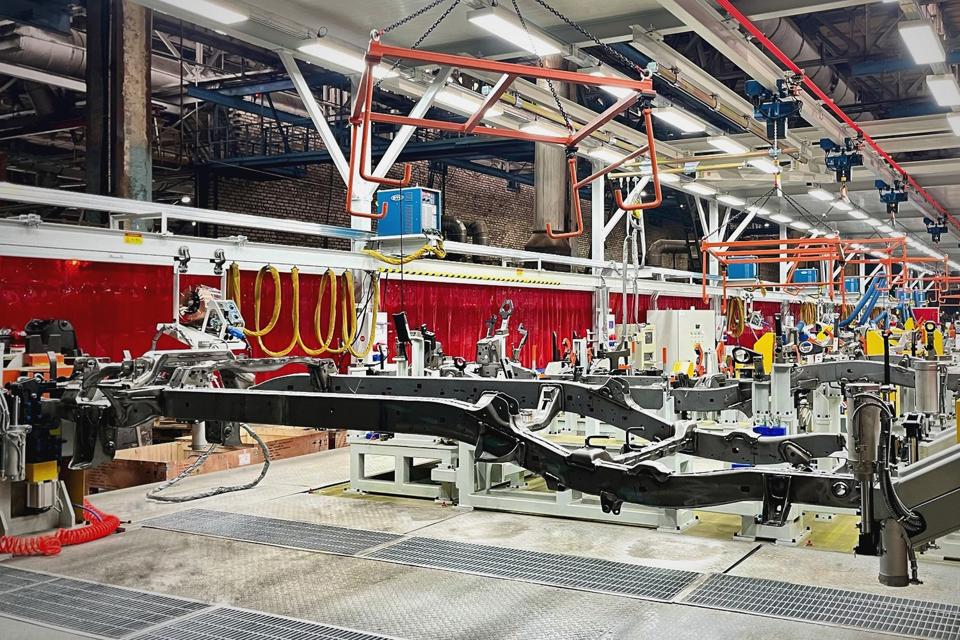
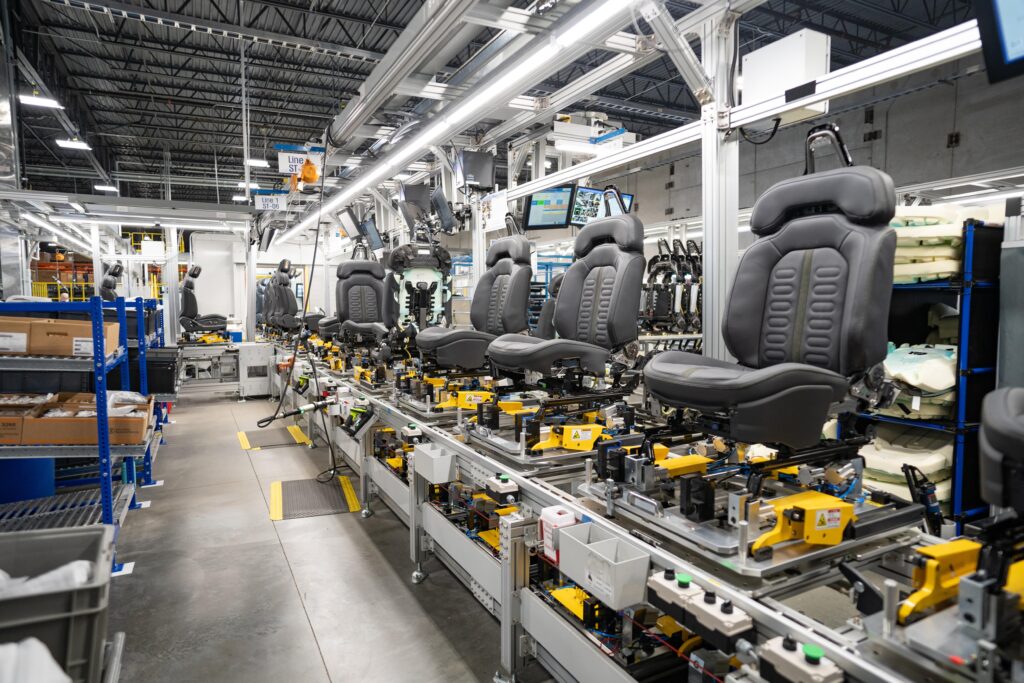
In automotive manufacturing, tire handling is an important part of the final assembly process. Tires must move from storage or supply areas to the correct installation stations at the right time. As vehicle production becomes more automated, a well-designed tire conveyor system helps manufacturers organize material flow, reduce manual handling, and coordinate tire delivery with the assembly line.
A tire conveyor system for automotive assembly is not simply a means of transporting tires from one location to another. Depending on the production layout, it may include conveying equipment, accumulation zones, transfer mechanisms, lifting devices, and control systems. These components work together to deliver tires efficiently while maintaining a stable supply to downstream operations.
For automotive manufacturers planning a new assembly line or upgrading an existing facility, understanding tire conveyor configurations, system design considerations, and integration requirements is essential to selecting an appropriate solution.
Watch youtube video of our Tire Conveyor System:
How a Tire Lane Diverting System Works | Automotive Tire Conveyor #shorts
What Is a Tire Conveyor System?
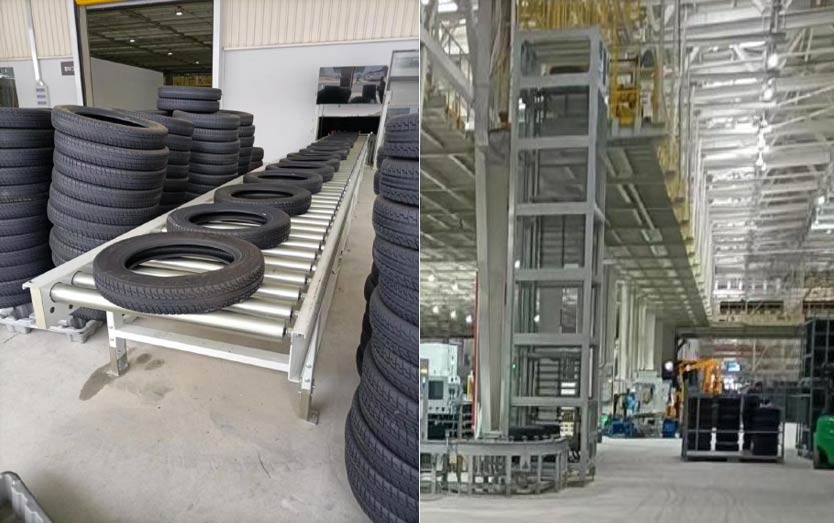
A tire conveyor system is a material handling solution designed to transport tires between storage areas, preparation stations, inspection points, and vehicle assembly workstations. It can be used for passenger cars, commercial vehicles, and other automotive production applications, depending on tire dimensions, load requirements, and process conditions.
Unlike general-purpose conveyors, tire conveying equipment must accommodate the geometry and handling characteristics of tires. Tires may be transported individually, in groups, on dedicated carriers, or through specially designed handling arrangements. The most suitable configuration depends on the production process and the degree of automation required.
In an automotive factory, the tire conveyor line may connect with warehouse operations, tire preparation areas, assembly stations, and other material handling systems. Consequently, the system should be designed around the complete material flow rather than as an isolated piece of equipment.
A properly engineered solution considers tire size, conveyor capacity, transfer distance, buffer requirements, workstation access, and the timing of tire delivery. These factors help determine the conveyor type, layout, and control strategy.
Applications of Tire Conveyor Systems in Automotive Manufacturing
Tire conveyor systems can support several stages of automotive production. Although the exact arrangement varies by factory, the following applications are common design considerations.
Tire Transportation to Assembly Stations
One of the primary applications is transporting tires from a supply area to vehicle assembly stations. Instead of requiring operators to move tires manually over long distances, a conveyor system provides a defined route between material supply and installation points.
This arrangement can improve material flow and reduce unnecessary handling. Furthermore, when the conveyor is integrated with production scheduling and workstation requirements, tires can be delivered in a more organized sequence.
The system layout should account for the distance between the supply area and the assembly line, the number of stations served, and the required delivery frequency. Where several stations share a common supply route, transfer points and distribution logic must be carefully planned.
Tire Buffering and Accumulation
Automotive assembly operations do not always consume materials at a perfectly constant rate. Short production interruptions, changes in workstation availability, and variations in replenishment timing can create temporary differences between tire supply and demand.
For this reason, a tire conveyor line may incorporate accumulation sections or designated buffer areas. These sections provide temporary storage within the material handling process, helping separate upstream supply activities from downstream installation operations.
However, buffer capacity should be based on actual production requirements. An undersized buffer may provide insufficient protection against short interruptions, while an oversized accumulation area can consume valuable factory space and increase equipment costs.
Tire Distribution and Transfer
Some production layouts require tires to move between different conveyor sections, elevations, or destinations. In these cases, transfer equipment may be needed to connect the main conveying route with individual supply lanes or assembly stations.
Depending on the layout, the system may use dedicated transfer mechanisms, lifting devices, or other compatible conveying equipment. The selection depends on the required transfer direction, available space, tire handling method, and cycle time.
In addition, the transfer sequence should be coordinated with upstream and downstream equipment to prevent congestion and unnecessary waiting.
Integration with Wheel and Tire Assembly Processes
Tire logistics may be connected with wheel assembly, tire preparation, inspection, or wheel-and-tire delivery processes. The exact scope depends on whether the factory handles tires and wheels separately or supplies assembled wheel-and-tire units to the vehicle line.
For example, where wheel-and-tire assemblies are delivered to installation stations, the conveyor system may need to accommodate the combined unit’s dimensions, weight, orientation, and carrier requirements. These characteristics can differ substantially from those of individual tires.
Therefore, the conveyor design should be based on the actual material being transported rather than assuming that all tire-related applications require the same equipment.
Types of Tire Conveyor Systems
There is no single conveyor configuration suitable for every automotive tire handling application. Instead, equipment selection should reflect the product characteristics, production process, and factory layout.
Roller Conveyor Systems
Roller conveyors move compatible loads along a series of rollers. Depending on the design, movement may be powered or gravity-assisted, although powered configurations are generally considered when controlled movement and predictable positioning are required.
For tire-related applications, roller conveyor suitability depends on tire dimensions, contact conditions, load stability, and the use of dedicated carriers or supporting fixtures. A conventional roller conveyor should not be assumed suitable for every loose-tire handling requirement.
When properly configured, roller conveyor sections can connect supply areas, accumulation zones, and transfer equipment. They can also provide a practical way to link separate sections of a material handling route.
Belt Conveyor Systems
Belt conveyors use a continuous belt to carry materials along a defined path. They may be considered for tire transportation where the belt surface, loading method, and product stability are compatible with the application.
The design must account for tire contact with the belt, loading and unloading arrangements, and the required transport speed. Inclined sections, if needed, require particular attention to prevent unwanted movement.
Belt conveyors can be useful in selected tire logistics applications, but the choice should be validated against actual tire dimensions and handling requirements.
Dedicated Carrier Conveyor Systems
Some automotive factories use dedicated carriers or fixtures to transport tires or wheel-and-tire assemblies. The carrier provides a defined support interface and can make the conveying arrangement more consistent, especially where equipment must interface with automated transfer or positioning stations.
Carrier-based systems may be appropriate when products need controlled orientation, repeatable positioning, or compatibility with multiple conveying sections.
Nevertheless, carriers introduce additional design considerations, including return logistics, carrier identification, maintenance access, and the space required for accumulation. These factors should be evaluated during the initial layout stage.
Integrated Conveyor and Transfer Systems
A tire handling line may combine multiple conveyor types with transfer equipment to accommodate different transport directions and workstation arrangements.
For example, a main conveyor route may transport tires toward the assembly area, while a transfer section directs them to a specific supply lane. Where floor space is limited, lifting or elevation-changing equipment may also be considered.
This integrated approach is particularly relevant when tire delivery must be coordinated with other automotive material handling operations. The complete system should be evaluated as one connected process, including its interfaces and control logic.
Key Design Considerations for an Automotive Tire Conveyor Line
A successful tire conveyor project starts with a clear understanding of the production process. Selecting equipment before defining the handling requirements can lead to unnecessary complexity, insufficient capacity, or difficult integration work.
Tire Dimensions and Load Characteristics
The first step is to identify the tire sizes and product configurations the system must handle. Tire diameter, width, mass, shape, and packaging can influence the required conveyor dimensions and support arrangements.
If the same line handles multiple tire specifications, the design should account for the full product range. Changes in product dimensions may affect guide spacing, carrier design, transfer clearances, and the stability of accumulated tires.
Where assembled wheel-and-tire units are involved, their combined dimensions and weight must also be considered.
Production Throughput and Cycle Time
Conveyor capacity must support the required production rate. However, nominal conveyor speed alone does not determine whether a system can meet the target output.
The engineering team should evaluate loading time, transfer time, accumulation behavior, workstation demand, and any necessary spacing between products. In addition, the system should account for short interruptions and the recovery behavior required after a stoppage.
A throughput calculation based only on ideal operating conditions may overestimate actual performance. Therefore, capacity validation should reflect the expected operating sequence and relevant production constraints.
Factory Layout and Available Space
The physical arrangement of the factory affects conveyor routing, transfer positions, operator access, and maintenance requirements. A tire conveyor line may need to pass around structural columns, connect with existing equipment, or share space with pedestrian and vehicle routes.
Early layout coordination can reduce interference between material flow and other production activities. It also helps identify where accumulation, direction changes, or elevation changes may be required.
For brownfield projects, the design team should verify existing floor conditions, equipment interfaces, and available installation space before finalizing the conveyor arrangement.
Buffer Capacity and Material Flow
Buffering should be designed according to the relationship between tire replenishment and assembly consumption. The required capacity depends on production rate, replenishment frequency, upstream reliability, and the duration of interruptions the buffer is intended to accommodate.
Moreover, accumulation must not create uncontrolled pressure between products or obstruct the release of tires to downstream stations. Suitable detection and control logic may be necessary to manage product spacing and release sequences.
The objective is to provide enough flexibility to support production without creating unnecessary work-in-process inventory.
Controls, Sensors, and Safety
Automated tire conveyor systems may use sensors to detect product presence, confirm transfer positions, monitor accumulation zones, and coordinate equipment movement. Depending on system complexity, programmable logic controllers (PLCs) can manage conveyor sequences and communicate with other production equipment.
Safety design is equally important. Risk assessment should consider moving components, transfer points, pinch hazards, access doors, maintenance areas, and the interaction between automated equipment and personnel.
Emergency stops, protective guarding, interlocks, and other safeguards should be selected according to the application and applicable safety requirements. They must also be integrated into the overall control strategy rather than treated as independent accessories.
Integrating Tire Conveyors with the Automotive Assembly Line
A tire conveyor system rarely operates independently in a modern automotive factory. Its effectiveness depends on how well it connects with upstream material supply and downstream assembly processes.
Coordination with Upstream Supply
The conveyor should receive tires in a controlled and predictable manner. Where supply originates from a warehouse, preparation area, or separate production process, the interface must define loading positions, product identification, transfer timing, and recovery procedures.
Clear interface requirements help prevent the conveyor from becoming a bottleneck when upstream equipment operates at a different rate.
Synchronization with Vehicle Assembly
Tire delivery may need to follow the vehicle sequence or the requirements of specific assembly stations. In such cases, product identification and release logic can help ensure that the correct tires reach the appropriate destination at the required time.
The necessary level of synchronization depends on the production process. Some applications require straightforward replenishment, while others may need more advanced sequencing and coordination with the vehicle tracking system.
Connection with Other Material Handling Equipment
Tire conveyor systems may interface with roller conveyors, pallet handling equipment, lifting devices, transfer mechanisms, and other material handling systems.
Each interface should define the physical transfer point, load condition, positioning accuracy, signal exchange, and fault response. In particular, equipment from different suppliers must be coordinated to avoid gaps in responsibility for controls, mechanical alignment, and commissioning.
For a complete automotive assembly project, these interfaces should be documented and validated before installation.
PLC and Production System Integration
At the equipment level, PLC-based control can coordinate conveyor movement, sensor feedback, accumulation, and transfer sequences. Where required, higher-level systems may exchange production status, product identification, or fault information with the conveyor controls.
The scope of integration should be determined by the factory’s operational requirements. A simple tire supply line may not need the same data architecture as a fully sequenced automotive assembly system.
Regardless of complexity, clear communication between equipment controls and production systems can improve visibility and support troubleshooting.
Common Challenges in Tire Conveyor Projects
Several issues can affect the performance of a tire conveyor line if they are not addressed during engineering.
Inconsistent product dimensions: Different tire sizes may require adjustable guides, dedicated carriers, or alternative handling arrangements. These requirements should be confirmed before equipment selection.
Insufficient accumulation capacity: If upstream replenishment is interrupted, a small buffer may be unable to maintain downstream supply. Conversely, excessive accumulation can increase the footprint and complicate material control.
Poorly coordinated transfer points: Misalignment or incomplete interface definition can lead to failed transfers, product instability, and avoidable downtime. Mechanical and control interfaces should therefore be reviewed together.
Limited maintenance access: Equipment installed in restricted areas can be difficult to inspect or repair. The layout should provide practical access to wear components, sensors, drives, and transfer mechanisms.
Unclear fault recovery procedures: When a conveyor stops, operators need a defined method for identifying the cause and restoring normal operation. Fault messages, equipment status indication, and recovery sequences should be included in the control design.
Addressing these challenges early can reduce commissioning difficulties and improve long-term maintainability.
How to Select a Tire Conveyor System Supplier
Choosing a supplier involves more than comparing individual conveyor components. Automotive manufacturers should assess the supplier’s ability to understand the production process, develop a suitable layout, and coordinate the interfaces between different equipment sections.
First, confirm that the proposed system matches the tire or wheel-and-tire products, target throughput, and required delivery sequence. Next, review the mechanical arrangement, control concept, accumulation strategy, and safety provisions.
It is also important to establish the scope of supply. Responsibilities for conveyor equipment, electrical controls, sensors, upstream and downstream interfaces, installation, commissioning, and documentation should be clearly defined.
Finally, consider how the system will be maintained throughout its operating life. Access to key components, availability of replacement parts, fault diagnostics, and support during commissioning can all influence the long-term value of the investment.
Tire Conveyor Solutions for Automotive Manufacturing
Hongbo Automation provides automotive manufacturing automation and material handling solutions, including conveyor systems designed around production requirements. For tire conveyor projects, the appropriate equipment configuration depends on tire specifications, factory layout, production capacity, and the connection with downstream assembly operations.
A project-based approach begins with reviewing the process flow, product characteristics, workstation requirements, and available installation space. Based on these inputs, the conveying route and equipment interfaces can be developed to suit the application.
Where a tire conveyor line forms part of a larger automotive assembly project, coordination with other conveying and material handling systems is also important. This helps establish a consistent approach to product transfer, equipment control, and production integration.
For manufacturers planning a new tire supply system or upgrading an existing line, the first step is to define the required material flow and the operating conditions the equipment must support.
Frequently Asked Questions
What is a tire conveyor system in automotive manufacturing?
A tire conveyor system transports tires or wheel-and-tire assemblies between supply areas, preparation stations, and vehicle assembly workstations. Depending on the application, it may include conveyors, transfer equipment, accumulation sections, and control systems.
Which conveyor type is best for tire handling?
There is no universal solution. Roller conveyors, belt conveyors, dedicated carrier systems, and integrated conveyor arrangements may be suitable for different applications. Selection depends on product dimensions, load characteristics, transfer requirements, and the production layout.
Can a tire conveyor system be integrated with an automotive assembly line?
Yes. A tire conveyor system can be designed to connect with upstream material supply, downstream assembly stations, and other material handling equipment. The required mechanical interfaces and control signals should be defined during engineering.
What information is needed to design a tire conveyor line?
Typical inputs include tire dimensions and weight, whether tires or assembled wheel-and-tire units are transported, target production rate, delivery sequence, conveyor route, available floor space, buffer requirements, and the interfaces with existing equipment.
Can a tire conveyor system handle different tire sizes?
Potentially, yes. The design must account for the full range of tire dimensions and product configurations. Depending on the variation, adjustable guides, dedicated carriers, or different handling arrangements may be required.
Conclusion
A well-designed tire conveyor system helps automotive manufacturers establish a controlled and reliable flow of tires to vehicle assembly stations. By considering product characteristics, production throughput, accumulation requirements, transfer arrangements, and system integration together, manufacturers can select equipment that fits both current operations and future production needs.
The most effective solution is not necessarily the most complex one. Instead, it is the configuration that meets the required handling conditions, integrates reliably with the surrounding production process, and remains practical to operate and maintain.