
Automated guided vehicles (AGVs) are widely used in automotive manufacturing to transport components, assemblies, pallets, and production materials between workstations and logistics areas. By automating repetitive material movement, AGV systems can reduce manual transport tasks, improve delivery consistency, and support more organized factory logistics.
However, selecting an AGV involves more than choosing a vehicle with the required payload capacity. Automotive manufacturers must also consider route design, material interfaces, production cycle time, fleet coordination, safety, and integration with existing equipment. Therefore, an effective AGV solution should be designed as part of the overall material handling system rather than as an isolated transport device.
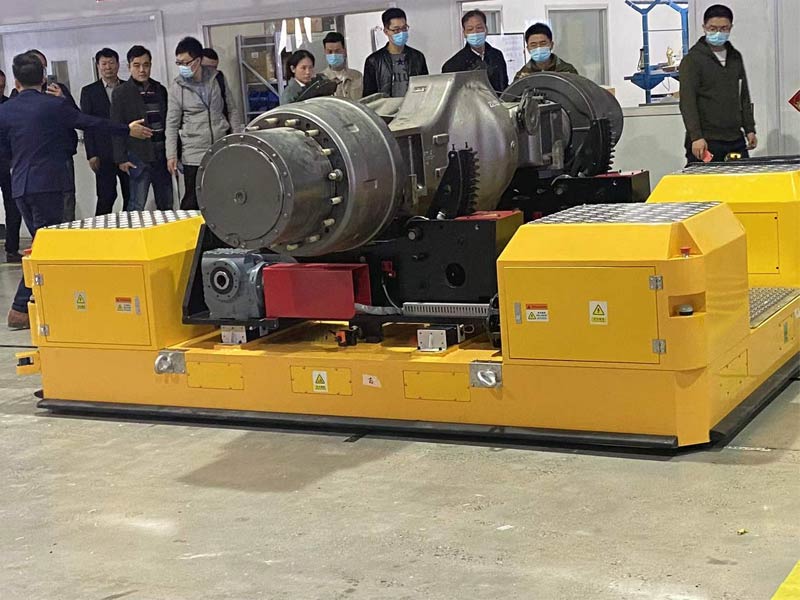
This article explains how AGVs work in automotive factories, where they are used, and what engineers should evaluate when integrating them into an automated production environment.
What Is an AGV in Automotive Manufacturing?
An automated guided vehicle is an industrial mobile vehicle designed to transport materials along a defined route or within a configured operating area without continuous manual driving. Depending on the navigation technology, an AGV may follow magnetic tape, magnetic markers, reflectors, embedded guidance elements, or other navigation references.
In automotive factories, AGVs can move engine components, transmission assemblies, axle modules, battery packs, pallets, containers, and line-side supplies. Some vehicles carry loads directly on their platforms, while others tow carts, lift pallets, or interface with dedicated transfer stations.
AGVs are particularly useful when material must travel repeatedly between production stations, storage areas, and assembly zones. In addition, they can help standardize delivery routes and reduce the need for forklifts in selected production areas. Nevertheless, the vehicle and its operating environment must be engineered together to ensure reliable movement and safe interaction with people and equipment.
How Do AGV Systems Work?
An AGV system typically consists of mobile vehicles, navigation infrastructure or localization technology, a fleet management system, charging equipment, and interfaces with production or warehouse systems.
Although implementations vary, a typical operating sequence includes the following stages.
1. Transport Request
A production station, warehouse system, or operator generates a material transport request. The request may specify the pickup location, destination, load type, priority, and required delivery time.
For example, an assembly workstation may request a new pallet when the current workpiece has moved to the next operation. The fleet management system then evaluates vehicle availability and assigns a suitable transport task.
2. Vehicle Assignment and Navigation
The AGV receives its task and travels toward the pickup point using its configured guidance or navigation system. Depending on the design, the vehicle may follow a fixed route, stop at defined markers, or use onboard localization sensors to determine its position.
At the same time, the control system must account for route occupancy, intersections, restricted areas, and other vehicles. These functions help reduce unnecessary waiting and prevent conflicting movements.
3. Load Pickup
At the pickup station, the AGV aligns with the designated load interface. It may receive a pallet through a roller or chain transfer, lift a load using an integrated mechanism, or connect to a compatible towing cart.
Accurate alignment is essential because the vehicle must engage the load safely and consistently. Therefore, the pickup interface should define acceptable positioning tolerances, load dimensions, and the required confirmation signals.
4. Transport and Delivery
After confirming that the load is secure, the vehicle travels to the destination. During transport, the system monitors relevant operating conditions, including vehicle status, route availability, and protective devices.
At the destination, the AGV transfers the load to a conveyor, buffer, rack, or workstation. The receiving equipment should confirm that the load has arrived and that the transfer is complete before the vehicle is released for another task.
5. Task Completion and Fleet Coordination
Once delivery is confirmed, the AGV reports its status to the fleet management system. It may then receive another task, move to a waiting point, or travel to a charging station.
For multi-vehicle installations, task allocation and traffic management are important because congestion can reduce the performance of the entire fleet. Consequently, route planning and dispatch logic should be evaluated against realistic production demand rather than the travel time of a single vehicle.
Common Types of AGVs Used in Automotive Factories
Different AGV configurations support different load types and production processes. The correct choice depends on payload, load geometry, transfer method, floor conditions, route requirements, and workstation design.
1. Unit Load AGVs
Unit load AGVs carry materials directly on an onboard platform or integrated conveyor. They are suitable for transporting pallets, containers, and selected assemblies between production areas.
In automotive component plants, unit load vehicles may supply assembly stations with bins or pallets. When combined with automatic loading and unloading interfaces, they can support repeatable delivery without requiring an operator to drive the vehicle.
2. Towing AGVs
Towing AGVs pull one or more carts along a designated route. They are often used to move multiple containers or material racks between a warehouse, supermarket, and production area.
This arrangement can be efficient when several deliveries follow the same route and individual loads do not require separate vehicle trips. However, the train length, turning radius, stopping distance, route width, and pedestrian interaction must be considered during layout design.
3. Fork-Type AGVs
Fork-type AGVs lift and transport compatible pallets or loads using integrated forks or a similar lifting mechanism. Depending on the design, they can collect materials from designated pickup locations and deliver them to production or storage areas.
Engineers must verify pallet entry clearance, fork geometry, load center, lift height, and the stability of the transported material. In addition, the floor and load interfaces must support the required operating conditions.
4. Conveyor-Top AGVs
Conveyor-top AGVs use an integrated roller, chain, or other transfer mechanism to exchange loads with fixed conveyor equipment. This configuration is useful when materials need to move between flexible transport routes and stationary production lines.
For example, an AGV may collect a pallet from a conveyor discharge point, travel to another production zone, and transfer the pallet onto a receiving conveyor. The vehicle and both conveyor interfaces must be synchronized so that loading and unloading occur in the correct sequence.
5. Heavy-Duty AGVs
Heavy-duty AGVs are designed to transport high-mass components or assemblies. Depending on the application, these may include engine assemblies, axles, chassis modules, or electric vehicle battery packs.
The required payload must include the workpiece, pallet, fixture, and any equipment carried by the vehicle. Moreover, acceleration, braking, floor capacity, load stability, and the consequences of an emergency stop must be evaluated as part of the system design.
AGV vs. AMR: What Is the Difference?
AGVs and autonomous mobile robots (AMRs) both automate material transport, but they do not necessarily use the same navigation and traffic management approach.
Traditional AGV installations often rely on defined routes or guidance infrastructure. AMRs generally use onboard sensing and localization to navigate within a configured environment and may be able to adjust their paths around obstacles. However, the actual capabilities of either system depend on the vehicle design, navigation technology, and software configuration.
| Comparison factor | AGV | AMR |
|---|---|---|
| Navigation | Often follows defined routes or guidance references | Generally uses onboard localization and autonomous navigation |
| Route flexibility | Depends on guidance and control architecture | Can often adapt routes within configured operating limits |
| Infrastructure | May require dedicated guidance infrastructure | May require mapping, localization references, or other environmental preparation |
| Traffic handling | Managed through vehicle controls and fleet software | Managed through navigation, fleet software, and configured traffic rules |
| Typical fit | Repetitive transport along stable routes | Material delivery requiring greater routing flexibility |
Neither technology is universally superior. An AGV may be a practical choice for repetitive movement between fixed stations, while an AMR may suit material delivery across areas where routes change more frequently. In either case, engineers should assess total system performance, safety, integration requirements, and lifecycle cost rather than navigation technology alone.
Automotive Applications of AGV Systems
Engine and Transmission Assembly
AGVs can transport engine components, transmission housings, subassemblies, and production pallets between assembly zones. In some layouts, they supply workstations with prepared kits or move assemblies between separate production cells.
Where the process requires precise machining, press-fitting, or automated tightening, the AGV typically performs the transport function while a dedicated fixture or lift-and-locate mechanism establishes the required position at the workstation.
Axle and Chassis Assembly
Axle and chassis components may be heavy, bulky, or difficult to handle manually. Appropriately designed AGVs can move these assemblies between manufacturing and inspection stations, provided that payload, load stability, floor conditions, and transfer interfaces meet the application requirements.
For larger components, the system may require a custom carrier or lifting arrangement. Consequently, vehicle dimensions and turning performance must be checked against the actual factory layout.
Electric Vehicle Battery and Powertrain Production
Battery packs and electric drive assemblies introduce specific handling requirements related to load mass, geometry, component protection, and production traceability. AGVs may transport these products between assembly stations, test areas, and temporary buffers.
Battery manufacturing and assembly environments may also impose additional requirements for handling interfaces, restricted access, or emergency response. These requirements should be identified during the project specification rather than addressed only after vehicle selection.
Line-Side Material Supply
AGVs can deliver containers, pallets, and material racks from storage or supermarket areas to assembly workstations. They may also support empty-container collection and return logistics.
When material consumption varies between stations, delivery tasks can be prioritized according to production demand. However, the system must be designed with realistic replenishment frequencies and traffic capacity; otherwise, delayed deliveries may interrupt production even when sufficient inventory exists elsewhere in the factory.
Transfer Between Production Zones
AGVs can connect work areas that are separated by distance, walls, or different production processes. For example, an assembly area may be linked to an inspection zone or a separate manufacturing cell without installing a continuous conveyor route between them.
In these applications, vehicle dispatching, loading interfaces, pedestrian access, and delivery confirmation become especially important. A clearly defined transport process helps prevent congestion and ensures that material reaches the correct destination.
Integrating AGVs with Automotive Assembly Lines
An AGV installation is most effective when its transport tasks are coordinated with the equipment it serves. This requires mechanical compatibility, electrical communication, and clearly defined operating sequences.
AGV and Conveyor Integration
Conveyor interfaces allow AGVs to exchange pallets or containers with fixed material handling equipment. Common arrangements include roller-to-roller transfer, chain transfer, lift-and-transfer mechanisms, and dedicated docking stations.
The design should define the handover position, transfer direction, load dimensions, permissible alignment error, and confirmation signals. In addition, the control sequence should prevent the AGV from leaving before the load transfer has been completed successfully.
AGV and Pallet Handling Integration
Where production uses reusable pallets, AGVs may deliver loaded pallets to a workstation and collect empty pallets or containers for return. Pallet identification can also be used to associate a transport task with a specific product or production order.
However, the pallet interface must be compatible with the vehicle’s transfer mechanism. Pallet dimensions, underside clearance, support points, total load, and orientation should therefore be confirmed before finalizing the equipment design.
AGV and Robotic Workstation Integration
AGVs can supply components to robotic assembly cells, machine-loading stations, and inspection equipment. In such applications, the robot and AGV usually perform different functions: the vehicle transports the load, while the robot carries out the required handling or processing operation.
The control system must coordinate arrival confirmation, workstation availability, robot status, and load transfer. If the robot is still operating or the station is occupied, the vehicle should follow the defined waiting or rerouting logic instead of attempting an unauthorized delivery.
PLC and MES Integration
The PLC manages local equipment sequences, sensor signals, interlocks, and transfer operations. A fleet management system coordinates vehicle assignments and movement, while higher-level systems such as an MES or warehouse management system may provide production requests, material priorities, or traceability information.
The exact architecture varies by project. Therefore, the integration specification should identify which system creates transport requests, which system assigns vehicles, how completion is confirmed, and how faults are reported.
For traceability, barcode or RFID identification may associate a pallet or load with a product order, production status, or destination. Nevertheless, data exchange should use clearly defined interfaces and error-handling rules so that communication failures do not create incorrect routing decisions.
Key Factors When Designing an AGV System
Payload and Load Dimensions
Vehicle capacity must be based on the complete transported load, including the component, carrier, fixture, and any additional equipment. The load center and geometry are also important because they affect vehicle stability and braking performance.
For heavy automotive assemblies, engineers should verify the required capacity under the actual operating conditions rather than selecting a vehicle based only on nominal weight.
Cycle Time and Fleet Size
The number of AGVs depends on transport demand, route length, pickup and delivery time, charging or battery-exchange arrangements, traffic delays, and vehicle availability.
A simplified initial estimate can be made by comparing the total transport workload with the effective operating time available per vehicle. However, this calculation must be refined through route analysis and realistic assumptions about intersections, loading delays, congestion, and peak demand. A fleet sized only for average conditions may be unable to support production during busy periods.
Route Layout and Traffic Management
Route design should minimize unnecessary travel while maintaining safe access for operators and maintenance personnel. Intersections, narrow passages, blind corners, loading areas, and shared pedestrian routes deserve particular attention.
In addition, the system should define vehicle priorities, waiting points, restricted zones, and recovery procedures. These measures help maintain predictable movement when multiple AGVs operate in the same area.
Floor Conditions and Transfer Interfaces
Floor flatness, surface condition, gradients, expansion joints, and available turning space can affect vehicle operation. Transfer stations must also be designed to provide suitable alignment and load support.
If the AGV must connect with a conveyor, rack, or workstation, the interface dimensions and permitted positioning tolerances should be specified early. Otherwise, mechanical modifications may be needed during installation and commissioning.
Charging and Availability
Battery capacity, charging method, operating hours, and shift patterns influence the number of vehicles required. Opportunity charging may be suitable for some continuous operations, while other applications may use dedicated charging periods or battery replacement arrangements.
The charging strategy should be considered alongside fleet scheduling. Otherwise, several vehicles may become unavailable at the same time, reducing the system’s ability to meet production demand.
Safety and Risk Assessment
AGV safety depends on the vehicle, its load, the operating environment, and its interaction with people and other equipment. Appropriate measures may include protective scanners, emergency stops, warning devices, speed limits, access controls, and traffic management.
Safety functions must be selected and validated according to the application and applicable standards. In particular, the design should account for loaded stopping distances, blind spots, transfer-station hazards, and foreseeable system faults.
Common AGV Implementation Problems
Several issues can reduce the performance of an AGV installation if they are not addressed during planning and commissioning.
- Insufficient transport capacity: The fleet cannot complete delivery tasks quickly enough to meet production demand. Reassess task frequency, cycle time, route capacity, and vehicle availability.
- Traffic congestion: Vehicles accumulate at intersections or narrow passages. Improve route planning, waiting-point allocation, and dispatch priorities.
- Unreliable load transfer: Pallets fail to align with conveyor or workstation interfaces. Verify mechanical tolerances, docking logic, sensors, and load geometry.
- Poor system integration: Vehicles arrive before stations are ready or leave before transfer confirmation. Define equipment handshakes, status signals, and timeout behavior.
- Inadequate charging strategy: Available vehicles cannot meet peak demand. Recalculate energy requirements and align charging schedules with production operations.
- Insufficient maintenance planning: Sensor contamination, worn drive components, or battery degradation cause repeated downtime. Establish preventive maintenance, diagnostics, and fault-recovery procedures.
A structured commissioning process should test normal transport cycles, maximum expected traffic, communication failures, blocked routes, emergency stops, and recovery from interrupted tasks. This provides a more realistic assessment than testing a single vehicle on an unobstructed route.
How to Select an AGV Solution for Automotive Manufacturing
Before choosing an AGV supplier, manufacturers should define the transport task and the conditions under which the system will operate. The following information provides a useful starting point:
- Material characteristics: Load mass, dimensions, center of gravity, handling method, and required carrier.
- Transport demand: Trips per hour, pickup and delivery points, production takt time, and peak demand.
- Route conditions: Travel distance, gradients, floor quality, aisle width, intersections, and pedestrian interaction.
- Transfer interfaces: Conveyor type, docking arrangement, lift height, alignment tolerance, and load confirmation method.
- Control requirements: Fleet management, PLC communication, transport request logic, identification, and MES or WMS integration.
- Safety requirements: Operating zones, protective devices, emergency procedures, and applicable standards.
- Lifecycle considerations: Battery management, maintenance access, spare parts, technical support, and future expansion.
After these requirements are established, the supplier can evaluate vehicle configuration, fleet size, routing, transfer equipment, charging strategy, and control architecture. Where possible, a simulation or detailed cycle-time study can help identify congestion risks before the system is installed.
AGV Integration Solutions from Hongbo Automation
Hongbo Automation provides automotive assembly line equipment and material handling solutions, including conveyor systems, pallet handling equipment, transfer machines, lifting mechanisms, and integrated automation equipment.
For projects that use AGVs, the key engineering task is to coordinate mobile transport with the fixed production line. This may involve designing suitable pallet interfaces, transfer stations, workstation handshakes, and PLC-based interlocks so that materials can move between logistics areas and assembly processes in a controlled sequence.
The appropriate configuration depends on the application, load characteristics, production rate, plant layout, and required control interfaces. Therefore, AGV deployment should be evaluated as part of the overall material handling design, particularly when it must work alongside pallet conveyors, cross transfer systems, robotic stations, and automated inspection equipment.
Frequently Asked Questions
What is an AGV used for in automotive manufacturing?
AGVs transport components, pallets, containers, and assemblies between storage areas, workstations, and production zones. They can support line-side replenishment, pallet movement, and transfers between separate manufacturing processes.
Can AGVs work with existing conveyor systems?
Yes. AGVs can exchange loads with compatible conveyor systems through roller, chain, lifting, or other engineered transfer interfaces. The mechanical arrangement and control sequence must be designed to ensure reliable load handover.
How many AGVs does an automotive factory need?
The required fleet size depends on transport frequency, route length, loading and unloading time, traffic conditions, charging requirements, and vehicle availability. A detailed cycle-time and capacity analysis is more reliable than estimating fleet size from floor area alone.
Are AGVs suitable for heavy automotive components?
Yes, provided that the vehicle, carrier, floor, transfer equipment, and safety systems are designed for the actual load and operating conditions. Heavy-duty applications require particular attention to load stability, braking, structural capacity, and transfer alignment.
What is the difference between an AGV and an AMR?
AGVs often use defined routes or guidance references, whereas AMRs generally use onboard localization and navigation to move within a configured environment. The distinction is not absolute, so manufacturers should compare actual navigation, traffic management, safety, and integration capabilities.
Can an AGV system connect to MES or warehouse management software?
Yes. Depending on the system architecture, fleet management software can exchange transport requests, task status, identification data, and completion information with MES or warehouse management systems. The required interfaces and responsibilities should be defined during system design.
Conclusion
AGV systems can improve material delivery and reduce repetitive transport work in automotive manufacturing. Their effectiveness, however, depends on more than vehicle specifications. Route planning, payload, transfer interfaces, fleet coordination, charging, safety, and production-system integration all influence overall performance.
By evaluating AGVs as part of an integrated material handling architecture, manufacturers can determine where mobile transport provides practical advantages and how it should interact with conveyors, pallet handling equipment, robots, and production controls.